{"title":"Exploring antidiabetic activity and in silico molecular docking studies of Cu(II) Schiff base complexes","authors":"Bini Babu Sujatha, Sindhu Yesodharan, Pooja Parvathy Rajan, Praveen Kumar, Surya Philip, Selwin Joseyphus Raphael, Mohanan Kochukittan","doi":"10.1007/s13738-025-03329-2","DOIUrl":null,"url":null,"abstract":"<div><p>A series of Cu(II) complexes [CuLCl], [CuLBr], [CuLNO<sub>3</sub>], and [CuLOAc], which have different counter anions, has been synthesised using a tridentate Schiff base, namely 2-(thienylideneamino)benzoic acid (L), to study the effects of the anions on fluorescence and α-amylase inhibitory activity. The spectral data indicate that the ligand moiety was coordinated to the Cu(II) ion through carboxylate (O), azomethine (N), and thiophene (S) atoms. The EPR spectral data suggest a significant covalent character for the Cu-L bond. The fluorescence properties of Cu(II) complexes vary depending on the anions present. As a part of the biological evaluation, antibacterial and α-amylase inhibitory activities of the Schiff base ligand and the Cu(II) complexes have been investigated. The complexes [CuLCl] and [CuLNO<sub>3</sub>] exhibited notable antibacterial potential with good minimum inhibitory concentration (MIC) values. From the in vitro α-amylase inhibitory activities, the [CuLNO<sub>3</sub>] and [CuLOAc] showed IC<sub>50</sub> 0.22 ± 0.019 mg/mL and 0.18 ± 0.015 mg/mL, respectively, which are comparable with the standard drug acarbose with an IC<sub>50</sub> of 0.11 ± 0.017 mg/mL. Furthermore, investigations involving the binding interactions of Cu(II) complexes with various enzymes’ active sites, including human pancreatic α-amylase (PDB ID: 4W93), maltase-glucoamylase (PDB ID: 3TOP), and lysosomal acid-α-glucosidase (PDB ID: 5NN8) involved in human glucose hydrolysis have been conducted using molecular docking. CDOCKER interaction energy values of the complexes were quite promising compared to acarbose.</p></div>","PeriodicalId":676,"journal":{"name":"Journal of the Iranian Chemical Society","volume":"23 2","pages":""},"PeriodicalIF":2.3000,"publicationDate":"2026-02-09","publicationTypes":"Journal Article","fieldsOfStudy":null,"isOpenAccess":false,"openAccessPdf":"","citationCount":"0","resultStr":null,"platform":"Semanticscholar","paperid":null,"PeriodicalName":"Journal of the Iranian Chemical Society","FirstCategoryId":"92","ListUrlMain":"https://link.springer.com/article/10.1007/s13738-025-03329-2","RegionNum":4,"RegionCategory":"化学","ArticlePicture":[],"TitleCN":null,"AbstractTextCN":null,"PMCID":null,"EPubDate":"","PubModel":"","JCR":"Q3","JCRName":"CHEMISTRY, MULTIDISCIPLINARY","Score":null,"Total":0}
引用次数: 0
Abstract
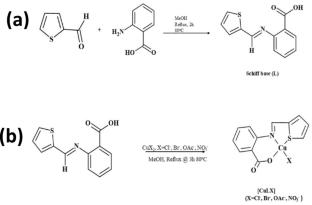
A series of Cu(II) complexes [CuLCl], [CuLBr], [CuLNO3], and [CuLOAc], which have different counter anions, has been synthesised using a tridentate Schiff base, namely 2-(thienylideneamino)benzoic acid (L), to study the effects of the anions on fluorescence and α-amylase inhibitory activity. The spectral data indicate that the ligand moiety was coordinated to the Cu(II) ion through carboxylate (O), azomethine (N), and thiophene (S) atoms. The EPR spectral data suggest a significant covalent character for the Cu-L bond. The fluorescence properties of Cu(II) complexes vary depending on the anions present. As a part of the biological evaluation, antibacterial and α-amylase inhibitory activities of the Schiff base ligand and the Cu(II) complexes have been investigated. The complexes [CuLCl] and [CuLNO3] exhibited notable antibacterial potential with good minimum inhibitory concentration (MIC) values. From the in vitro α-amylase inhibitory activities, the [CuLNO3] and [CuLOAc] showed IC50 0.22 ± 0.019 mg/mL and 0.18 ± 0.015 mg/mL, respectively, which are comparable with the standard drug acarbose with an IC50 of 0.11 ± 0.017 mg/mL. Furthermore, investigations involving the binding interactions of Cu(II) complexes with various enzymes’ active sites, including human pancreatic α-amylase (PDB ID: 4W93), maltase-glucoamylase (PDB ID: 3TOP), and lysosomal acid-α-glucosidase (PDB ID: 5NN8) involved in human glucose hydrolysis have been conducted using molecular docking. CDOCKER interaction energy values of the complexes were quite promising compared to acarbose.
期刊介绍:
JICS is an international journal covering general fields of chemistry. JICS welcomes high quality original papers in English dealing with experimental, theoretical and applied research related to all branches of chemistry. These include the fields of analytical, inorganic, organic and physical chemistry as well as the chemical biology area. Review articles discussing specific areas of chemistry of current chemical or biological importance are also published. JICS ensures visibility of your research results to a worldwide audience in science. You are kindly invited to submit your manuscript to the Editor-in-Chief or Regional Editor. All contributions in the form of original papers or short communications will be peer reviewed and published free of charge after acceptance.

 求助内容:
求助内容: 应助结果提醒方式:

 京公网安备 11010802042870号


