{"title":"Thermodynamic Modeling of the Decomposition of Ilmenite in Neutral and Oxidizing Atmospheres","authors":"V. A. Salina, N. I. Il’inykh, B. R. Gel’chinskii","doi":"10.1134/S0036029525702994","DOIUrl":null,"url":null,"abstract":"<p>The TERRA software package is used to perform thermodynamic modeling of the thermal decomposition of powdered ilmenite under low-temperature plasma conditions in the temperature range 300–6000 K. Argon and air are used as plasma-forming gases. Information on the properties of some components of the system under study is taken from the TERRA.props database. In addition, the thermodynamic properties of the condensed (solid and liquid) states of the compounds FeTiO<sub>3</sub>, Fe<sub>2</sub>TiO<sub>4</sub>, Fe<sub>2</sub>TiO<sub>5</sub>, FeTi<sub>2</sub>O<sub>5</sub>, FeTi, and Fe<sub>2</sub>Ti are added to the database, and the thermodynamic constants for Ti, TiO, Ti<sub>2</sub>O<sub>3</sub>, Ti<sub>3</sub>O<sub>5</sub>, TiO<sub>3</sub>, Fe, Fe<sub>2</sub>O<sub>3</sub>, FeO, Fe<sub>2</sub>N, and Fe<sub>4</sub>N are corrected in accordance with the literature data. The results of thermodynamic modeling are used to calculate the temperature dependences of the component contents in the condensed and gas phases and to identify the regions of their existence. FeTiO<sub>3</sub> is found not to decompose on heating in an argon atmosphere in the temperature range 300–1200 K. When the temperature increases, Fe<sub>2</sub>TiO<sub>4</sub> (1300–1600 K), FeTi<sub>2</sub>O<sub>5</sub> (1300–1900 K), and FeO (1600–1900 K) can form. At <i>T</i> ≥ 2000 K, FeTiO<sub>3</sub> and FeTi<sub>2</sub>O<sub>5</sub> form. When ilmenite is heated by an air plasma jet, double oxides Fe<sub>3</sub>O<sub>4</sub>, TiO<sub>2</sub>, and Fe<sub>2</sub>O<sub>3</sub> and triple oxides FeTi<sub>2</sub>O<sub>5</sub>, Fe<sub>2</sub>TiO<sub>5</sub>, and Fe<sub>2</sub>TiO<sub>4</sub> can form in a condensed phase along with ilmenite. The modeling results will be used to develop a technology for producing an ilmenite powder in an arc plasma reactor.</p>","PeriodicalId":769,"journal":{"name":"Russian Metallurgy (Metally)","volume":"2025 10","pages":"1966 - 1972"},"PeriodicalIF":0.3000,"publicationDate":"2026-02-09","publicationTypes":"Journal Article","fieldsOfStudy":null,"isOpenAccess":false,"openAccessPdf":"","citationCount":"0","resultStr":null,"platform":"Semanticscholar","paperid":null,"PeriodicalName":"Russian Metallurgy (Metally)","FirstCategoryId":"5","ListUrlMain":"https://link.springer.com/article/10.1134/S0036029525702994","RegionNum":0,"RegionCategory":null,"ArticlePicture":[],"TitleCN":null,"AbstractTextCN":null,"PMCID":null,"EPubDate":"","PubModel":"","JCR":"Q4","JCRName":"METALLURGY & METALLURGICAL ENGINEERING","Score":null,"Total":0}
引用次数: 0
Abstract
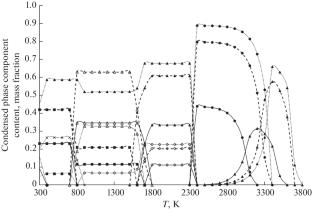
The TERRA software package is used to perform thermodynamic modeling of the thermal decomposition of powdered ilmenite under low-temperature plasma conditions in the temperature range 300–6000 K. Argon and air are used as plasma-forming gases. Information on the properties of some components of the system under study is taken from the TERRA.props database. In addition, the thermodynamic properties of the condensed (solid and liquid) states of the compounds FeTiO3, Fe2TiO4, Fe2TiO5, FeTi2O5, FeTi, and Fe2Ti are added to the database, and the thermodynamic constants for Ti, TiO, Ti2O3, Ti3O5, TiO3, Fe, Fe2O3, FeO, Fe2N, and Fe4N are corrected in accordance with the literature data. The results of thermodynamic modeling are used to calculate the temperature dependences of the component contents in the condensed and gas phases and to identify the regions of their existence. FeTiO3 is found not to decompose on heating in an argon atmosphere in the temperature range 300–1200 K. When the temperature increases, Fe2TiO4 (1300–1600 K), FeTi2O5 (1300–1900 K), and FeO (1600–1900 K) can form. At T ≥ 2000 K, FeTiO3 and FeTi2O5 form. When ilmenite is heated by an air plasma jet, double oxides Fe3O4, TiO2, and Fe2O3 and triple oxides FeTi2O5, Fe2TiO5, and Fe2TiO4 can form in a condensed phase along with ilmenite. The modeling results will be used to develop a technology for producing an ilmenite powder in an arc plasma reactor.
期刊介绍:
Russian Metallurgy (Metally) publishes results of original experimental and theoretical research in the form of reviews and regular articles devoted to topical problems of metallurgy, physical metallurgy, and treatment of ferrous, nonferrous, rare, and other metals and alloys, intermetallic compounds, and metallic composite materials. The journal focuses on physicochemical properties of metallurgical materials (ores, slags, matters, and melts of metals and alloys); physicochemical processes (thermodynamics and kinetics of pyrometallurgical, hydrometallurgical, electrochemical, and other processes); theoretical metallurgy; metal forming; thermoplastic and thermochemical treatment; computation and experimental determination of phase diagrams and thermokinetic diagrams; mechanisms and kinetics of phase transitions in metallic materials; relations between the chemical composition, phase and structural states of materials and their physicochemical and service properties; interaction between metallic materials and external media; and effects of radiation on these materials.

 求助内容:
求助内容: 应助结果提醒方式:

 京公网安备 11010802042870号


