{"title":"Oxidation of Uranium Mononitride by (Ar + O2) Mixtures. Thermodynamic Modeling and Kinetics","authors":"M. V. Mazannikov, A. M. Potapov, Yu. P. Zaikov","doi":"10.1134/S0036029525703021","DOIUrl":null,"url":null,"abstract":"<p>The thermodynamic modeling of uranium mononitride (UN) oxidation by gas mixtures (Ar + O<sub>2</sub>) at different temperatures and oxygen contents in the mixture is performed. The oxidation is found to proceed via several consecutive stages, and each stage includes a number of parallel reactions. At the majority of stages, the equilibrium composition of oxidation products is complicated and includes nonstoichiometric compounds. The exception is the composition with the ratio O/U = 2 at which stoichiometric UO<sub>2</sub> is formed. The kinetics of UN oxidation by the (Ar + 20% O<sub>2</sub>) gas mixture is studied. According to differential thermal analysis results, uranium mononitride is slowly oxidized in a temperature range of 300–400°C. As a temperature of 420°C is reached, the sample weight increases sharply accompanied by a significant heat evolution. The maximum reaction rate is achieved at 432°C. The maximum increase in the sample weight is 12.4%, which exceeds the theoretical value in the reaction UN → U<sub>3</sub>O<sub>8</sub> (+11.26%) but is lower than that in the reaction UN → UO<sub>3</sub> (+13.49%). The sample weight begins to decrease with further heating above 500°C and decreases to the end of experiment by 0.5% of maximum values. Flue gases leaving a simultaneous thermal analyzer are examined using a quadrupole mass spectrometer. These gases, except for argon, oxygen, and nitrogen, contain impurities of nitrides (NO, NO<sub>2</sub>, and, possibly, N<sub>2</sub>O). The oxidation of UN by the (Ar + 20% O<sub>2</sub>) gas mixture at 450°C is studied by thermogravimetry. The stages of the process are revealed. The maximum oxidation rate is 0.4%/min.</p>","PeriodicalId":769,"journal":{"name":"Russian Metallurgy (Metally)","volume":"2025 10","pages":"1987 - 1994"},"PeriodicalIF":0.3000,"publicationDate":"2026-02-09","publicationTypes":"Journal Article","fieldsOfStudy":null,"isOpenAccess":false,"openAccessPdf":"","citationCount":"0","resultStr":null,"platform":"Semanticscholar","paperid":null,"PeriodicalName":"Russian Metallurgy (Metally)","FirstCategoryId":"5","ListUrlMain":"https://link.springer.com/article/10.1134/S0036029525703021","RegionNum":0,"RegionCategory":null,"ArticlePicture":[],"TitleCN":null,"AbstractTextCN":null,"PMCID":null,"EPubDate":"","PubModel":"","JCR":"Q4","JCRName":"METALLURGY & METALLURGICAL ENGINEERING","Score":null,"Total":0}
引用次数: 0
Abstract
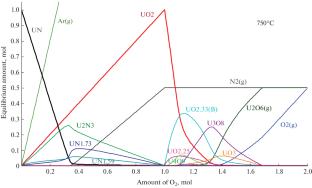
The thermodynamic modeling of uranium mononitride (UN) oxidation by gas mixtures (Ar + O2) at different temperatures and oxygen contents in the mixture is performed. The oxidation is found to proceed via several consecutive stages, and each stage includes a number of parallel reactions. At the majority of stages, the equilibrium composition of oxidation products is complicated and includes nonstoichiometric compounds. The exception is the composition with the ratio O/U = 2 at which stoichiometric UO2 is formed. The kinetics of UN oxidation by the (Ar + 20% O2) gas mixture is studied. According to differential thermal analysis results, uranium mononitride is slowly oxidized in a temperature range of 300–400°C. As a temperature of 420°C is reached, the sample weight increases sharply accompanied by a significant heat evolution. The maximum reaction rate is achieved at 432°C. The maximum increase in the sample weight is 12.4%, which exceeds the theoretical value in the reaction UN → U3O8 (+11.26%) but is lower than that in the reaction UN → UO3 (+13.49%). The sample weight begins to decrease with further heating above 500°C and decreases to the end of experiment by 0.5% of maximum values. Flue gases leaving a simultaneous thermal analyzer are examined using a quadrupole mass spectrometer. These gases, except for argon, oxygen, and nitrogen, contain impurities of nitrides (NO, NO2, and, possibly, N2O). The oxidation of UN by the (Ar + 20% O2) gas mixture at 450°C is studied by thermogravimetry. The stages of the process are revealed. The maximum oxidation rate is 0.4%/min.
期刊介绍:
Russian Metallurgy (Metally) publishes results of original experimental and theoretical research in the form of reviews and regular articles devoted to topical problems of metallurgy, physical metallurgy, and treatment of ferrous, nonferrous, rare, and other metals and alloys, intermetallic compounds, and metallic composite materials. The journal focuses on physicochemical properties of metallurgical materials (ores, slags, matters, and melts of metals and alloys); physicochemical processes (thermodynamics and kinetics of pyrometallurgical, hydrometallurgical, electrochemical, and other processes); theoretical metallurgy; metal forming; thermoplastic and thermochemical treatment; computation and experimental determination of phase diagrams and thermokinetic diagrams; mechanisms and kinetics of phase transitions in metallic materials; relations between the chemical composition, phase and structural states of materials and their physicochemical and service properties; interaction between metallic materials and external media; and effects of radiation on these materials.

 求助内容:
求助内容: 应助结果提醒方式:

 京公网安备 11010802042870号


