{"title":"Effective Extraction and Separation Mechanism of Phenolic Acids Based Aqueous Two-Phase Extraction by Functionalized Ionic Liquids","authors":"Xin-Hong Wang, Xue-Quan Zou, Jing-Ping Wang","doi":"10.1007/s10953-025-01499-4","DOIUrl":null,"url":null,"abstract":"<div><p>Phenolic acids, widely present in agro-industrial residues (e.g., olive leaves, rice husk hydrolysate) and plant extracts, are valuable bioactive compounds with antioxidant and pharmaceutical applications. Their efficient separation from complex aqueous matrices remains a critical challenge in green extraction processes. Ionic liquids (ILs) are recognized as sustainable solvents for liquid–liquid extraction due to their structural versatility and low environmental impact. However, conventional ILs often exhibit suboptimal performance in aqueous two-phase systems (ATPS) for recovering phenolic acids. This study systematically investigated three functionalized imidazolium ILs ([CMmim]BF<sub>4</sub>, [CMmim]Cl, [HEmim]Cl) combined with sodium dihydrogen phosphate (NaH<sub>2</sub>PO<sub>4</sub>) based ATPS to optimize the extraction of phenolic acids (ferulic acid, cinnamic acid, and gallic acid). Through single-factor experiments, the highest efficiencies were achieved under mild conditions (298 K, pH 3.0, phase ratio 9.0): 64.54% for ferulic acid, 72.56% for cinnamic acid, and 80.84% for gallic acid at NaH<sub>2</sub>PO<sub>4</sub> concentrations of 0.5 g·mL<sup>−1</sup> for FA and CA, 0.45 g·mL⁻<sup>1</sup> for GA, respectively. Thermodynamic analysis revealed enthalpy-driven extraction (Δ<i>H</i> = − 21.62 to − 25.83 kJ·mol<sup>−1</sup>; Δ<i>S</i> = − 8.00 to − 17.35 J·mol<sup>−1</sup>·K<sup>−</sup><sup>1</sup>), dominated by hydrogen bonding and van der Waals interactions, as confirmed by UV–vis, FTIR, and <sup>1</sup>H NMR spectroscopy. The functional groups (–COOH, –OH) on ILs were shown to enhance solute–solvent interactions, while NaH<sub>2</sub>PO<sub>4</sub> acts as a kosmotropic salt to promote phase separation via the Hofmeister effect. These findings highlighted the potential of functionalized IL-based ATPS for efficient and sustainable extraction of bioactive compounds from aqueous media. They also established a mechanistic framework for designing specific ILs, offering a green alternative to volatile organic solvents in bioactive compound recovery.</p></div>","PeriodicalId":666,"journal":{"name":"Journal of Solution Chemistry","volume":"55 2","pages":"204 - 218"},"PeriodicalIF":1.3000,"publicationDate":"2025-10-08","publicationTypes":"Journal Article","fieldsOfStudy":null,"isOpenAccess":false,"openAccessPdf":"","citationCount":"0","resultStr":null,"platform":"Semanticscholar","paperid":null,"PeriodicalName":"Journal of Solution Chemistry","FirstCategoryId":"92","ListUrlMain":"https://link.springer.com/article/10.1007/s10953-025-01499-4","RegionNum":4,"RegionCategory":"化学","ArticlePicture":[],"TitleCN":null,"AbstractTextCN":null,"PMCID":null,"EPubDate":"","PubModel":"","JCR":"Q4","JCRName":"CHEMISTRY, PHYSICAL","Score":null,"Total":0}
引用次数: 0
Abstract
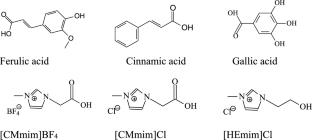
Phenolic acids, widely present in agro-industrial residues (e.g., olive leaves, rice husk hydrolysate) and plant extracts, are valuable bioactive compounds with antioxidant and pharmaceutical applications. Their efficient separation from complex aqueous matrices remains a critical challenge in green extraction processes. Ionic liquids (ILs) are recognized as sustainable solvents for liquid–liquid extraction due to their structural versatility and low environmental impact. However, conventional ILs often exhibit suboptimal performance in aqueous two-phase systems (ATPS) for recovering phenolic acids. This study systematically investigated three functionalized imidazolium ILs ([CMmim]BF4, [CMmim]Cl, [HEmim]Cl) combined with sodium dihydrogen phosphate (NaH2PO4) based ATPS to optimize the extraction of phenolic acids (ferulic acid, cinnamic acid, and gallic acid). Through single-factor experiments, the highest efficiencies were achieved under mild conditions (298 K, pH 3.0, phase ratio 9.0): 64.54% for ferulic acid, 72.56% for cinnamic acid, and 80.84% for gallic acid at NaH2PO4 concentrations of 0.5 g·mL−1 for FA and CA, 0.45 g·mL⁻1 for GA, respectively. Thermodynamic analysis revealed enthalpy-driven extraction (ΔH = − 21.62 to − 25.83 kJ·mol−1; ΔS = − 8.00 to − 17.35 J·mol−1·K−1), dominated by hydrogen bonding and van der Waals interactions, as confirmed by UV–vis, FTIR, and 1H NMR spectroscopy. The functional groups (–COOH, –OH) on ILs were shown to enhance solute–solvent interactions, while NaH2PO4 acts as a kosmotropic salt to promote phase separation via the Hofmeister effect. These findings highlighted the potential of functionalized IL-based ATPS for efficient and sustainable extraction of bioactive compounds from aqueous media. They also established a mechanistic framework for designing specific ILs, offering a green alternative to volatile organic solvents in bioactive compound recovery.
期刊介绍:
Journal of Solution Chemistry offers a forum for research on the physical chemistry of liquid solutions in such fields as physical chemistry, chemical physics, molecular biology, statistical mechanics, biochemistry, and biophysics. The emphasis is on papers in which the solvent plays a dominant rather than incidental role. Featured topics include experimental investigations of the dielectric, spectroscopic, thermodynamic, transport, or relaxation properties of both electrolytes and nonelectrolytes in liquid solutions.

 求助内容:
求助内容: 应助结果提醒方式:

 京公网安备 11010802042870号


