Athithyan Ilangovan, Sri Bala Kameswari Kanchinadham
{"title":"Valorization of banana leaf waste for cellulose nanofiber extraction: a sustainable approach for leather applications","authors":"Athithyan Ilangovan, Sri Bala Kameswari Kanchinadham","doi":"10.1007/s13399-026-07069-y","DOIUrl":null,"url":null,"abstract":"<div><p>In India, large quantities of banana leaf waste generated from restaurants, event halls, and markets are often discarded in stormwater drains, causing blockages, or dumped in open landfills. This study explores the potential for utilizing this waste to extract cellulose nanofibers (CNF) for leather-related applications. CNF were extracted using an alkali–acid treatment from both the leaf portion (RBL) and the midrib portion (RBS) of banana leaf waste. FE-SEM and AFM analyses confirmed the formation of fibrous nanostructures with diameters in the range of 25–80 nm. XRD analysis verified the presence of cellulose nanofibers, with crystallite sizes of 3.7 nm for CNF derived from the leaf portion (CNF-BL) and 4.0 nm for those from the midrib portion (CNF-BS). The specific surface areas (SBET) were 50.36 m²/g for CNF-BL and 43.42 m²/g for CNF-BS, indicating high surface reactivity suitable for composite applications. The extracted nanofibers were incorporated into leather finishing formulations as additives in binders and pigments, meeting the quality requirements of ISO 11,640. In addition, the nanofibers were successfully used to fabricate a leather-like material exhibiting a tensile strength of 9.27 N/mm² and a tear strength of 15.33 N. Overall, the results demonstrate that banana leaf waste can be effectively valorized into high-performance cellulose nanofibers, supporting sustainable waste management and circular economy practices in the leather industry.</p><h3>Graphical abstract</h3><div><figure><div><div><picture><source><img></source></picture></div></div></figure></div></div>","PeriodicalId":488,"journal":{"name":"Biomass Conversion and Biorefinery","volume":"16 3","pages":""},"PeriodicalIF":4.1000,"publicationDate":"2026-02-05","publicationTypes":"Journal Article","fieldsOfStudy":null,"isOpenAccess":false,"openAccessPdf":"","citationCount":"0","resultStr":null,"platform":"Semanticscholar","paperid":null,"PeriodicalName":"Biomass Conversion and Biorefinery","FirstCategoryId":"5","ListUrlMain":"https://link.springer.com/article/10.1007/s13399-026-07069-y","RegionNum":4,"RegionCategory":"工程技术","ArticlePicture":[],"TitleCN":null,"AbstractTextCN":null,"PMCID":null,"EPubDate":"","PubModel":"","JCR":"Q3","JCRName":"ENERGY & FUELS","Score":null,"Total":0}
引用次数: 0
Abstract
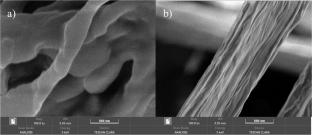
In India, large quantities of banana leaf waste generated from restaurants, event halls, and markets are often discarded in stormwater drains, causing blockages, or dumped in open landfills. This study explores the potential for utilizing this waste to extract cellulose nanofibers (CNF) for leather-related applications. CNF were extracted using an alkali–acid treatment from both the leaf portion (RBL) and the midrib portion (RBS) of banana leaf waste. FE-SEM and AFM analyses confirmed the formation of fibrous nanostructures with diameters in the range of 25–80 nm. XRD analysis verified the presence of cellulose nanofibers, with crystallite sizes of 3.7 nm for CNF derived from the leaf portion (CNF-BL) and 4.0 nm for those from the midrib portion (CNF-BS). The specific surface areas (SBET) were 50.36 m²/g for CNF-BL and 43.42 m²/g for CNF-BS, indicating high surface reactivity suitable for composite applications. The extracted nanofibers were incorporated into leather finishing formulations as additives in binders and pigments, meeting the quality requirements of ISO 11,640. In addition, the nanofibers were successfully used to fabricate a leather-like material exhibiting a tensile strength of 9.27 N/mm² and a tear strength of 15.33 N. Overall, the results demonstrate that banana leaf waste can be effectively valorized into high-performance cellulose nanofibers, supporting sustainable waste management and circular economy practices in the leather industry.
期刊介绍:
Biomass Conversion and Biorefinery presents articles and information on research, development and applications in thermo-chemical conversion; physico-chemical conversion and bio-chemical conversion, including all necessary steps for the provision and preparation of the biomass as well as all possible downstream processing steps for the environmentally sound and economically viable provision of energy and chemical products.

 求助内容:
求助内容: 应助结果提醒方式:

 京公网安备 11010802042870号


