{"title":"Average Chemical Composition of Sandy and Clayey Rocks in Large Different Age Structural Zones of Continents on Various Discriminant Diagrams","authors":"A. V. Maslov","doi":"10.1134/S0024490225700385","DOIUrl":null,"url":null,"abstract":"<p>Based on the volume-weighted average chemical compositions of sandy and clayey rocks of platforms, geosynclines/mobile zones, and orogenic zones published in 1990 by A.B. Ronov and coauthors, the distribution of their data points on discriminant diagrams is considered. They provide insight into rock complexes eroded in paleocatchments and paleogeodynamic settings of the accumulation of sedimentary sequences. It is shown that the change in the bulk chemical composition of sandstones from platforms to orogenic zones in the Late Precambrian, Paleozoic, and Mesozoic–Cenozoic has its own specifics. For example, in the K<sub>2</sub>O/Na<sub>2</sub>O–SiO<sub>2</sub>/Al<sub>2</sub>O<sub>3</sub> diagram, the chemical composition of the Upper Precambrian sandstones in the specified series changes toward a decrease in the values of both parameters. Accordingly, their data points “shift” from the field of passive continental margins (PM) to the field of active continental margins (ACM). Data points of Paleozoic and Mesozoic–Cenozoic sandstones from platform areas to geosynclinal areas demonstrate the same trend, but later the trend becomes opposite. The position of data points of sandstones of similar but different age tectonic structures also varies notably in the diagrams. In the same K<sub>2</sub>O/Na<sub>2</sub>O–SiO<sub>2</sub>/Al<sub>2</sub>O<sub>3</sub> diagram, data points of platform sandstones correspond almost exclusively to the PM field, while those of sandstones from orogenic areas do not go beyond the ASM field. The data point of Late Proterozoic geosynclinal sandstones is also located in the PM field, while the data point of similar Mesozoic–Cenozoic sandstones is in the field of mature island-arc systems (A1). In the absence of cardinal variations in the style of geodynamics of the Late Precambrian and Phanerozoic, all this may be a consequence of changes over time, first of all, in the composition of provenances, the intensification of orogeny, and variations in other factors (local included) that controlled the accumulation of sedimentary sequences over the past ~1.8 Ga.</p>","PeriodicalId":18150,"journal":{"name":"Lithology and Mineral Resources","volume":"61 1","pages":"1 - 15"},"PeriodicalIF":0.9000,"publicationDate":"2026-02-03","publicationTypes":"Journal Article","fieldsOfStudy":null,"isOpenAccess":false,"openAccessPdf":"","citationCount":"0","resultStr":null,"platform":"Semanticscholar","paperid":null,"PeriodicalName":"Lithology and Mineral Resources","FirstCategoryId":"89","ListUrlMain":"https://link.springer.com/article/10.1134/S0024490225700385","RegionNum":4,"RegionCategory":"地球科学","ArticlePicture":[],"TitleCN":null,"AbstractTextCN":null,"PMCID":null,"EPubDate":"","PubModel":"","JCR":"Q4","JCRName":"GEOCHEMISTRY & GEOPHYSICS","Score":null,"Total":0}
引用次数: 0
Abstract
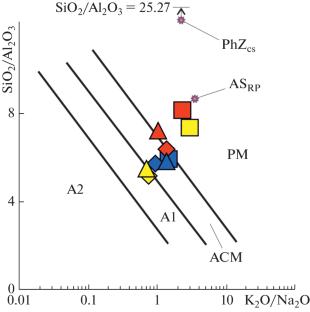
Based on the volume-weighted average chemical compositions of sandy and clayey rocks of platforms, geosynclines/mobile zones, and orogenic zones published in 1990 by A.B. Ronov and coauthors, the distribution of their data points on discriminant diagrams is considered. They provide insight into rock complexes eroded in paleocatchments and paleogeodynamic settings of the accumulation of sedimentary sequences. It is shown that the change in the bulk chemical composition of sandstones from platforms to orogenic zones in the Late Precambrian, Paleozoic, and Mesozoic–Cenozoic has its own specifics. For example, in the K2O/Na2O–SiO2/Al2O3 diagram, the chemical composition of the Upper Precambrian sandstones in the specified series changes toward a decrease in the values of both parameters. Accordingly, their data points “shift” from the field of passive continental margins (PM) to the field of active continental margins (ACM). Data points of Paleozoic and Mesozoic–Cenozoic sandstones from platform areas to geosynclinal areas demonstrate the same trend, but later the trend becomes opposite. The position of data points of sandstones of similar but different age tectonic structures also varies notably in the diagrams. In the same K2O/Na2O–SiO2/Al2O3 diagram, data points of platform sandstones correspond almost exclusively to the PM field, while those of sandstones from orogenic areas do not go beyond the ASM field. The data point of Late Proterozoic geosynclinal sandstones is also located in the PM field, while the data point of similar Mesozoic–Cenozoic sandstones is in the field of mature island-arc systems (A1). In the absence of cardinal variations in the style of geodynamics of the Late Precambrian and Phanerozoic, all this may be a consequence of changes over time, first of all, in the composition of provenances, the intensification of orogeny, and variations in other factors (local included) that controlled the accumulation of sedimentary sequences over the past ~1.8 Ga.
期刊介绍:
Lithology and Mineral Resources is an international peer reviewed journal that publishes articles on a wide range of problems related to the formation of sedimentary rocks and ores. Special attention is given to comparison of ancient sedimentary rock and ore formation with present-day processes. The major part of the journal is devoted to comparative analysis of sedimentary processes on the continents and in oceans, as well as the genetic aspects of the formation of sedimentary and hydrothermal–sedimentary mineral resources. The journal welcomes manuscripts from all countries in the English or Russian language.

 求助内容:
求助内容: 应助结果提醒方式:

 京公网安备 11010802042870号


