M. Saeed Abaee, Zahra Shaabani, Elaheh Akbarzadeh, Yazdanbakhsh L. Nosood, Mohammad M. Mojtahedi, Abbas Shockravi, Klaus Harms
{"title":"DBU/H2O: a tunable organocatalytic medium to control the reaction of isophorone with aldehydes at vinylogous aldol addition stage","authors":"M. Saeed Abaee, Zahra Shaabani, Elaheh Akbarzadeh, Yazdanbakhsh L. Nosood, Mohammad M. Mojtahedi, Abbas Shockravi, Klaus Harms","doi":"10.1007/s13738-026-03353-w","DOIUrl":null,"url":null,"abstract":"<div><p>A tunable DBU/H<sub>2</sub>O medium was employed to investigate the reaction of isophorone <b>1</b> with a variety of aromatic aldehydes <b>2</b>. One hour mixing of the two components in the medium at room temperature selectively afforded substitution products <b>3</b> through activation of the methyl group γ to the carbonyl functionality of isophorone. When the same mixtures were heated at 60 °C for two hours, vinylogous aldol condensation products <b>4</b> were obtained instead. This temperature-dependent reactivity demonstrates the switchable behavior of the DBU/H<sub>2</sub>O system, allowing precise control over the formation of either aldol addition or condensation products. The versatility of this approach was demonstrated by the synthesis of a wide range of derivatives, highlighting the efficiency and selectivity of this organocatalytic method. Structural characterization of the newly formed compounds was achieved by NMR spectroscopy and single-crystal X-ray diffraction, verifying the proposed molecular architectures. Overall, this work presents DBU/H<sub>2</sub>O as a simple, green, and tunable medium to control the selectivity of vinylogous aldol-type reactions in the isophorone system.</p></div>","PeriodicalId":676,"journal":{"name":"Journal of the Iranian Chemical Society","volume":"23 2","pages":""},"PeriodicalIF":2.3000,"publicationDate":"2026-02-03","publicationTypes":"Journal Article","fieldsOfStudy":null,"isOpenAccess":false,"openAccessPdf":"","citationCount":"0","resultStr":null,"platform":"Semanticscholar","paperid":null,"PeriodicalName":"Journal of the Iranian Chemical Society","FirstCategoryId":"92","ListUrlMain":"https://link.springer.com/article/10.1007/s13738-026-03353-w","RegionNum":4,"RegionCategory":"化学","ArticlePicture":[],"TitleCN":null,"AbstractTextCN":null,"PMCID":null,"EPubDate":"","PubModel":"","JCR":"Q3","JCRName":"CHEMISTRY, MULTIDISCIPLINARY","Score":null,"Total":0}
引用次数: 0
Abstract
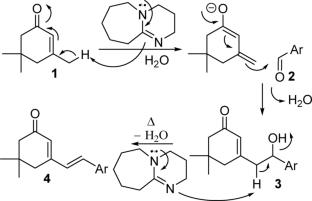
A tunable DBU/H2O medium was employed to investigate the reaction of isophorone 1 with a variety of aromatic aldehydes 2. One hour mixing of the two components in the medium at room temperature selectively afforded substitution products 3 through activation of the methyl group γ to the carbonyl functionality of isophorone. When the same mixtures were heated at 60 °C for two hours, vinylogous aldol condensation products 4 were obtained instead. This temperature-dependent reactivity demonstrates the switchable behavior of the DBU/H2O system, allowing precise control over the formation of either aldol addition or condensation products. The versatility of this approach was demonstrated by the synthesis of a wide range of derivatives, highlighting the efficiency and selectivity of this organocatalytic method. Structural characterization of the newly formed compounds was achieved by NMR spectroscopy and single-crystal X-ray diffraction, verifying the proposed molecular architectures. Overall, this work presents DBU/H2O as a simple, green, and tunable medium to control the selectivity of vinylogous aldol-type reactions in the isophorone system.
期刊介绍:
JICS is an international journal covering general fields of chemistry. JICS welcomes high quality original papers in English dealing with experimental, theoretical and applied research related to all branches of chemistry. These include the fields of analytical, inorganic, organic and physical chemistry as well as the chemical biology area. Review articles discussing specific areas of chemistry of current chemical or biological importance are also published. JICS ensures visibility of your research results to a worldwide audience in science. You are kindly invited to submit your manuscript to the Editor-in-Chief or Regional Editor. All contributions in the form of original papers or short communications will be peer reviewed and published free of charge after acceptance.

 求助内容:
求助内容: 应助结果提醒方式:

 京公网安备 11010802042870号


