
Quantifying ground temperature characteristics affected by underground buildings in spatial-temporal distributions
IF 6.9
2区 工程技术
Q1 ENVIRONMENTAL SCIENCES
引用次数: 0
Abstract
Ecological and human environments face growing threats from the severe Subsurface Urban Heat Island (SUHI) effect, which simultaneously presents opportunities for shallow geothermal energy utilization. Underground buildings emerge as a key driver of ground temperature change—both the dynamic effects of underground buildings on ground temperature and their hourly spatial-temporal distribution remain poorly characterized. This knowledge gap not only restricts the efficient utilization of ground source heat pumps, but also causes unnecessary environmental pollution. In this context, this study simulates the dynamic effect of the water table, hydraulic head, and the geometric dimensions and temperature operation modes of underground buildings on the surrounding ground temperature field under the hydrogeological conditions of Beijing, China. Key findings include: (1) the influence of hydraulic gradient on ground temperature increases with horizontal distance, while soil thermal conductivity shows an asymmetric response to ±20% variation; (2) water table depth governs lateral thermal asymmetry, with higher water tables enhancing upstream–downstream temperature differences; (3) building width impacts vertical temperatures 2.4 times more than depth, while horizontal effects depend solely on depth; (4) building types induce distinct seasonal fluctuations, with amplitudes increasing over time and peaking in early spring; and (5) the interaction of geometric dimensions and temperature operation modes produces more pronounced and divergent ground temperature variations (+ 3.3 °C at 40 m depth, seasonal swing 11–22.5 °C) penetrating to 80 m depth. These insights contribute to mitigating SUHI and improving the utilization of geothermal resources.
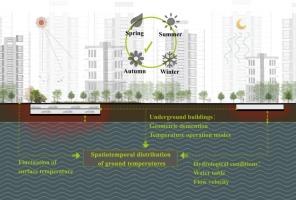
地下建筑对地温时空分布影响的定量分析
严重的地下城市热岛效应对生态和人类环境的威胁日益严重,同时也为浅层地热能的利用提供了机遇。地下建筑是地温变化的关键驱动因素,但地下建筑对地温的动态影响及其逐时时空分布特征尚不明确。这种知识差距不仅制约了地源热泵的高效利用,而且造成了不必要的环境污染。在此背景下,本研究模拟了北京水文地质条件下地下水位、水头、地下建筑几何尺寸和温度运行方式对周边地温场的动态影响。主要发现包括:(1)水力梯度对地温的影响随水平距离的增加而增加,土壤导热系数在±20%的变化范围内呈不对称响应;(2)地下水位深度决定了横向热不对称性,地下水位越高,上下游温差越大;(3)建筑宽度对竖向温度的影响是深度的2.4倍,而对水平温度的影响仅取决于深度;(4)建筑类型有明显的季节性波动,随时间的推移,波动幅度逐渐增大,在早春达到峰值;(5)几何尺寸和温度运行模式的相互作用导致地表温度变化更加明显和发散(40 m深度+ 3.3°C,季节波动11-22.5°C),渗透到80 m深度。这些见解有助于减轻SUHI和提高地热资源的利用。
本文章由计算机程序翻译,如有差异,请以英文原文为准。
求助全文
约1分钟内获得全文
求助全文
来源期刊
Urban Climate
Social Sciences-Urban Studies
CiteScore
9.70
自引率
9.40%
发文量
286
期刊介绍:
Urban Climate serves the scientific and decision making communities with the publication of research on theory, science and applications relevant to understanding urban climatic conditions and change in relation to their geography and to demographic, socioeconomic, institutional, technological and environmental dynamics and global change. Targeted towards both disciplinary and interdisciplinary audiences, this journal publishes original research papers, comprehensive review articles, book reviews, and short communications on topics including, but not limited to, the following:
Urban meteorology and climate[...]
Urban environmental pollution[...]
Adaptation to global change[...]
Urban economic and social issues[...]
Research Approaches[...]
 求助内容:
求助内容: 应助结果提醒方式:

 京公网安备 11010802042870号


