
Does a tradeoff between temporal stability and sampling frequency contribute to the prediction accuracy of soil moisture in alternative stable states?
IF 6.6
1区 农林科学
Q1 SOIL SCIENCE
引用次数: 0
Abstract
Soil water content (SWC) regulates patchy vegetation patterns in arid regions, where alternative stable states (ASS) explain vegetation mosaics. Although temporal stability and sampling frequency (SF) are critical for SWC prediction, their tradeoff and its impact on prediction accuracy remain poorly understood. Using SWC data from 48 sampling occasions at 70 cm depth across grassland, shrubland, and forest ecosystems, we examined how SF influences SWC dynamics and prediction accuracy.
Results showed that SF significantly affected SWC dynamics and temporal stability, particularly under lower SFs (15–45 days, LSFs) compared to higher SFs (≤7 days, HSFs). Under HSFs, mean SWC remained stable across vegetation types, whereas under LSFs, significant effects emerged except in specific grassland layers. Temporal stability indices—including Spearman’s rank correlation coefficient, mean relative difference range, and representative location values—were generally higher under HSFs. Despite this, SWC was accurately predicted across all vegetation types and soil layers under LSFs (R2 > 0.75, p < 0.01). Moreover, indirect prediction methods significantly outperformed direct methods. These findings reveal a vegetation-dependent tradeoff between SF and temporal stability: forests retain high predictability under LSFs, while grasslands require HSFs for accurate estimation. This hydrological distinction offers insight into the stability mechanisms underlying alternative vegetation states within ASS frameworks. Our study informs optimized SWC monitoring strategies and advances process-based understanding of ASS formation and maintenance in arid ecosystems.
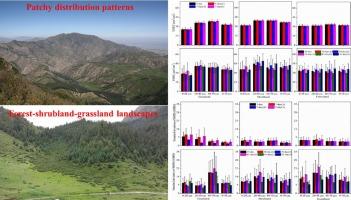
时间稳定性和采样频率之间的权衡是否有助于土壤湿度在替代稳定状态下的预测准确性?
土壤含水量(SWC)调节着干旱区斑块状植被模式,其中可选稳定状态(ASS)解释了植被嵌合现象。虽然时间稳定性和采样频率(SF)对SWC预测至关重要,但它们的权衡及其对预测精度的影响仍然知之甚少。利用草地、灌丛和森林生态系统70 cm深度48次采样的SWC数据,研究了顺丰度对SWC动态和预测精度的影响。结果表明,相对于较高的SFs(≤7 d, HSFs), SF对SWC动态和时间稳定性有显著影响,特别是在较低的SFs (15-45 d, lfs)下。除特定草地层外,不同植被类型的平均SWC在高通量草地上保持稳定,而低通量草地对SWC的影响显著。时间稳定性指数,包括Spearman等级相关系数、平均相对差值和代表性位置值,在高通量条件下普遍较高。尽管如此,在lfs下,所有植被类型和土层的SWC预测都是准确的(R2 > 0.75, p < 0.01)。此外,间接预测方法显著优于直接预测方法。这些发现揭示了植被依赖于森林密度和时间稳定性之间的权衡:森林在低密度密度下保持高可预测性,而草地需要高密度密度来进行准确的估计。这种水文差异提供了对ASS框架内替代植被状态的稳定性机制的深入了解。我们的研究为优化SWC监测策略提供了信息,并促进了对干旱生态系统中ASS形成和维持的基于过程的理解。
本文章由计算机程序翻译,如有差异,请以英文原文为准。
求助全文
约1分钟内获得全文
求助全文
来源期刊
Geoderma
农林科学-土壤科学
CiteScore
11.80
自引率
6.60%
发文量
597
审稿时长
58 days
期刊介绍:
Geoderma - the global journal of soil science - welcomes authors, readers and soil research from all parts of the world, encourages worldwide soil studies, and embraces all aspects of soil science and its associated pedagogy. The journal particularly welcomes interdisciplinary work focusing on dynamic soil processes and functions across space and time.
 求助内容:
求助内容: 应助结果提醒方式:

 京公网安备 11010802042870号


