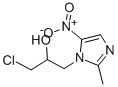
Facile Synthesis of Magnetic Covalent Organic Frameworks for Highly Efficient Extraction and Trace Determination of Ornidazole in Food Samples

IF 7.2 Q1 FOOD SCIENCE & TECHNOLOGY
Jiahui Zhu, Shilong Lv, Mo-Lin Li, W. Zhu, Yushen Liu, Lu‐Liang Wang
{"title":"Facile Synthesis of Magnetic Covalent Organic Frameworks for Highly Efficient Extraction and Trace Determination of Ornidazole in Food Samples","authors":"Jiahui Zhu, Shilong Lv, Mo-Lin Li, W. Zhu, Yushen Liu, Lu‐Liang Wang","doi":"10.1016/j.jfutfo.2025.12.006","DOIUrl":null,"url":null,"abstract":"• A novel core-shell magnetic covalent organic framework (Fe 3 O 4 @TZ-DMTP) was synthesized via in situ hydrothermal growth. • Effective extraction performance for ornidazole was achieved by π-π, hydrogen bonding and hydrophobic interaction sites of Fe 3 O 4 @TZ-DMTP adsorbent . • The established Fe 3 O 4 @TZ-DMTP-MSPE-HPLC method for ornidazole was validated and applied in real food samples analysis. Ornidazole (ONZ), a widely used nitroimidazole antibiotic, has raised significant environmental and health concerns due to its persistence and potential carcinogenicity. Existing detection methods often suffer from matrix interference and cumbersome procedures. In this study, a novel magnetic covalent organic framework (Fe 3 O 4 @TZ-DMTP) with a core-shell structure was synthesized via in situ hydrothermal growth of 2,4,6-tri(4-aminophenyl)-1,3,5-triazine (TZ) and 2,5-dimethoxy-terephthalaldehyde (DMTP) on magnetic nanoparticles. The composite exhibited high surface area, superparamagnetism and excellent adsorption capacity for ONZ through π-π interactions, hydrogen bonding, and hydrophobic effects. Coupled with HPLC-DAD, a robust magnetic solid-phase extraction (MSPE) method was developed, achieving a wide linear range (0.01-10 µg mL⁻¹) and low detection limit (0.003 µg mL⁻¹). The method demonstrated superior anti-interference capability and reusability (>90% recovery after 7 cycles). Successful application to tap water, lake water, aquaculture water, milk and honey samples confirmed its practicality with recoveries of 80.8-103.2% and RSDs < 13.8%. This work provides a sustainable and efficient strategy for monitoring nitroimidazole residues in complex matrices.","PeriodicalId":100784,"journal":{"name":"Journal of Future Foods","volume":"1 1","pages":""},"PeriodicalIF":7.2000,"publicationDate":"2025-12-01","publicationTypes":"Journal Article","fieldsOfStudy":null,"isOpenAccess":false,"openAccessPdf":"","citationCount":"0","resultStr":null,"platform":"Semanticscholar","paperid":null,"PeriodicalName":"Journal of Future Foods","FirstCategoryId":"0","ListUrlMain":"https://doi.org/10.1016/j.jfutfo.2025.12.006","RegionNum":0,"RegionCategory":null,"ArticlePicture":[],"TitleCN":null,"AbstractTextCN":null,"PMCID":null,"EPubDate":"","PubModel":"","JCR":"Q1","JCRName":"FOOD SCIENCE & TECHNOLOGY","Score":null,"Total":0}
引用次数: 0

Abstract

• A novel core-shell magnetic covalent organic framework (Fe 3 O 4 @TZ-DMTP) was synthesized via in situ hydrothermal growth. • Effective extraction performance for ornidazole was achieved by π-π, hydrogen bonding and hydrophobic interaction sites of Fe 3 O 4 @TZ-DMTP adsorbent . • The established Fe 3 O 4 @TZ-DMTP-MSPE-HPLC method for ornidazole was validated and applied in real food samples analysis. Ornidazole (ONZ), a widely used nitroimidazole antibiotic, has raised significant environmental and health concerns due to its persistence and potential carcinogenicity. Existing detection methods often suffer from matrix interference and cumbersome procedures. In this study, a novel magnetic covalent organic framework (Fe 3 O 4 @TZ-DMTP) with a core-shell structure was synthesized via in situ hydrothermal growth of 2,4,6-tri(4-aminophenyl)-1,3,5-triazine (TZ) and 2,5-dimethoxy-terephthalaldehyde (DMTP) on magnetic nanoparticles. The composite exhibited high surface area, superparamagnetism and excellent adsorption capacity for ONZ through π-π interactions, hydrogen bonding, and hydrophobic effects. Coupled with HPLC-DAD, a robust magnetic solid-phase extraction (MSPE) method was developed, achieving a wide linear range (0.01-10 µg mL⁻¹) and low detection limit (0.003 µg mL⁻¹). The method demonstrated superior anti-interference capability and reusability (>90% recovery after 7 cycles). Successful application to tap water, lake water, aquaculture water, milk and honey samples confirmed its practicality with recoveries of 80.8-103.2% and RSDs < 13.8%. This work provides a sustainable and efficient strategy for monitoring nitroimidazole residues in complex matrices.
磁性共价有机框架的简易合成及食品样品中奥硝唑的高效提取和痕量测定
•通过原位水热生长合成了一种新型核壳磁性共价有机骨架(fe3o4 @TZ-DMTP)。•fe3o4 @TZ-DMTP吸附剂的π-π、氢键和疏水相互作用位点对奥硝唑的萃取效果较好。验证了建立的Fe 3 O 4 @TZ-DMTP-MSPE-HPLC检测奥硝唑的方法,并将其应用于实际食品样品的分析。奥硝唑(Ornidazole, ONZ)是一种广泛使用的硝基咪唑类抗生素,由于其持久性和潜在的致癌性,引起了严重的环境和健康问题。现有的检测方法往往存在矩阵干扰和繁琐的程序。在本研究中,通过在磁性纳米颗粒上原位水热生长,合成了具有核壳结构的新型磁性共价有机骨架(Fe 3 O 4 @TZ-DMTP)。该复合材料通过π-π相互作用、氢键和疏水效应对ONZ具有高表面积、超顺磁性和优异的吸附能力。与HPLC-DAD相结合,建立了一种可靠的磁固相萃取(MSPE)方法,具有宽的线性范围(0.01-10µg mL⁻¹)和低的检出限(0.003µg mL⁻¹)。该方法具有良好的抗干扰能力和可重复使用性(循环7次后回收率高达90%)。成功应用于自来水、湖水、水产养殖水、牛奶和蜂蜜样品,回收率为80.8 ~ 103.2%,rsd < 13.8%,证实了该方法的实用性。这项工作为监测复杂基质中硝基咪唑残留提供了一种可持续和有效的策略。
本文章由计算机程序翻译,如有差异,请以英文原文为准。
求助全文
约1分钟内获得全文 求助全文
来源期刊
CiteScore
5.80
自引率
0.00%
发文量
0
文献相关原料
原料信息
原料厂家
×
引用
GB/T 7714-2015
复制
MLA
复制
APA
复制
导出至
BibTeX EndNote RefMan NoteFirst NoteExpress
×
提示
您的信息不完整,为了账户安全,请先补充。
现在去补充
×
提示
您因"违规操作"
具体请查看互助需知
我知道了
×
提示
确定
请完成安全验证×
copy
已复制链接
快去分享给好友吧!
我知道了
右上角分享
点击右上角分享
0
联系我们:info@booksci.cn Book学术提供免费学术资源搜索服务,方便国内外学者检索中英文文献。致力于提供最便捷和优质的服务体验。 Copyright © 2023 布克学术 All rights reserved.
京ICP备2023020795号-1
ghs 京公网安备 11010802042870号
Book学术文献互助
Book学术文献互助群
群 号:604180095
Book学术官方微信
小红书