
Selective enrichment and rapid determination of malachite green in aquaculture water using magnetic molecularly imprinted dispersive SPE coupled to SERS-PLS
IF 1.3
4区 化学
Q4 CHEMISTRY, ANALYTICAL
Chinese Journal of Analytical Chemistry
Pub Date : 2026-05-01
Epub Date: 2025-12-04
DOI:10.1016/j.cjac.2025.100687
引用次数: 0
Abstract
We report a rapid method for the selective enrichment and sensitive detection of malachite green (MG) in aquaculture water. Magnetic molecularly imprinted polymers (MMIPs) prepared via Pickering-emulsion polymerization were employed in a magnetic dispersive SPE workflow prior to surface-enhanced Raman spectroscopy (SERS). Partial least squares (PLS) models were built on preprocessed SERS spectra to predict MG concentrations. The optimised model achieved excellent linearity (Rtrain=0.9897; Rtest=0.9836), a detection limit of 0.19 ng/mL, and spike recoveries of 80% to 110% in real aquaculture water. Results were benchmarked against HPLC, showing good agreement. The method integrates selective preconcentration with portable SERS readout, enabling on-site MG screening with high sensitivity and short turnaround. The method demonstrated good robustness and accuracy under the optimized pH, adsorption time, and MMIPs mass conditions. This combined MI-MDSPE/SERS-PLS strategy provides a practical route for rapid monitoring of MG in aquaculture settings.
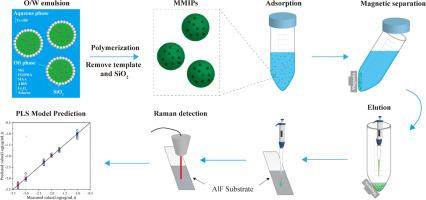
磁性分子印迹分散固相萃取- SERS-PLS法在水产养殖水中选择性富集及快速测定孔雀石绿
报道了一种水产养殖水体中孔雀石绿(MG)的快速富集和灵敏检测方法。在表面增强拉曼光谱(SERS)之前,通过Pickering-emulsion聚合法制备磁性分子印迹聚合物(MMIPs)。在预处理后的SERS光谱上建立偏最小二乘(PLS)模型来预测MG浓度。优化后的模型具有良好的线性关系(R列=0.9897;R检验=0.9836),检出限为0.19 ng/mL,在真实养殖水体中的峰回收率为80 ~ 110%。结果与高效液相色谱法相比较,结果吻合较好。该方法将选择性预浓缩与便携式SERS读数相结合,使现场MG筛选具有高灵敏度和短周期。在优化的pH、吸附时间和MMIPs质量条件下,该方法具有良好的稳健性和准确性。这种联合MI-MDSPE/SERS-PLS策略为水产养殖环境中MG的快速监测提供了一条实用的途径。
本文章由计算机程序翻译,如有差异,请以英文原文为准。
求助全文
约1分钟内获得全文
求助全文
来源期刊
CiteScore
3.60
自引率
25.00%
发文量
17223
审稿时长
35 days
期刊介绍:
Chinese Journal of Analytical Chemistry(CJAC) is an academic journal of analytical chemistry established in 1972 and sponsored by the Chinese Chemical Society and Changchun Institute of Applied Chemistry, Chinese Academy of Sciences. Its objectives are to report the original scientific research achievements and review the recent development of analytical chemistry in all areas. The journal sets up 5 columns including Research Papers, Research Notes, Experimental Technique and Instrument, Review and Progress and Summary Accounts. The journal published monthly in Chinese language. A detailed abstract, keywords and the titles of figures and tables are provided in English, except column of Summary Accounts. Prof. Wang Erkang, an outstanding analytical chemist, academician of Chinese Academy of Sciences & Third World Academy of Sciences, holds the post of the Editor-in-chief.
文献相关原料
公司名称
产品信息
麦克林
Triton X-100
麦克林
Oleic acid
麦克林
2,2′-Azobis(2-methylpropionitrile)
 求助内容:
求助内容: 应助结果提醒方式:

 京公网安备 11010802042870号


