
Energy-looping strategies in Cs2NaYF6 double perovskites: Enabling ultra-low temperature self-calibrating thermometry and fluorescent anti-counterfeiting
IF 9.6
1区 化学
Q1 CHEMISTRY, APPLIED
引用次数: 0
Abstract
Remote temperature sensing based on luminescence intensity ratio (LIR) remains a significant challenge in extreme environments, particularly at ultra-low temperatures. Herein, multimodal dynamically tunable fluorescence is achieved in Cs2NaYF6 double perovskites through single or co-doping with Eu3+ and Tb3+. Dipole–dipole interaction is confirmed to mediate energy transfer between the Tb3+ and Eu3+, establishing enhanced energy-looping among 5D4 (Tb3+) and 5D1 (Eu3+) levels under 377 nm irradiation. The 5D4 → 7F5 transition of Tb3+ gives rise to four well-resolved emission, arising from the Stark splitting of the 5D4 level under Oh symmetry. Energy-looping facilitates sustained back energy transfer from the 5D1 level of Eu3+ to Stark sublevels, thereby amplifying the temperature-dependent variation of the LIR for four-peak emission. This results in a high relative sensitivity of 1.07%/K at 80 K and a low temperature uncertainty of 0.61 K. Meanwhile, real-time feedback is enabled by employing multimodal LIR self-calibration based on the non-thermally coupled levels of Tb3+ and Eu3+. Furthermore, by dual-wavelength switching excitation, photon barcodes and encrypted QR codes are successfully developed. Overall, this study establishes an effective LIR-based strategy for high-precision remote thermometry in ultra-low temperature environments, and opens avenues for the development of advanced fluorescent anti-counterfeiting.

Cs2NaYF6双钙钛矿的能量环策略:实现超低温自校准测温和荧光防伪
基于发光强度比(LIR)的远程温度遥感在极端环境下,特别是在超低温下仍然是一个重大挑战。本文通过与Eu3+和Tb3+单掺杂或共掺杂,在Cs2NaYF6双钙钛矿中实现了多模态动态可调荧光。证实了偶极-偶极相互作用介导了Tb3+和Eu3+之间的能量传递,在377 nm辐照下,5D4 (Tb3+)和5D1 (Eu3+)之间建立了增强的能量环。Tb3+的5D4→7F5跃迁产生了四次高分辨发射,这是由Oh对称下5D4能级的Stark分裂引起的。能量环促进了从Eu3+的5D1能级到Stark亚能级的持续反向能量转移,从而放大了四峰发射LIR的温度依赖性变化。在80k时的相对灵敏度为1.07%/K,低温不确定度为0.61 K。同时,采用基于Tb3+和Eu3+非热耦合水平的多模态LIR自校准实现了实时反馈。此外,通过双波长开关激发,成功开发了光子条形码和加密QR码。总体而言,本研究建立了一种有效的基于红外光谱的超低温环境下高精度远程测温策略,为先进荧光防伪技术的发展开辟了道路。
本文章由计算机程序翻译,如有差异,请以英文原文为准。
求助全文
约1分钟内获得全文
求助全文
来源期刊
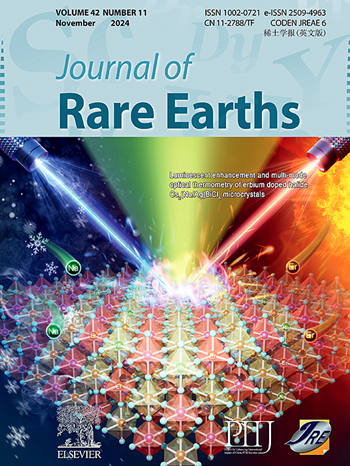
Journal of Rare Earths
化学-应用化学
CiteScore
8.70
自引率
14.30%
发文量
374
审稿时长
1.7 months
期刊介绍:
The Journal of Rare Earths reports studies on the 17 rare earth elements. It is a unique English-language learned journal that publishes works on various aspects of basic theory and applied science in the field of rare earths (RE). The journal accepts original high-quality original research papers and review articles with inventive content, and complete experimental data. It represents high academic standards and new progress in the RE field. Due to the advantage of abundant RE resources of China, the research on RE develops very actively, and papers on the latest progress in this field emerge every year. It is not only an important resource in which technicians publish and obtain their latest research results on RE, but also an important way of reflecting the updated progress in RE research field.
The Journal of Rare Earths covers all research and application of RE rare earths including spectroscopy, luminescence and phosphors, rare earth catalysis, magnetism and magnetic materials, advanced rare earth materials, RE chemistry & hydrometallurgy, RE metallography & pyrometallurgy, RE new materials, RE solid state physics & solid state chemistry, rare earth applications, RE analysis & test, RE geology & ore dressing, etc.
 求助内容:
 应助结果提醒方式:


 京公网安备 11010802042870号


