
Design and construction of cuttlefish ink derived melanin complexed microneedles for microenvironment regulation to improve vitiligo treatment
IF 5.3
2区 生物学
Q1 MARINE & FRESHWATER BIOLOGY
引用次数: 3
Abstract
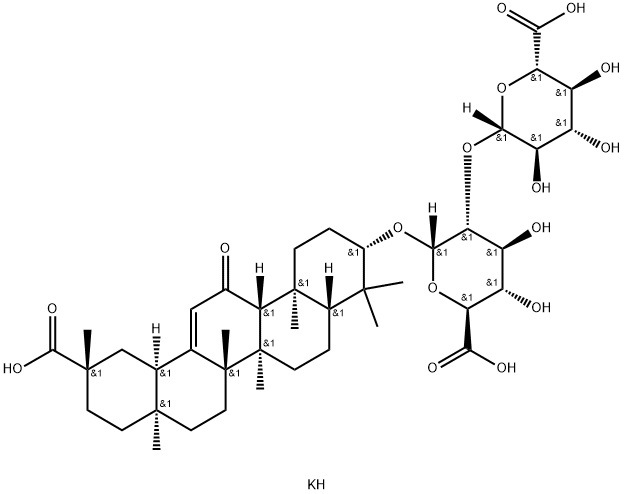
Abstract Vitiligo is an autoimmune disorder marked by melanocyte destruction and epidermal depigmentation, primarily driven by inflammatory and oxidative stress within the affected skin lesions. Consequently, there is an urgent need for therapeutic strategies focused on protecting melanocytes and replenishing melanin for effective vitiligo management. In this study, a novel microneedle-based therapeutic platform (C/D/E@MN) was fabricated that was composed of cuttlefish ink nanoparticles (CINPs) for melanin supplementation, dipotassium glycyrrhizinate (DPG) for inflammation regulation, and skin-derived exosomes (EXO) to promote melanocyte proliferation. In addition, microneedles with varying dissolution profiles (swellable, slow-dissolving, and fast-dissolving) were designed and evaluated their performance to optimize therapeutic efficacy. In vitro results demonstrated that fast-dissolving microneedles (FDMN) significantly reduced cellular reactive oxygen species (ROS) and the secretion of vitiligo-related inflammatory cytokines and chemokines, such as IL-8, CXCL-16, and HMGB-1. Upon a vitiligo mice model, C/D/E@FDMN treatment group generated a significant increase in skin melanin content and a 15.5% reduction of whitening degree. The microneedles protected melanocytes and promoted lesion repigmentation through synergistic antioxidant, anti-inflammatory and cyto-proliferative mechanisms, offering a promising strategy for improved vitiligo therapy.墨鱼墨汁衍生黑色素复合微针微环境调控改善白癜风治疗的设计与构建
白癜风是一种以黑素细胞破坏和表皮色素沉着为特征的自身免疫性疾病,主要由受影响皮肤病变内的炎症和氧化应激驱动。因此,迫切需要以保护黑色素细胞和补充黑色素为重点的治疗策略来有效地管理白癜风。本研究构建了一种新型微针治疗平台(C/D/E@MN),该平台由墨鱼墨水纳米颗粒(CINPs)补充黑色素,甘草酸二钾(DPG)调节炎症,皮肤源性外泌体(EXO)促进黑素细胞增殖组成。此外,还设计了具有不同溶解特征(可溶胀、慢溶和快溶)的微针,并评估了它们的性能,以优化治疗效果。体外实验结果表明,快溶微针(FDMN)可显著降低细胞活性氧(ROS)和白癜风相关炎症因子和趋化因子(如IL-8、CXCL-16和HMGB-1)的分泌。在白癜风小鼠模型中,C/D/E@FDMN处理组皮肤黑色素含量显著增加,美白程度降低15.5%。微针通过协同抗氧化、抗炎和细胞增殖机制保护黑素细胞,促进病变色素沉着,为改善白癜风治疗提供了一个有希望的策略。
本文章由计算机程序翻译,如有差异,请以英文原文为准。
求助全文
约1分钟内获得全文
求助全文
来源期刊
Marine Life Science & Technology
MARINE & FRESHWATER BIOLOGY-
CiteScore
9.60
自引率
10.50%
发文量
58
期刊介绍:
Marine Life Science & Technology (MLST), established in 2019, is dedicated to publishing original research papers that unveil new discoveries and theories spanning a wide spectrum of life sciences and technologies. This includes fundamental biology, fisheries science and technology, medicinal bioresources, food science, biotechnology, ecology, and environmental biology, with a particular focus on marine habitats.
The journal is committed to nurturing synergistic interactions among these diverse disciplines, striving to advance multidisciplinary approaches within the scientific field. It caters to a readership comprising biological scientists, aquaculture researchers, marine technologists, biological oceanographers, and ecologists.
文献相关原料
原料信息
原料厂家
 求助内容:
求助内容: 应助结果提醒方式:

 京公网安备 11010802042870号


