
Selective recognition of quaternary ammonium cations
IF 19.6
1区 化学
Q1 CHEMISTRY, MULTIDISCIPLINARY
引用次数: 0
Abstract
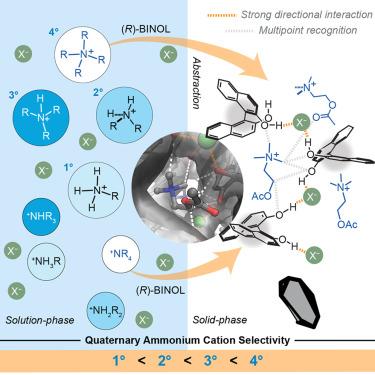
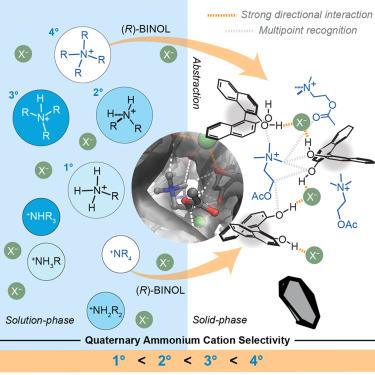
The selective recognition of ammonium cations fundamentally relies on their degree of substitution. In biological systems, proteins can preferentially bind more substituted ammonium cations over less substituted homologs. By contrast, the stronger hydrogen-bond donor ability and enhanced cation-π interactions of less substituted cations would predict the preferential recognition of these species. Here, we show that combining supramolecular recognition with solid-phase abstraction enables the selective abstraction of quaternary ammonium cations across diverse cation scaffolds in the solid crystalline state. Quaternary ammonium cations access a lower-energy solid state than tertiary counterparts through multipoint binding to an adaptive array of isostructural BINOL·counterion networks. The preferential abstraction of quaternary ammonium cations from mixtures of homologous cations proceeds under thermodynamic control with excellent selectivity and remains operative even under aqueous conditions.
季铵离子的选择性识别
铵离子的选择性识别从根本上依赖于它们的取代程度。在生物系统中,蛋白质可以优先结合更多取代的铵离子而不是取代较少的同源物。相比之下,较强的氢键供体能力和较少取代阳离子增强的阳离子-π相互作用预测了这些物种的优先识别。在这里,我们展示了将超分子识别与固相提取相结合,可以在固体结晶状态下选择性地提取不同阳离子支架上的季铵阳离子。季铵盐阳离子通过与自适应异构BINOL·反网络阵列的多点结合,获得比叔铵盐更低能量的固态。从同源阳离子混合物中优先提取季铵盐阳离子是在热力学控制下进行的,具有优异的选择性,即使在水条件下也保持有效。
本文章由计算机程序翻译,如有差异,请以英文原文为准。
求助全文
约1分钟内获得全文
求助全文
来源期刊
Chem
Environmental Science-Environmental Chemistry
CiteScore
32.40
自引率
1.30%
发文量
281
期刊介绍:
Chem, affiliated with Cell as its sister journal, serves as a platform for groundbreaking research and illustrates how fundamental inquiries in chemistry and its related fields can contribute to addressing future global challenges. It was established in 2016, and is currently edited by Robert Eagling.
 求助内容:
求助内容: 应助结果提醒方式:

 京公网安备 11010802042870号


