
Gut microbiota immaturity with DL-endopeptidase deficiency links antibiotic use to preterm late-onset sepsis
IF 18.7
1区 医学
Q1 MICROBIOLOGY
引用次数: 0
Abstract
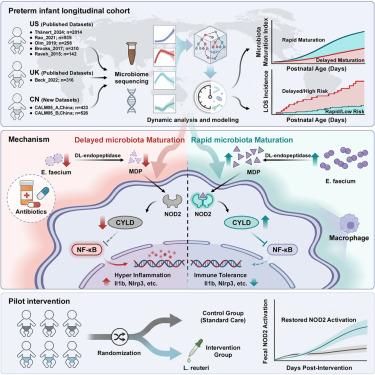
Early antibiotic exposure increases late-onset sepsis (LOS) risk in preterm infants, potentially via gut dysbiosis. Analyzing 4,938 longitudinal fecal samples from preterm infants in China, the US, and the UK, we identified a differential pace of gut microbiota development among preterm infants. Delayed maturation correlated with over one-third of LOS risk associated with early antibiotic exposure. Deficiency of a bacterial DL-endopeptidase represented a hallmark of delayed microbiota development and correlated with elevated LOS risk. Supplementation with DL-endopeptidase-producing Enterococcus faecium or Limosilactobacillus reuteri activated the NOD2 receptor via muramyl dipeptide (MDP), regulated macrophage differentiation and polarization, restrained hyperinflammation via cylindromatosis (CYLD) induction, and protected neonatal mice from LOS. A pilot randomized controlled trial showed that L. reuteri supplementation enhanced fecal NOD2 activation in preterm infants. These findings link microbiota immaturity and reduced DL-endopeptidase activity to antibiotic exposure and LOS risk and highlight a candidate biomarker that warrants further validation for clinical translation.
肠道菌群不成熟与dl -内肽酶缺乏症将抗生素的使用与早产迟发性败血症联系起来
早期抗生素暴露增加了早产儿迟发性败血症(LOS)的风险,可能通过肠道生态失调。通过分析中国、美国和英国的4938个早产儿的纵向粪便样本,我们发现了早产儿肠道微生物群发育的不同速度。延迟成熟与超过三分之一与早期抗生素暴露相关的LOS风险相关。细菌dl -内肽酶缺乏是微生物群发育延迟的标志,与LOS风险升高相关。补充产生dl -内肽酶的粪肠球菌或罗伊氏乳杆菌通过muramyl二肽(MDP)激活NOD2受体,调节巨噬细胞分化和极化,通过诱导柱状瘤病(CYLD)抑制过度炎症,并保护新生小鼠免受LOS的影响。一项随机对照试验表明,补充罗伊氏乳杆菌可增强早产儿粪便中NOD2的激活。这些发现将微生物群不成熟和dl -内肽酶活性降低与抗生素暴露和LOS风险联系起来,并突出了一个候选生物标志物,值得进一步验证临床转化。
本文章由计算机程序翻译,如有差异,请以英文原文为准。
求助全文
约1分钟内获得全文
求助全文
来源期刊
Cell host & microbe
生物-微生物学
CiteScore
45.10
自引率
1.70%
发文量
201
审稿时长
4-8 weeks
期刊介绍:
Cell Host & Microbe is a scientific journal that was launched in March 2007. The journal aims to provide a platform for scientists to exchange ideas and concepts related to the study of microbes and their interaction with host organisms at a molecular, cellular, and immune level. It publishes novel findings on a wide range of microorganisms including bacteria, fungi, parasites, and viruses. The journal focuses on the interface between the microbe and its host, whether the host is a vertebrate, invertebrate, or plant, and whether the microbe is pathogenic, non-pathogenic, or commensal. The integrated study of microbes and their interactions with each other, their host, and the cellular environment they inhabit is a unifying theme of the journal. The published work in Cell Host & Microbe is expected to be of exceptional significance within its field and also of interest to researchers in other areas. In addition to primary research articles, the journal features expert analysis, commentary, and reviews on current topics of interest in the field.
 求助内容:
求助内容: 应助结果提醒方式:

 京公网安备 11010802042870号


