
Reimagining metal-organic framework discovery: Integrating experiment, computation, and artificial intelligence
IF 19.6
1区 化学
Q1 CHEMISTRY, MULTIDISCIPLINARY
引用次数: 0
Abstract
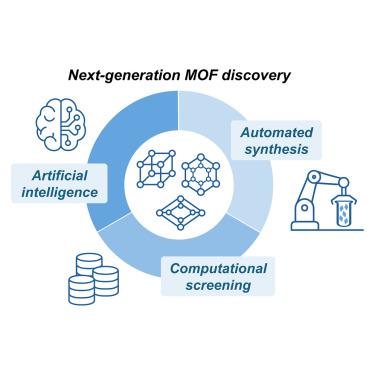
The traditional development of novel metal-organic frameworks (MOFs) is often hindered by challenges such as synthetic accessibility and time- and resource-intensive experimentation. High-throughput, automated experimental and computational techniques have enabled rapid chemical space exploration and theoretical MOF design. When combined with artificial intelligence (AI), these methods can be used to lead autonomous laboratories to new frontiers for MOF discovery, where these materials can be designed for a specific application, efficiently synthesized, characterized, and evaluated. This perspective highlights the role of AI in advancing automated MOF synthesis and characterization, computational MOF design and screening, and the integration of these approaches within autonomous workflows to ultimately enable the MOF laboratories of the future.
重新构想金属有机框架发现:整合实验、计算和人工智能
传统的新型金属有机框架(mof)的开发经常受到诸如合成可及性和时间和资源密集型实验等挑战的阻碍。高通量、自动化实验和计算技术使快速化学空间探索和理论MOF设计成为可能。当与人工智能(AI)相结合时,这些方法可用于将自主实验室引导到MOF发现的新领域,在那里这些材料可以针对特定应用进行设计,有效地合成,表征和评估。这一观点强调了人工智能在推进自动化MOF合成和表征、计算MOF设计和筛选方面的作用,以及这些方法在自主工作流程中的集成,最终使未来的MOF实验室成为可能。
本文章由计算机程序翻译,如有差异,请以英文原文为准。
求助全文
约1分钟内获得全文
求助全文
来源期刊
Chem
Environmental Science-Environmental Chemistry
CiteScore
32.40
自引率
1.30%
发文量
281
期刊介绍:
Chem, affiliated with Cell as its sister journal, serves as a platform for groundbreaking research and illustrates how fundamental inquiries in chemistry and its related fields can contribute to addressing future global challenges. It was established in 2016, and is currently edited by Robert Eagling.
 求助内容:
求助内容: 应助结果提醒方式:

 京公网安备 11010802042870号


