
Morphological adaptations of cavefish support enhanced hydrodynamic perception for underwater environmental monitoring

IF 14.3 1区 环境科学与生态学 Q1 ENVIRONMENTAL SCIENCES
Environmental Science and Ecotechnology Pub Date : 2026-03-01 Epub Date: 2026-02-13 DOI:10.1016/j.ese.2026.100677
Qi Yang , Qirui Liu , Yuling Wei , Chubin Weng , Li Ma , He Tian , Fang Zhang , Kenneth A. Rose , William R. Jeffery , Mengzhen Xu
{"title":"Morphological adaptations of cavefish support enhanced hydrodynamic perception for underwater environmental monitoring","authors":"Qi Yang ,&nbsp;Qirui Liu ,&nbsp;Yuling Wei ,&nbsp;Chubin Weng ,&nbsp;Li Ma ,&nbsp;He Tian ,&nbsp;Fang Zhang ,&nbsp;Kenneth A. Rose ,&nbsp;William R. Jeffery ,&nbsp;Mengzhen Xu","doi":"10.1016/j.ese.2026.100677","DOIUrl":null,"url":null,"abstract":"<div><div>Many of Earth's most biodiverse and biogeochemically active aquatic ecosystems—including groundwater karst systems, turbid estuaries and the deep ocean—are perpetually dark and hydraulically complex, making long-term, high-resolution monitoring technologically challenging. Conventional optical and acoustic sensors suffer rapid signal attenuation and high energy demand in these conditions. Cavefishes of the genus <em>Sinocyclocheilus</em>, which inhabit lightless subterranean waters, have evolved distinctive cranial morphologies—a duckbilled head, dorsal horn and hump—hypothesized to enhance hydrodynamic perception. Here we show, by combining vital staining of neuromasts with validated computational fluid dynamics simulations across a morphological series of <em>Sinocyclocheilus</em> species, that these structures dramatically amplify differential pressure signals (by up to 429.8%) and near-wall velocity gradients (by up to 69.2%) while extending perceptual range. Regions of maximal hydrodynamic variation predicted by the models closely match the observed distribution of canal and superficial neuromasts, revealing a clear biomimetic design principle: sensors should be positioned where flow-field gradients are strongest. These findings establish a quantitative, evolution-guided framework for optimizing artificial lateral line (ALL) sensor arrays, enabling autonomous underwater vehicles to perform energy-efficient, high-fidelity monitoring in some of the planet's most sensitive and data-scarce aquatic environments.</div></div>","PeriodicalId":34434,"journal":{"name":"Environmental Science and Ecotechnology","volume":"30 ","pages":"Article 100677"},"PeriodicalIF":14.3000,"publicationDate":"2026-03-01","publicationTypes":"Journal Article","fieldsOfStudy":null,"isOpenAccess":false,"openAccessPdf":"","citationCount":"0","resultStr":null,"platform":"Semanticscholar","paperid":null,"PeriodicalName":"Environmental Science and Ecotechnology","FirstCategoryId":"93","ListUrlMain":"https://www.sciencedirect.com/science/article/pii/S2666498426000220","RegionNum":1,"RegionCategory":"环境科学与生态学","ArticlePicture":[],"TitleCN":null,"AbstractTextCN":null,"PMCID":null,"EPubDate":"2026/2/13 0:00:00","PubModel":"Epub","JCR":"Q1","JCRName":"ENVIRONMENTAL SCIENCES","Score":null,"Total":0}
引用次数: 0

Abstract

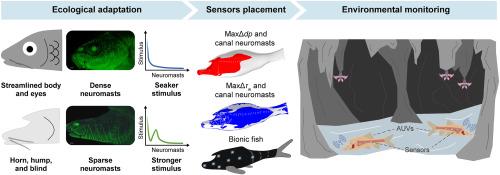
Many of Earth's most biodiverse and biogeochemically active aquatic ecosystems—including groundwater karst systems, turbid estuaries and the deep ocean—are perpetually dark and hydraulically complex, making long-term, high-resolution monitoring technologically challenging. Conventional optical and acoustic sensors suffer rapid signal attenuation and high energy demand in these conditions. Cavefishes of the genus Sinocyclocheilus, which inhabit lightless subterranean waters, have evolved distinctive cranial morphologies—a duckbilled head, dorsal horn and hump—hypothesized to enhance hydrodynamic perception. Here we show, by combining vital staining of neuromasts with validated computational fluid dynamics simulations across a morphological series of Sinocyclocheilus species, that these structures dramatically amplify differential pressure signals (by up to 429.8%) and near-wall velocity gradients (by up to 69.2%) while extending perceptual range. Regions of maximal hydrodynamic variation predicted by the models closely match the observed distribution of canal and superficial neuromasts, revealing a clear biomimetic design principle: sensors should be positioned where flow-field gradients are strongest. These findings establish a quantitative, evolution-guided framework for optimizing artificial lateral line (ALL) sensor arrays, enabling autonomous underwater vehicles to perform energy-efficient, high-fidelity monitoring in some of the planet's most sensitive and data-scarce aquatic environments.
Abstract Image

洞穴鱼的形态适应支持增强水下环境监测的水动力感知。
地球上许多最具生物多样性和生物地球化学活性的水生生态系统——包括地下水喀斯特系统、浑浊河口和深海——永远是黑暗的,水力复杂,这使得长期、高分辨率的监测技术具有挑战性。在这些条件下,传统的光学和声学传感器信号衰减快,能量需求高。洞穴鱼属(Sinocyclocheilus)生活在黑暗的水下,它们进化出了独特的头骨形态——鸭嘴、背角和驼背——据推测,这是为了增强对水动力的感知。在这里,我们通过将神经鞘的生命染色与经过验证的计算流体动力学模拟相结合,展示了这些结构在扩展感知范围的同时显着放大了压差信号(高达429.8%)和近壁速度梯度(高达69.2%)。模型预测的最大水动力变化区域与观察到的椎管和浅表神经鞘分布密切匹配,揭示了一个明确的仿生设计原则:传感器应放置在流场梯度最强的地方。这些发现为优化人工侧线(ALL)传感器阵列建立了一个定量的、进化导向的框架,使自主水下航行器能够在地球上一些最敏感和数据稀缺的水生环境中执行节能、高保真的监测。
本文章由计算机程序翻译,如有差异,请以英文原文为准。
求助全文
约1分钟内获得全文 求助全文
来源期刊
CiteScore
20.40
自引率
6.30%
发文量
11
审稿时长
18 days
期刊介绍: Environmental Science & Ecotechnology (ESE) is an international, open-access journal publishing original research in environmental science, engineering, ecotechnology, and related fields. Authors publishing in ESE can immediately, permanently, and freely share their work. They have license options and retain copyright. Published by Elsevier, ESE is co-organized by the Chinese Society for Environmental Sciences, Harbin Institute of Technology, and the Chinese Research Academy of Environmental Sciences, under the supervision of the China Association for Science and Technology.

×
引用
GB/T 7714-2015
复制
MLA
复制
APA
复制
导出至
BibTeX EndNote RefMan NoteFirst NoteExpress
×
提示
您的信息不完整,为了账户安全,请先补充。
现在去补充
×
提示
您因"违规操作"
具体请查看互助需知
我知道了
×
提示
确定
请完成安全验证×
copy
已复制链接
快去分享给好友吧!
我知道了
右上角分享
点击右上角分享
0
联系我们:info@booksci.cn Book学术提供免费学术资源搜索服务,方便国内外学者检索中英文文献。致力于提供最便捷和优质的服务体验。 Copyright © 2023 布克学术 All rights reserved.
京ICP备2023020795号-1
ghs 京公网安备 11010802042870号
Book学术文献互助
Book学术文献互助群
群 号:604180095
Book学术官方微信
小红书


