
S-adenosyl-L-methionine reverses ethanol-induced developmental toxicity in FASD model of Danio rerio embryos via dual-modulation of oxidative stress and glutathione homeostasis
IF 3.7
3区 医学
Q3 NEUROSCIENCES
Neurotoxicology and teratology
Pub Date : 2026-03-01
Epub Date: 2026-02-23
DOI:10.1016/j.ntt.2026.107589
引用次数: 0
Abstract
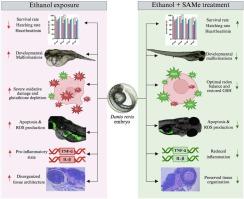
Fetal Alcohol Spectrum Disorder (FASD) represents a major global public health concern, affecting approximately 7.7 per 1000 births worldwide and remains as the most common preventable cause of lifelong neurodevelopmental impairment. Despite its prevalence, current clinical interventions are largely symptom-supportive and fail to address the underlying developmental pathology, underscoring the need for targeted, mechanism-based therapeutic strategies. Given the central involvement of oxidative stress and inflammation in FASD pathogenesis, this study evaluated the protective efficacy of S-adenosyl-L-methionine (SAMe), a key metabolic intermediate and universal methyl donor, using a zebrafish embryo model because of its high translational relevance and optical transparency. Fertilized embryos were exposed to 1.25% ethanol and co-treated with SAMe (15 and 30 μM) until 96 h post-fertilization (hpf). Ethanol exposure resulted in reduced survival and hatching rates, cardiac rhythm abnormalities, pronounced morphological defects, and compromised tissue integrity. SAMe treatment, particularly at 30 μM, significantly ameliorated these developmental abnormalities and associated biochemical dysregulations. Mechanistically, SAMe exerted a dual protective effect by restoring glutathione biosynthesis and attenuating oxidative stress-driven inflammatory responses. This was evidenced by marked reductions in reactive oxygen species, apoptosis, lipid peroxidation, and nitric oxide levels, alongside significant downregulation of pro-inflammatory cytokines, including TNF-α and IL-1β. Importantly, these biochemical and molecular improvements were consistently translated into phenotypic rescue, with substantial normalization of tissue architecture and developmental morphology. Collectively, these findings establish SAMe as a promising anti-teratogenic intervention that directly targets core oxidative and inflammatory pathways underlying FASD, highlighting its potential translational relevance as a mechanism-driven therapeutic strategy.
s -腺苷- l-蛋氨酸通过氧化应激和谷胱甘肽稳态的双重调节逆转乙醇诱导的斑马鱼胚胎FASD模型的发育毒性。
胎儿酒精谱系障碍(FASD)是一个主要的全球公共卫生问题,全世界每1000例新生儿中约有7.7例受到影响,并且仍然是终身神经发育障碍最常见的可预防原因。尽管其普遍存在,但目前的临床干预措施主要是症状支持,未能解决潜在的发育病理,强调需要有针对性的、基于机制的治疗策略。鉴于氧化应激和炎症在FASD发病机制中的核心作用,本研究利用斑马鱼胚胎模型评估了s -腺苷- l-蛋氨酸(SAMe)的保护作用,SAMe是一种关键的代谢中间体和通用甲基供体,因为它具有高度的翻译相关性和光学透明度。将受精卵暴露于1.25%乙醇中,并与SAMe (15 μM和30 μM)共处理至受精后96 h (hpf)。乙醇暴露导致成活率和孵化率降低、心律异常、明显的形态缺陷和组织完整性受损。同样的处理,特别是在30 μM下,显著改善了这些发育异常和相关的生化失调。在机制上,SAMe通过恢复谷胱甘肽生物合成和减轻氧化应激驱动的炎症反应发挥双重保护作用。这可以通过活性氧、细胞凋亡、脂质过氧化和一氧化氮水平的显著降低,以及促炎细胞因子(包括TNF-α和IL-1β)的显著下调来证明。重要的是,这些生化和分子的改善一致地转化为表型拯救,组织结构和发育形态的实质性正常化。总的来说,这些发现表明SAMe是一种有希望的抗致畸干预措施,直接针对FASD的核心氧化和炎症途径,突出了其作为一种机制驱动的治疗策略的潜在翻译相关性。
本文章由计算机程序翻译,如有差异,请以英文原文为准。
求助全文
约1分钟内获得全文
求助全文
来源期刊
CiteScore
5.60
自引率
10.30%
发文量
48
审稿时长
58 days
期刊介绍:
Neurotoxicology and Teratology provides a forum for publishing new information regarding the effects of chemical and physical agents on the developing, adult or aging nervous system. In this context, the fields of neurotoxicology and teratology include studies of agent-induced alterations of nervous system function, with a focus on behavioral outcomes and their underlying physiological and neurochemical mechanisms. The Journal publishes original, peer-reviewed Research Reports of experimental, clinical, and epidemiological studies that address the neurotoxicity and/or functional teratology of pesticides, solvents, heavy metals, nanomaterials, organometals, industrial compounds, mixtures, drugs of abuse, pharmaceuticals, animal and plant toxins, atmospheric reaction products, and physical agents such as radiation and noise. These reports include traditional mammalian neurotoxicology experiments, human studies, studies using non-mammalian animal models, and mechanistic studies in vivo or in vitro. Special Issues, Reviews, Commentaries, Meeting Reports, and Symposium Papers provide timely updates on areas that have reached a critical point of synthesis, on aspects of a scientific field undergoing rapid change, or on areas that present special methodological or interpretive problems. Theoretical Articles address concepts and potential mechanisms underlying actions of agents of interest in the nervous system. The Journal also publishes Brief Communications that concisely describe a new method, technique, apparatus, or experimental result.
 求助内容:
求助内容: 应助结果提醒方式:

 京公网安备 11010802042870号


