
Fate of dissolved pharmaceutically active compounds (PhACs) in irrigation water in rice paddy: Implications to human and soil health
IF 5.5
3区 环境科学与生态学
Q2 ENVIRONMENTAL SCIENCES
Journal of contaminant hydrology
Pub Date : 2026-03-01
Epub Date: 2026-02-17
DOI:10.1016/j.jconhyd.2026.104898
引用次数: 0
Abstract
Pharmaceutically active compounds (PhACs) may enter the food chain through food crops. This study investigates the influence of dissolved PhACs in irrigation water on rice crops and soil, identifying enduring implications on human and soil health. We conducted a field-scale experiment to investigate the accumulation and impacts of two prevalent PhACs, ibuprofen (IBP) and caffeine (CAF), in irrigation water on rice paddies under realistic agronomic conditions. The experiment was carried out in designated subplots with three dosage levels. The results revealed that IBP exhibited higher persistence in the field soil, leading to ∼2 times higher plant uptake than CAF. Most of the introduced contaminants attenuated in soil,root, shoot or degraded naturally, reducing grain accumulation, which ranged from 0.13% to 0.4% and from 0.38% to 1.4% for IBP and CAF, respectively. However, toxic PhAc metabolites were identified in the grains, raising significant concerns. Owing to its higher translocation and grain accumulation, the hazard quotient (HQ) of CAF surpassed 0.1, indicating a potential risk associated with regular dietary intake. The presence of PhACs significantly altered soil microbial enzyme activities, bacterial abundance, and community composition within the soil-plant microbiome, indicating potential long-term impacts on geo-health. In conclusion, the applied PhACs undergo significant attenuation within the field-soil and plant components, lowering grain accumulation; however, the presence of toxic PhAC metabolites in grains and changes in soil bacterial composition indicate potential concerns.
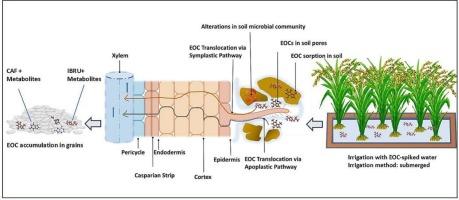
稻田灌溉水中溶解的药物活性化合物(PhACs)的命运:对人类和土壤健康的影响。
药物活性化合物(PhACs)可以通过粮食作物进入食物链。本研究调查了灌溉水中溶解的PhACs对水稻作物和土壤的影响,确定了对人类和土壤健康的持久影响。通过田间试验,研究了在实际农艺条件下,稻田灌溉水中常见的两种PhACs——布洛芬(ibuprofen, IBP)和咖啡因(caff, CAF)的积累及其影响。实验在三个剂量水平的指定子区进行。结果表明,IBP在田间土壤中具有更高的持久性,导致植物吸收量比CAF高2倍。大部分引入污染物在土壤、根、茎中自然衰减或降解,减少了籽粒积累,IBP和CAF的减少幅度分别为0.13% ~ 0.4%和0.38% ~ 1.4%。然而,在谷物中发现了有毒的PhAc代谢物,引起了极大的关注。由于其较高的转运能力和籽粒积累能力,CAF的危险系数(HQ)超过0.1,表明其存在与日常膳食摄入有关的潜在风险。PhACs的存在显著改变了土壤微生物酶活性、细菌丰度和土壤-植物微生物组内的群落组成,表明对地球健康的潜在长期影响。综上所述,施用的PhACs在田间土壤和植物组分中具有显著的衰减作用,降低了籽粒积累;然而,谷物中有毒PhAC代谢物的存在和土壤细菌组成的变化表明了潜在的问题。
本文章由计算机程序翻译,如有差异,请以英文原文为准。
求助全文
约1分钟内获得全文
求助全文
来源期刊
Journal of contaminant hydrology
环境科学-地球科学综合
CiteScore
6.80
自引率
2.80%
发文量
129
审稿时长
68 days
期刊介绍:
The Journal of Contaminant Hydrology is an international journal publishing scientific articles pertaining to the contamination of subsurface water resources. Emphasis is placed on investigations of the physical, chemical, and biological processes influencing the behavior and fate of organic and inorganic contaminants in the unsaturated (vadose) and saturated (groundwater) zones, as well as at groundwater-surface water interfaces. The ecological impacts of contaminants transported both from and to aquifers are of interest. Articles on contamination of surface water only, without a link to groundwater, are out of the scope. Broad latitude is allowed in identifying contaminants of interest, and include legacy and emerging pollutants, nutrients, nanoparticles, pathogenic microorganisms (e.g., bacteria, viruses, protozoa), microplastics, and various constituents associated with energy production (e.g., methane, carbon dioxide, hydrogen sulfide).
The journal''s scope embraces a wide range of topics including: experimental investigations of contaminant sorption, diffusion, transformation, volatilization and transport in the surface and subsurface; characterization of soil and aquifer properties only as they influence contaminant behavior; development and testing of mathematical models of contaminant behaviour; innovative techniques for restoration of contaminated sites; development of new tools or techniques for monitoring the extent of soil and groundwater contamination; transformation of contaminants in the hyporheic zone; effects of contaminants traversing the hyporheic zone on surface water and groundwater ecosystems; subsurface carbon sequestration and/or turnover; and migration of fluids associated with energy production into groundwater.
 求助内容:
求助内容: 应助结果提醒方式:

 京公网安备 11010802042870号


