
Tracking environmental resistance through surveillance of ESBL- and colistin-resistant Escherichia coli in livestock waste for One Health action

IF 4.4 2区 医学 Q1 INFECTIOUS DISEASES
Thitima Srathongneam , Phub Zam , Phongsawat Paisantham , Punyawee Dulyayangkul , Montakarn Sresung , Supitchaya Theplhar , Nisanart Charoenlap , Paiboon Vattanaviboon , Olarn Kijpreedaborisuthi , Suchada Susutthi , Skorn Mongkolsuk , Kwanrawee Sirikanchana
{"title":"Tracking environmental resistance through surveillance of ESBL- and colistin-resistant Escherichia coli in livestock waste for One Health action","authors":"Thitima Srathongneam ,&nbsp;Phub Zam ,&nbsp;Phongsawat Paisantham ,&nbsp;Punyawee Dulyayangkul ,&nbsp;Montakarn Sresung ,&nbsp;Supitchaya Theplhar ,&nbsp;Nisanart Charoenlap ,&nbsp;Paiboon Vattanaviboon ,&nbsp;Olarn Kijpreedaborisuthi ,&nbsp;Suchada Susutthi ,&nbsp;Skorn Mongkolsuk ,&nbsp;Kwanrawee Sirikanchana","doi":"10.1016/j.ijheh.2026.114763","DOIUrl":null,"url":null,"abstract":"<div><div>Antimicrobial-resistant bacteria are emerging biological contaminants that threaten both ecosystems and human health. Antimicrobial resistance (AMR) in livestock waste is increasingly recognized as an environmental hazard of global concern, with implications for food safety and public health. This study examined the occurrence and environmental behavior of extended-spectrum β-lactamase (ESBL)-producting and colistin-resistant <em>Escherichia coli</em> under environmentally relevant conditions in livestock waste from pig, cow, goat, chicken, and duck farms in Thailand. Cefotaxime-resistant <em>E. coli</em> were detected in all animal types, with pig, cow, and duck farms serving as major reservoirs. Untreated pig wastewater contained the highest levels of resistant <em>E. coli</em> (70% prevalence; 5.13–7.55 log<sub>10</sub> CFU/100 mL), while treatment reduced but did not eliminate contamination. Among 78 confirmed isolates, all were resistant to ampicillin and cefotaxime, 5.1% to ceftazidime, and none to carbapenems. Phenotypic colistin resistance occurred in 6.4% of isolates. All isolates carried <em>bla</em><sub>CTX-M</sub> genes, mainly <em>bla</em><sub>CTX-M</sub> group 1 (85.9%), while <em>bla</em><sub>CTX-M</sub> group 9 (15.4%) was also detected. Plasmid-mediated <em>mcr</em> genes (<em>mcr</em>-1 to <em>mcr</em>-3) were identified in 5.1% of isolates, exclusively from untreated pig wastewater, confirming these effluents as localized hotspots for resistance dissemination. Multiple antibiotic resistance indices ranged 0.29–0.43, with the highest values in pig farm isolates, indicating moderate to high levels of multidrug resistance. Overall, livestock wastewater represents a significant source of microbial contaminants. This study provides field-based evidence to support risk assessment and mitigation of antimicrobial-resistant bacteria within the One Health framework, emphasizing the importance of improving waste management to protect environmental and public health.</div></div>","PeriodicalId":13994,"journal":{"name":"International journal of hygiene and environmental health","volume":"273 ","pages":"Article 114763"},"PeriodicalIF":4.4000,"publicationDate":"2026-04-01","publicationTypes":"Journal Article","fieldsOfStudy":null,"isOpenAccess":false,"openAccessPdf":"","citationCount":"0","resultStr":null,"platform":"Semanticscholar","paperid":null,"PeriodicalName":"International journal of hygiene and environmental health","FirstCategoryId":"3","ListUrlMain":"https://www.sciencedirect.com/science/article/pii/S1438463926000234","RegionNum":2,"RegionCategory":"医学","ArticlePicture":[],"TitleCN":null,"AbstractTextCN":null,"PMCID":null,"EPubDate":"2026/2/23 0:00:00","PubModel":"Epub","JCR":"Q1","JCRName":"INFECTIOUS DISEASES","Score":null,"Total":0}
引用次数: 0

Abstract

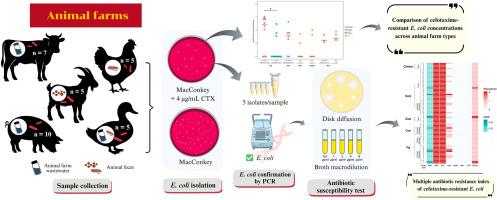
Antimicrobial-resistant bacteria are emerging biological contaminants that threaten both ecosystems and human health. Antimicrobial resistance (AMR) in livestock waste is increasingly recognized as an environmental hazard of global concern, with implications for food safety and public health. This study examined the occurrence and environmental behavior of extended-spectrum β-lactamase (ESBL)-producting and colistin-resistant Escherichia coli under environmentally relevant conditions in livestock waste from pig, cow, goat, chicken, and duck farms in Thailand. Cefotaxime-resistant E. coli were detected in all animal types, with pig, cow, and duck farms serving as major reservoirs. Untreated pig wastewater contained the highest levels of resistant E. coli (70% prevalence; 5.13–7.55 log10 CFU/100 mL), while treatment reduced but did not eliminate contamination. Among 78 confirmed isolates, all were resistant to ampicillin and cefotaxime, 5.1% to ceftazidime, and none to carbapenems. Phenotypic colistin resistance occurred in 6.4% of isolates. All isolates carried blaCTX-M genes, mainly blaCTX-M group 1 (85.9%), while blaCTX-M group 9 (15.4%) was also detected. Plasmid-mediated mcr genes (mcr-1 to mcr-3) were identified in 5.1% of isolates, exclusively from untreated pig wastewater, confirming these effluents as localized hotspots for resistance dissemination. Multiple antibiotic resistance indices ranged 0.29–0.43, with the highest values in pig farm isolates, indicating moderate to high levels of multidrug resistance. Overall, livestock wastewater represents a significant source of microbial contaminants. This study provides field-based evidence to support risk assessment and mitigation of antimicrobial-resistant bacteria within the One Health framework, emphasizing the importance of improving waste management to protect environmental and public health.
Abstract Image

通过监测畜禽粪便中的ESBL和粘菌素抗性大肠杆菌来跟踪环境抗性。
耐抗生素细菌是威胁生态系统和人类健康的新出现的生物污染物。畜禽粪便中的抗菌素耐药性(AMR)日益被认为是全球关注的环境危害,对食品安全和公共卫生产生影响。本研究研究了泰国猪、牛、山羊、鸡和鸭养殖场畜禽粪便中产广谱β-内酰胺酶(ESBL)和耐粘菌素大肠杆菌在环境相关条件下的发生和环境行为。在所有动物类型中均检测到耐头孢噻肟大肠杆菌,猪、牛和鸭养殖场是主要宿主。未经处理的猪废水含有最高水平的耐药大肠杆菌(70%的流行率;5.13-7.55 log10 CFU/100 mL),而处理减少了污染,但没有消除污染。78株确诊菌株对氨苄西林和头孢噻肟均耐药,对头孢他啶耐药5.1%,对碳青霉烯类无耐药。6.4%的分离株出现表型粘菌素耐药。所有分离株均携带blaCTX-M基因,以blaCTX-M 1群(85.9%)为主,blaCTX-M 9群(15.4%)也检出。在5.1%的分离株中发现了质粒介导的mcr基因(mcr-1至mcr-3),这些菌株全部来自未经处理的猪废水,证实这些废水是耐药性传播的局部热点。多种抗生素耐药指数范围为0.29 ~ 0.43,以猪场分离株最高,表明菌株具有中等至高度的多重耐药水平。总的来说,牲畜废水是微生物污染物的重要来源。这项研究提供了实地证据,支持在“同一个健康”框架内评估和减轻抗微生物药物耐药性细菌的风险,强调了改善废物管理以保护环境和公众健康的重要性。
本文章由计算机程序翻译,如有差异,请以英文原文为准。
求助全文
约1分钟内获得全文 求助全文
来源期刊
CiteScore
11.50
自引率
5.00%
发文量
151
审稿时长
22 days
期刊介绍: The International Journal of Hygiene and Environmental Health serves as a multidisciplinary forum for original reports on exposure assessment and the reactions to and consequences of human exposure to the biological, chemical, and physical environment. Research reports, short communications, reviews, scientific comments, technical notes, and editorials will be peer-reviewed before acceptance for publication. Priority will be given to articles on epidemiological aspects of environmental toxicology, health risk assessments, susceptible (sub) populations, sanitation and clean water, human biomonitoring, environmental medicine, and public health aspects of exposure-related outcomes.

×
引用
GB/T 7714-2015
复制
MLA
复制
APA
复制
导出至
BibTeX EndNote RefMan NoteFirst NoteExpress
×
提示
您的信息不完整,为了账户安全,请先补充。
现在去补充
×
提示
您因"违规操作"
具体请查看互助需知
我知道了
×
提示
确定
请完成安全验证×
copy
已复制链接
快去分享给好友吧!
我知道了
右上角分享
点击右上角分享
0
联系我们:info@booksci.cn Book学术提供免费学术资源搜索服务,方便国内外学者检索中英文文献。致力于提供最便捷和优质的服务体验。 Copyright © 2023 布克学术 All rights reserved.
京ICP备2023020795号-1
ghs 京公网安备 11010802042870号
Book学术文献互助
Book学术文献互助群
群 号:604180095
Book学术官方微信
小红书


