{"title":"Syndrome attractors: providing a system dynamics view of disease from the integrative medicine perspective.","authors":"Zi-Wei Zhao, Wen-Yan Li, Wan-Zhi Li, Yun Wang","doi":"10.1016/j.joim.2026.02.001","DOIUrl":null,"url":null,"abstract":"<p><p>Biomedical science has long been based on a reductionist approach, attributing diseases to specific molecular or pathway abnormalities. However, for complex diseases caused by multiple interrelated biological dysfunctions, the static, localized and linear approach struggles to fully capture the biological essence of diseases, which makes it challenging to form effective therapeutic strategies. In contrast, traditional Chinese medicine (TCM) theory offers distinct advantages. TCM identifies the comprehensive pathological state of the human body centered on the concept of syndrome differentiation; it employs systematic regulatory methods, and emphasizes the prevention of syndrome progression. This approach embodies both systemic and dynamic perspectives, thereby achieving great therapeutic outcomes for complex diseases. Nevertheless, current research on TCM syndromes has predominantly relied on a reductionist framework, interpreting syndromes merely as abnormalities in molecular expression levels; this limits the appreciation of their inherent systemic and dynamic characteristics. To address this issue, we propose an integrative perspective that is grounded in TCM syndrome theory while employing a nonlinear dynamical systems approach to disease understanding. In this paper, we first elucidate the state-medicine characteristics that are inherent in TCM theory; then we discuss how TCM syndromes align with the properties of an attractor in complex dynamical systems, proposing that TCM syndromes represent pathological attractor states of the human system; finally, we conceptualize a syndrome attractor in the system of the human body and elaborate on its value in modern medicine. This concept introduces the analytical methods of nonlinear dynamics into the study of TCM syndromes, enabling a more comprehensive elucidation of their systemic and dynamic biological basis. It bridges TCM syndrome differentiation and intervention methods with complexity science, thereby offering a new approach for integrating the holistic and systematic views of TCM with biomedical research. This study aimed to promote a dynamic systems-level understanding of diseases in modern medicine, while providing a reference for addressing current challenges for complex and refractory diseases. Please cite this article as: Zhao ZW, Li WY, Li WZ, Wang Y. Syndrome attractors: Providing a system dynamics view of disease from the integrative medicine perspective. J Integr Med. 2026; Epub ahead of print.</p>","PeriodicalId":48599,"journal":{"name":"Journal of Integrative Medicine-Jim","volume":" ","pages":""},"PeriodicalIF":4.0000,"publicationDate":"2026-02-05","publicationTypes":"Journal Article","fieldsOfStudy":null,"isOpenAccess":false,"openAccessPdf":"","citationCount":"0","resultStr":null,"platform":"Semanticscholar","paperid":null,"PeriodicalName":"Journal of Integrative Medicine-Jim","FirstCategoryId":"3","ListUrlMain":"https://doi.org/10.1016/j.joim.2026.02.001","RegionNum":2,"RegionCategory":"医学","ArticlePicture":[],"TitleCN":null,"AbstractTextCN":null,"PMCID":null,"EPubDate":"","PubModel":"","JCR":"Q1","JCRName":"INTEGRATIVE & COMPLEMENTARY MEDICINE","Score":null,"Total":0}
引用次数: 0
Abstract
Biomedical science has long been based on a reductionist approach, attributing diseases to specific molecular or pathway abnormalities. However, for complex diseases caused by multiple interrelated biological dysfunctions, the static, localized and linear approach struggles to fully capture the biological essence of diseases, which makes it challenging to form effective therapeutic strategies. In contrast, traditional Chinese medicine (TCM) theory offers distinct advantages. TCM identifies the comprehensive pathological state of the human body centered on the concept of syndrome differentiation; it employs systematic regulatory methods, and emphasizes the prevention of syndrome progression. This approach embodies both systemic and dynamic perspectives, thereby achieving great therapeutic outcomes for complex diseases. Nevertheless, current research on TCM syndromes has predominantly relied on a reductionist framework, interpreting syndromes merely as abnormalities in molecular expression levels; this limits the appreciation of their inherent systemic and dynamic characteristics. To address this issue, we propose an integrative perspective that is grounded in TCM syndrome theory while employing a nonlinear dynamical systems approach to disease understanding. In this paper, we first elucidate the state-medicine characteristics that are inherent in TCM theory; then we discuss how TCM syndromes align with the properties of an attractor in complex dynamical systems, proposing that TCM syndromes represent pathological attractor states of the human system; finally, we conceptualize a syndrome attractor in the system of the human body and elaborate on its value in modern medicine. This concept introduces the analytical methods of nonlinear dynamics into the study of TCM syndromes, enabling a more comprehensive elucidation of their systemic and dynamic biological basis. It bridges TCM syndrome differentiation and intervention methods with complexity science, thereby offering a new approach for integrating the holistic and systematic views of TCM with biomedical research. This study aimed to promote a dynamic systems-level understanding of diseases in modern medicine, while providing a reference for addressing current challenges for complex and refractory diseases. Please cite this article as: Zhao ZW, Li WY, Li WZ, Wang Y. Syndrome attractors: Providing a system dynamics view of disease from the integrative medicine perspective. J Integr Med. 2026; Epub ahead of print.
期刊介绍:
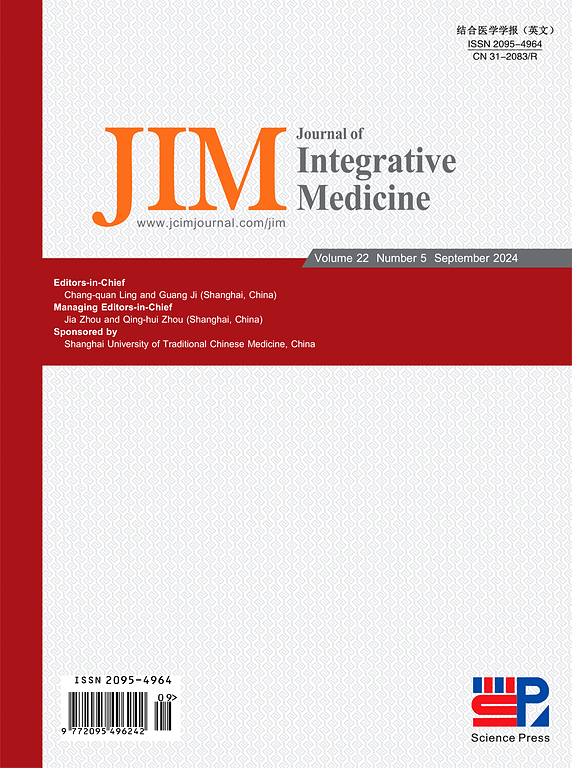
The predecessor of JIM is the Journal of Chinese Integrative Medicine (Zhong Xi Yi Jie He Xue Bao). With this new, English-language publication, we are committed to make JIM an international platform for publishing high-quality papers on complementary and alternative medicine (CAM) and an open forum in which the different professions and international scholarly communities can exchange views, share research and their clinical experience, discuss CAM education, and confer about issues and problems in our various disciplines and in CAM as a whole in order to promote integrative medicine.
JIM is indexed/abstracted in: MEDLINE/PubMed, ScienceDirect, Emerging Sources Citation Index (ESCI), Scopus, Embase, Chemical Abstracts (CA), CAB Abstracts, EBSCO, WPRIM, JST China, Chinese Science Citation Database (CSCD), and China National Knowledge Infrastructure (CNKI).
JIM Editorial Office uses ThomsonReuters ScholarOne Manuscripts as submitting and review system (submission link: http://mc03.manuscriptcentral.com/jcim-en).
JIM is published bimonthly. Manuscripts submitted to JIM should be written in English. Article types include but are not limited to randomized controlled and pragmatic trials, translational and patient-centered effectiveness outcome studies, case series and reports, clinical trial protocols, preclinical and basic science studies, systematic reviews and meta-analyses, papers on methodology and CAM history or education, conference proceedings, editorials, commentaries, short communications, book reviews, and letters to the editor.
Our purpose is to publish a prestigious international journal for studies in integrative medicine. To achieve this aim, we seek to publish high-quality papers on any aspects of integrative medicine, such as acupuncture and traditional Chinese medicine, Ayurveda medicine, herbal medicine, homeopathy, nutrition, chiropractic, mind-body medicine, taichi, qigong, meditation, and any other modalities of CAM; our commitment to international scope ensures that research and progress from all regions of the world are widely covered. These ensure that articles published in JIM have the maximum exposure to the international scholarly community.
JIM can help its authors let their papers reach the widest possible range of readers, and let all those who share an interest in their research field be concerned with their study.

 求助内容:
求助内容: 应助结果提醒方式:

 京公网安备 11010802042870号


