{"title":"Investigation of the Association Between COVID-19 and Hepatitis B Vaccination Among Healthcare Workers: A Cross-Sectional Study in Turkey.","authors":"Seval Müzeyyen Ecin, Abdulsamet Sandal","doi":"10.23749/mdl.2026.17965","DOIUrl":null,"url":null,"abstract":"<p><p> Backgrounds: Vaccination is a cornerstone of public health. While COVID-19 vaccination became globally prioritized during the pandemic, Hepatitis B immunization has remained a mandatory occupational requirement in Turkey, particularly among healthcare workers (HCWs). This study evaluated Hepatitis B immunization and factors associated with COVID-19 vaccination among Turkish HCWs.</p><p><strong>Methods: </strong>A retrospective cross-sectional study was conducted between February 1 and August 15, 2024, at Mersin City Training and Research Hospital. Employees and trainee students who underwent periodic health examinations were included. Participants were grouped as physicians, non-physician HCWs, and non-healthcare professionals. Data included demographics, vaccination history, hematological and biochemical parameters, and clinical characteristics. Logistic regression identified factors associated with COVID-19 vaccination status.</p><p><strong>Results: </strong>Of 4,048 participants, 92.1% received at least one COVID-19 vaccine dose and 90.0% were vaccinated against Hepatitis B. Physicians demonstrated the highest coverage for both vaccines. Male gender (OR=1.37, 95% CI: 1.04-1.80), non-physician HCW status (OR=2.51, 95% CI: 1.33-4.75), non-healthcare professional status (OR=2.99, 95% CI: 1.55-5.77), and behaviorally linked elevated platelet count (OR=1.54, 95% CI: 1.04-2.28) were independently associated with COVID-19 non-vaccination. A prior history of Hepatitis B vaccination showed a strong protective effect against COVID-19 non-vaccination (OR=0.30, 95% CI: 0.23-0.40).</p><p><strong>Conclusions: </strong>Vaccine uptake varied across occupational groups, with physicians achieving the highest rates. Prior compliance with mandatory Hepatitis B vaccination was positively associated with COVID-19 vaccine acceptance, emphasizing the role of previous immunization behavior in new vaccine adoption. Occupational health policies integrating vaccination counseling and follow-up are essential to improve coverage among non-physician HCWs.</p>","PeriodicalId":49833,"journal":{"name":"Medicina Del Lavoro","volume":"117 1","pages":"17965"},"PeriodicalIF":2.1000,"publicationDate":"2026-02-24","publicationTypes":"Journal Article","fieldsOfStudy":null,"isOpenAccess":false,"openAccessPdf":"https://www.ncbi.nlm.nih.gov/pmc/articles/PMC12983182/pdf/","citationCount":"0","resultStr":null,"platform":"Semanticscholar","paperid":null,"PeriodicalName":"Medicina Del Lavoro","FirstCategoryId":"3","ListUrlMain":"https://doi.org/10.23749/mdl.2026.17965","RegionNum":4,"RegionCategory":"医学","ArticlePicture":[],"TitleCN":null,"AbstractTextCN":null,"PMCID":null,"EPubDate":"","PubModel":"","JCR":"Q2","JCRName":"PUBLIC, ENVIRONMENTAL & OCCUPATIONAL HEALTH","Score":null,"Total":0}
引用次数: 0
Abstract
Backgrounds: Vaccination is a cornerstone of public health. While COVID-19 vaccination became globally prioritized during the pandemic, Hepatitis B immunization has remained a mandatory occupational requirement in Turkey, particularly among healthcare workers (HCWs). This study evaluated Hepatitis B immunization and factors associated with COVID-19 vaccination among Turkish HCWs.
Methods: A retrospective cross-sectional study was conducted between February 1 and August 15, 2024, at Mersin City Training and Research Hospital. Employees and trainee students who underwent periodic health examinations were included. Participants were grouped as physicians, non-physician HCWs, and non-healthcare professionals. Data included demographics, vaccination history, hematological and biochemical parameters, and clinical characteristics. Logistic regression identified factors associated with COVID-19 vaccination status.
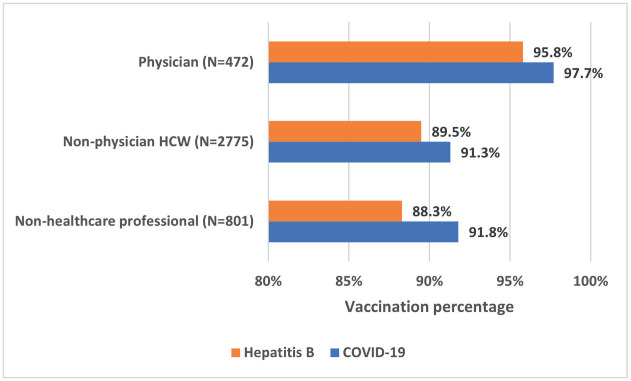
Results: Of 4,048 participants, 92.1% received at least one COVID-19 vaccine dose and 90.0% were vaccinated against Hepatitis B. Physicians demonstrated the highest coverage for both vaccines. Male gender (OR=1.37, 95% CI: 1.04-1.80), non-physician HCW status (OR=2.51, 95% CI: 1.33-4.75), non-healthcare professional status (OR=2.99, 95% CI: 1.55-5.77), and behaviorally linked elevated platelet count (OR=1.54, 95% CI: 1.04-2.28) were independently associated with COVID-19 non-vaccination. A prior history of Hepatitis B vaccination showed a strong protective effect against COVID-19 non-vaccination (OR=0.30, 95% CI: 0.23-0.40).
Conclusions: Vaccine uptake varied across occupational groups, with physicians achieving the highest rates. Prior compliance with mandatory Hepatitis B vaccination was positively associated with COVID-19 vaccine acceptance, emphasizing the role of previous immunization behavior in new vaccine adoption. Occupational health policies integrating vaccination counseling and follow-up are essential to improve coverage among non-physician HCWs.
期刊介绍:
La Medicina del Lavoro is a bimonthly magazine founded in 1901 by L. Devoto, and then directed by L. Prieti, E. Vigliani, V. Foà, P.A. Bertazzi (Milan). Now directed by A. Mutti (Parma), the magazine is the official Journal of the Italian Society of Occupational Medicine (SIML), aimed at training and updating all professionals involved in prevention and cure of occupational diseases.

 求助内容:
求助内容: 应助结果提醒方式:

 京公网安备 11010802042870号


