Jacek Staszewski, Aleksander Dębiec, Katarzyna Gniadek-Olejniczak, Adam Stępień, Renata Piusinska-Macoch, Stefan Strilciuc, David Balo, George Harston, Krzysztof Brzozowski, Piotr Zięcina, Jerzy Narloch, Marek Wierzbicki, Piotr Piasecki
{"title":"Cerebrolysin after Endovascular Thrombectomy in Stroke: 12‑Month Functional Outcomes in a Propensity‑Matched Cohort.","authors":"Jacek Staszewski, Aleksander Dębiec, Katarzyna Gniadek-Olejniczak, Adam Stępień, Renata Piusinska-Macoch, Stefan Strilciuc, David Balo, George Harston, Krzysztof Brzozowski, Piotr Zięcina, Jerzy Narloch, Marek Wierzbicki, Piotr Piasecki","doi":"10.1007/s12975-026-01414-z","DOIUrl":null,"url":null,"abstract":"<p><p>Background Long-term outcomes after endovascular thrombectomy (EVT) and the role of adjunctive neuroprotection to achieve post-stroke independence remain incompletely characterized. In this hypothesis-generating target-trial emulation, we assessed 12-month functional outcomes in a prespecified extension of a propensity score-matched cohort of rigorously selected EVT patients treated with adjunctive Cerebrolysin, a multimodal neuroprotective agent. Methods Consecutive EVT patients were prospectively enrolled and treated with Cerebrolysin 30 mL/day for 21 days starting immediately post-EVT, with a second 21-day course at 69-90 days. Outcomes were compared with historical controls using 1:1 nearest-neighbor propensity score matching on ten prespecified covariates. The primary endpoint was functional independence (modified Rankin Scale [mRS] 0-2) at 12 months. Secondary endpoints included 12-month mRS shift, Barthel Index (BI), and need for institutional care. Multivariable regression models were used to estimate adjusted associations, with prespecified sensitivity analyses including calendar time and key EVT predictors. Results Cerebrolysin use was associated with higher odds of 12-month functional independence after adjustment for potential confounders (aOR 6.10, 95% CI 1.64-22.66; p<0.01) and a favorable shift toward lower disability across the 12-month mRS distribution (common OR for favorable shift 3.57, 95% CI 1.42-8.93; p<0.01). Cumulative 12-month mortality was similar between groups (both 18%). Among survivors, 6% of the Cerebrolysin group versus 19% of controls required institutional care (unadjusted OR 0.26; 95% CI 0.07-0.99; NNT 8). BI scores were higher in the Cerebrolysin group than in controls (median (Q1-Q3) 92 (82-100) vs 83 (73-93); p=0.01). In multivariable models, Cerebrolysin remained associated with 12-month independence alongside complete reperfusion (mTICI 3), lower post-EVT NIHSS, fewer device passes, and absence of symptomatic intracranial hemorrhage. Conclusions In EVT-treated patients selected for a small infarct core, robust collaterals, and high-quality reperfusion, adjunctive Cerebrolysin showed a potential benefit toward better 12-month functional outcomes. These exploratory findings require confirmation in multicenter randomized trials to establish efficacy and refine patient selection.</p>","PeriodicalId":23237,"journal":{"name":"Translational Stroke Research","volume":"17 2","pages":""},"PeriodicalIF":4.2000,"publicationDate":"2026-02-25","publicationTypes":"Journal Article","fieldsOfStudy":null,"isOpenAccess":false,"openAccessPdf":"https://www.ncbi.nlm.nih.gov/pmc/articles/PMC12935719/pdf/","citationCount":"0","resultStr":null,"platform":"Semanticscholar","paperid":null,"PeriodicalName":"Translational Stroke Research","FirstCategoryId":"3","ListUrlMain":"https://doi.org/10.1007/s12975-026-01414-z","RegionNum":2,"RegionCategory":"医学","ArticlePicture":[],"TitleCN":null,"AbstractTextCN":null,"PMCID":null,"EPubDate":"","PubModel":"","JCR":"Q1","JCRName":"CLINICAL NEUROLOGY","Score":null,"Total":0}
引用次数: 0
Abstract
Background Long-term outcomes after endovascular thrombectomy (EVT) and the role of adjunctive neuroprotection to achieve post-stroke independence remain incompletely characterized. In this hypothesis-generating target-trial emulation, we assessed 12-month functional outcomes in a prespecified extension of a propensity score-matched cohort of rigorously selected EVT patients treated with adjunctive Cerebrolysin, a multimodal neuroprotective agent. Methods Consecutive EVT patients were prospectively enrolled and treated with Cerebrolysin 30 mL/day for 21 days starting immediately post-EVT, with a second 21-day course at 69-90 days. Outcomes were compared with historical controls using 1:1 nearest-neighbor propensity score matching on ten prespecified covariates. The primary endpoint was functional independence (modified Rankin Scale [mRS] 0-2) at 12 months. Secondary endpoints included 12-month mRS shift, Barthel Index (BI), and need for institutional care. Multivariable regression models were used to estimate adjusted associations, with prespecified sensitivity analyses including calendar time and key EVT predictors. Results Cerebrolysin use was associated with higher odds of 12-month functional independence after adjustment for potential confounders (aOR 6.10, 95% CI 1.64-22.66; p<0.01) and a favorable shift toward lower disability across the 12-month mRS distribution (common OR for favorable shift 3.57, 95% CI 1.42-8.93; p<0.01). Cumulative 12-month mortality was similar between groups (both 18%). Among survivors, 6% of the Cerebrolysin group versus 19% of controls required institutional care (unadjusted OR 0.26; 95% CI 0.07-0.99; NNT 8). BI scores were higher in the Cerebrolysin group than in controls (median (Q1-Q3) 92 (82-100) vs 83 (73-93); p=0.01). In multivariable models, Cerebrolysin remained associated with 12-month independence alongside complete reperfusion (mTICI 3), lower post-EVT NIHSS, fewer device passes, and absence of symptomatic intracranial hemorrhage. Conclusions In EVT-treated patients selected for a small infarct core, robust collaterals, and high-quality reperfusion, adjunctive Cerebrolysin showed a potential benefit toward better 12-month functional outcomes. These exploratory findings require confirmation in multicenter randomized trials to establish efficacy and refine patient selection.
期刊介绍:
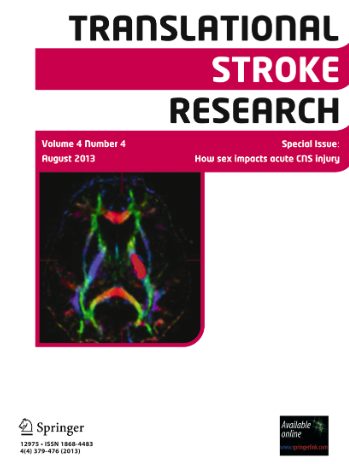
Translational Stroke Research covers basic, translational, and clinical studies. The Journal emphasizes novel approaches to help both to understand clinical phenomenon through basic science tools, and to translate basic science discoveries into the development of new strategies for the prevention, assessment, treatment, and enhancement of central nervous system repair after stroke and other forms of neurotrauma.
Translational Stroke Research focuses on translational research and is relevant to both basic scientists and physicians, including but not restricted to neuroscientists, vascular biologists, neurologists, neuroimagers, and neurosurgeons.

 求助内容:
 应助结果提醒方式:


 京公网安备 11010802042870号


