
Fibrosis activity vs. disease stage: Complementary and independent predictors of outcomes in alcohol-related liver disease
IF 7.5
1区 医学
Q1 GASTROENTEROLOGY & HEPATOLOGY
引用次数: 0
Abstract
Background & Aims
Excessive alcohol consumption accelerates fibrosis progression in steatotic liver disease. Disease activity can be described by fibrogenic activity, of which collagen formation is a central process. Type III collagen formation (PRO-C3) is a biomarker of fibrosis activity. We aimed to evaluate whether PRO-C3 predicts clinical outcomes in alcohol-related liver disease (ALD) independent of fibrosis stage.
Methods
We conducted a prospective cohort study including patients with prior or current excessive alcohol intake (men: ≥36 g/day; women: ≥24 g/day for >1 year) and no prior decompensation. At baseline, liver biopsies, clinical investigations, and non-invasive blood tests were performed. During follow-up, patients’ electronic healthcare records were manually reviewed for decompensation events and all-cause mortality. Decompensation was defined according to Baveno VII recommendations.
Results
We followed 458 patients with ALD (76% male; mean age 57 ± 10 years) for a median of 5.9 years (IQR 4.5–7.8). At baseline, fibrosis stages were F0–1 (n = 260), F2 (n = 107), and F3-4 (n = 91). During follow-up, 67 patients experienced decompensation and 100 died. PRO-C3 provided prognostic value beyond fibrosis stage as a predictor of decompensation, both in patients with no to moderate fibrosis (F0-2; subhazard ratio per unit increase in PRO-C3 1.05; 95% CI 1.03–1.07; p <0.001) and in patients with cirrhosis (F4; subhazard ratio 1.01; 95% CI 1.00–1.03; p = 0.048).
Conclusions
In ALD, prognosis is determined by both baseline fibrosis stage and markers of fibrosis activity. PRO-C3, a biomarker of fibrosis activity, was more strongly associated with the risk of decompensation than Kleiner fibrosis stage and predicted decompensation across fibrosis stages.
Impact and implications
This study shows that fibrosis activity measured by PRO-C3 captures dynamic disease processes in alcohol-related liver disease that are not fully reflected by histological fibrosis stage. These findings are important for clinicians and patients because PRO-C3 independently predicts decompensation and supports stratifying risk by fibrosis activity in addition to stage. Practically, incorporating fibrosis-activity biomarkers could guide earlier monitoring and interventions aimed at modulating fibrogenic activity.
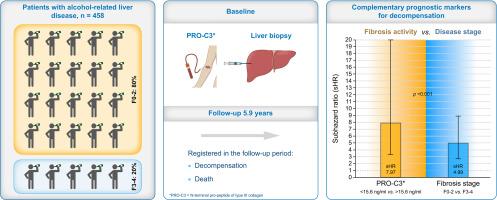
纤维化活动与疾病分期:酒精相关性肝病结局的补充和独立预测因素
背景与目的:过度饮酒加速脂肪变性肝病纤维化进展。疾病活动性可以用纤维原活性来描述,其中胶原形成是中心过程。III型胶原形成(PRO-C3)是纤维化活性的生物标志物。我们的目的是评估PRO-C3是否能独立于纤维化分期预测酒精相关性肝病(ALD)的临床结果。方法:我们进行了一项前瞻性队列研究,纳入了既往或目前过量饮酒的患者(男性:≥36 g/天;女性:≥24 g/天,持续10 ~ 10年),既往无代偿。基线时,进行肝活检、临床检查和非侵入性血液检查。在随访期间,人工检查患者的电子医疗记录,以查找失代偿事件和全因死亡率。失代偿是根据《巴韦诺VII》的建议定义的。结果:我们随访了458例ALD患者(76%为男性,平均年龄57±10岁),中位随访5.9年(IQR 4.5-7.8)。在基线时,纤维化分期为F0-1 (n = 260)、F2 (n = 107)和F3-4 (n = 91)。随访期间,67例患者出现代偿失代偿,100例死亡。在无纤维化至中度纤维化的患者中,PRO-C3作为失代偿的预测因子提供了纤维化期后的预后价值(F0-2; PRO-C3每单位增加的亚危险比1.05;95% CI 1.03-1.07; p = 0.048)。结论:ALD的预后是由基线纤维化分期和纤维化活动标志物决定的。PRO-C3是一种纤维化活性的生物标志物,与Kleiner纤维化阶段相比,它与失代偿风险的相关性更强,并预测了各个纤维化阶段的失代偿。影响和意义:本研究表明,PRO-C3测量的纤维化活性捕获了酒精相关肝病的动态疾病过程,而组织学纤维化阶段不能完全反映这一过程。这些发现对临床医生和患者都很重要,因为PRO-C3独立地预测失代偿,并通过纤维化活动和分期来支持风险分层。实际上,结合纤维化活性生物标志物可以指导旨在调节纤维化活性的早期监测和干预。
本文章由计算机程序翻译,如有差异,请以英文原文为准。
求助全文
约1分钟内获得全文
求助全文
来源期刊
JHEP Reports
GASTROENTEROLOGY & HEPATOLOGY-
CiteScore
12.40
自引率
2.40%
发文量
161
审稿时长
36 days
期刊介绍:
JHEP Reports is an open access journal that is affiliated with the European Association for the Study of the Liver (EASL). It serves as a companion journal to the highly respected Journal of Hepatology.
The primary objective of JHEP Reports is to publish original papers and reviews that contribute to the advancement of knowledge in the field of liver diseases. The journal covers a wide range of topics, including basic, translational, and clinical research. It also focuses on global issues in hepatology, with particular emphasis on areas such as clinical trials, novel diagnostics, precision medicine and therapeutics, cancer research, cellular and molecular studies, artificial intelligence, microbiome research, epidemiology, and cutting-edge technologies.
In summary, JHEP Reports is dedicated to promoting scientific discoveries and innovations in liver diseases through the publication of high-quality research papers and reviews covering various aspects of hepatology.
 求助内容:
求助内容: 应助结果提醒方式:

 京公网安备 11010802042870号


