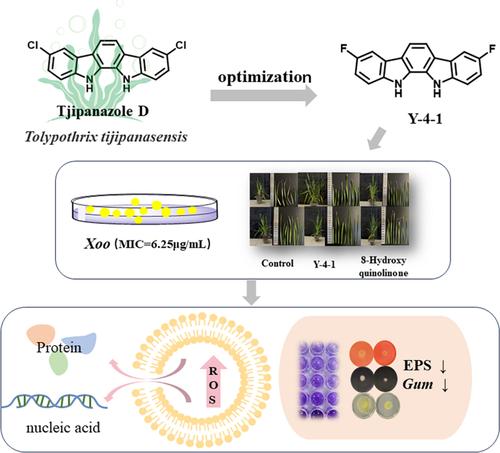
Background: Bacterial leaf blight caused by Xanthomonas oryzae pv. oryzae (Xoo) severely threatens global rice yields. With increasing resistance to conventional antibacterial agents, new antibacterial agents are urgently needed. This study aimed to optimize the cyanobacterial metabolite tjipanazole D to develop a derivative with enhanced antibacterial activity against Xoo and evaluate its mechanism of action.
Results: Derivative Y-4-1 was successfully synthesized using a fluorination substitution strategy. This derivative Y-4-1 exhibited significantly enhanced antibacterial efficacy against Xoo (minimum inhibitory concentration = 6.25 μg/mL, compared with 100 μg/mL for tjipanazole D). Mechanistic studies revealed that Y-4-1 exerted its antibacterial effects by disrupting the cell membrane of Xoo, inhibiting xanthomonadin biosynthesis, and aggravating oxidative damage. Furthermore, biofilm formation was inhibited in a dose-dependent way by reducing the production of Xoo extracellular polymers such as exopolysaccharides and extracellular enzymes and inhibiting Xoo motility, and ultimately resulting in bacterial death. RNA sequencing and Kyoto Encyclopedia of Genes and Genomes pathway enrichment analysis indicated that differentially expressed genes were significantly enriched in key pathways such as plant-pathogen interactions and ribosome biogenesis. Notably, the mechanisms regulating biofilm formation play a crucial role in mediating plant-pathogen interactions.
期刊介绍:
Pest Management Science is the international journal of research and development in crop protection and pest control. Since its launch in 1970, the journal has become the premier forum for papers on the discovery, application, and impact on the environment of products and strategies designed for pest management.
Published for SCI by John Wiley & Sons Ltd.

 求助内容:
求助内容: 应助结果提醒方式:

 京公网安备 11010802042870号


