{"title":"The influence of sliding velocity and temperature on the ductile-to-brittle transition in asperity-level wear: a molecular dynamics study","authors":"S. Z. Wattel, J.-F. Molinari","doi":"10.26599/frict.2025.9441212","DOIUrl":null,"url":null,"abstract":"<p>During sliding contact, asperities may undergo either ductile smoothing or brittle fracture, producing debris. A critical junction scale, d∗, governed by material properties, dictates this transition. Previous studies using Molecu-lar Dynamics (MD) simulations with tunable interatomic potentials revealed this scale under quasi-static conditions—fixed temperature and low sliding velocities. Here, we extend that work to investigate how temperature and sliding velocity influence the ductile-to-brittle transition at the asperity level. Material properties governed by short-range atomic interactions, such as stiff-ness and surface energy, remain relatively constant with temperature. In con-trast, shear strength, influenced by longer-range interactions, decreases with rising temperature, promoting a brittle-to-ductile shift in asperity behavior. Incorporating temperature-dependent shear strength into the d∗ expression successfully predicts the lower bound of the transition. However, capturing the upper bound requires an additional term to account for ductile fracture energy.<br />At higher sliding velocities, a new brittle failure mode emerges: instead of a single crack forming at the asperity base, multiple dynamically propagating cracks develop, resulting in fragmented debris.<br />Finally, long-timescale MD simulations of rough-on-rough contact under adi-abatic conditions reveal how interface heating influences wear during ex-tended sliding. Regardless of velocity, asperities initially fracture and gener-ate debris that aggregates into a single rolling particle. This particle grows steadily until the surrounding material nears its liquefaction temperature, triggering collapse. These simulations reproduce known wear regimes: an early, high-wear running-in phase followed by a steady-state mild wear stage. Notably, tangential work, heat generation, and wear rate depend primarily on total sliding distance rather than velocity.</p>","PeriodicalId":12442,"journal":{"name":"Friction","volume":"5 1","pages":""},"PeriodicalIF":8.1000,"publicationDate":"2026-02-25","publicationTypes":"Journal Article","fieldsOfStudy":null,"isOpenAccess":false,"openAccessPdf":"","citationCount":"0","resultStr":null,"platform":"Semanticscholar","paperid":null,"PeriodicalName":"Friction","FirstCategoryId":"5","ListUrlMain":"https://doi.org/10.26599/frict.2025.9441212","RegionNum":1,"RegionCategory":"工程技术","ArticlePicture":[],"TitleCN":null,"AbstractTextCN":null,"PMCID":null,"EPubDate":"","PubModel":"","JCR":"Q1","JCRName":"ENGINEERING, MECHANICAL","Score":null,"Total":0}
引用次数: 0
Abstract
During sliding contact, asperities may undergo either ductile smoothing or brittle fracture, producing debris. A critical junction scale, d∗, governed by material properties, dictates this transition. Previous studies using Molecu-lar Dynamics (MD) simulations with tunable interatomic potentials revealed this scale under quasi-static conditions—fixed temperature and low sliding velocities. Here, we extend that work to investigate how temperature and sliding velocity influence the ductile-to-brittle transition at the asperity level. Material properties governed by short-range atomic interactions, such as stiff-ness and surface energy, remain relatively constant with temperature. In con-trast, shear strength, influenced by longer-range interactions, decreases with rising temperature, promoting a brittle-to-ductile shift in asperity behavior. Incorporating temperature-dependent shear strength into the d∗ expression successfully predicts the lower bound of the transition. However, capturing the upper bound requires an additional term to account for ductile fracture energy. At higher sliding velocities, a new brittle failure mode emerges: instead of a single crack forming at the asperity base, multiple dynamically propagating cracks develop, resulting in fragmented debris. Finally, long-timescale MD simulations of rough-on-rough contact under adi-abatic conditions reveal how interface heating influences wear during ex-tended sliding. Regardless of velocity, asperities initially fracture and gener-ate debris that aggregates into a single rolling particle. This particle grows steadily until the surrounding material nears its liquefaction temperature, triggering collapse. These simulations reproduce known wear regimes: an early, high-wear running-in phase followed by a steady-state mild wear stage. Notably, tangential work, heat generation, and wear rate depend primarily on total sliding distance rather than velocity.
期刊介绍:
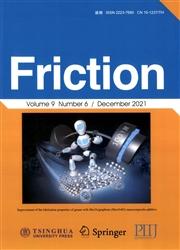
Friction is a peer-reviewed international journal for the publication of theoretical and experimental research works related to the friction, lubrication and wear. Original, high quality research papers and review articles on all aspects of tribology are welcome, including, but are not limited to, a variety of topics, such as:
Friction: Origin of friction, Friction theories, New phenomena of friction, Nano-friction, Ultra-low friction, Molecular friction, Ultra-high friction, Friction at high speed, Friction at high temperature or low temperature, Friction at solid/liquid interfaces, Bio-friction, Adhesion, etc.
Lubrication: Superlubricity, Green lubricants, Nano-lubrication, Boundary lubrication, Thin film lubrication, Elastohydrodynamic lubrication, Mixed lubrication, New lubricants, New additives, Gas lubrication, Solid lubrication, etc.
Wear: Wear materials, Wear mechanism, Wear models, Wear in severe conditions, Wear measurement, Wear monitoring, etc.
Surface Engineering: Surface texturing, Molecular films, Surface coatings, Surface modification, Bionic surfaces, etc.
Basic Sciences: Tribology system, Principles of tribology, Thermodynamics of tribo-systems, Micro-fluidics, Thermal stability of tribo-systems, etc.
Friction is an open access journal. It is published quarterly by Tsinghua University Press and Springer, and sponsored by the State Key Laboratory of Tribology (TsinghuaUniversity) and the Tribology Institute of Chinese Mechanical Engineering Society.

 求助内容:
 应助结果提醒方式:


 京公网安备 11010802042870号


