
Interaction between airway basal cells, mast cells and type 2 immunity contributes to epithelial barrier dysfunction in allergic rhinitis
IF 5.5
2区 医学
Q1 IMMUNOLOGY
引用次数: 0
Abstract
Basal cell dysfunction contributes to the pathophysiology of chronic inflammatory airway disorders and is linked to persistent epithelial barrier defects. Epithelial integrity dysfunction, basal cell hyperplasia and metaplasia have been described in allergic rhinitis (AR). However, it remains unclear how basal cell progenitor functions are regulated and if basal cells contribute to type 2 inflammatory responses. Here, we report on the proinflammatory and sensory role of basal cells in AR. Using primary nasal basal cells from controls and AR patients, we demonstrate that Der p1 induces basal cell cytokine (IL-6) and chemokine (CXCL1, CXCL6, CXCL8, SCF) expression and/or release via PAR2, suggesting a role for basal cells as environmental sensors and inflammatory regulators. Using nasal biopsies, we show that mast cells are attracted to the epithelium in AR, likely via basal cell-derived SCF, and induce basal cell chemokine (CCL26, CXCL1, CXCL6, SCF) release via histamine and tryptase in vitro. Finally, histamine, IL-4 and IL-13 impair primary nasal basal cell proliferation, mobility, barrier formation, and differentiation in in vitro cellular assays, illustrating basal cell dysfunction in AR.
气道基底细胞、肥大细胞和2型免疫的相互作用有助于变应性鼻炎的上皮屏障功能障碍。
基底细胞功能障碍有助于慢性炎性气道疾病的病理生理,并与持续的上皮屏障缺陷有关。上皮完整性障碍,基底细胞增生和化生在变应性鼻炎(AR)中被描述。然而,目前尚不清楚基底细胞祖细胞的功能是如何调节的,以及基底细胞是否参与了2型炎症反应。本文中,我们报道了基底细胞在AR中的促炎和感觉作用。我们使用来自对照组和AR患者的原代鼻基底细胞,证明Der p1通过PAR2诱导基底细胞细胞因子(IL-6)和趋化因子(CXCL1、CXCL6、CXCL8、SCF)的表达和/或释放,表明基底细胞作为环境传感器和炎症调节剂的作用。通过鼻腔活检,我们发现肥大细胞可能通过基底细胞来源的SCF被吸引到AR的上皮上,并在体外通过组胺和胰蛋白酶诱导基底细胞趋化因子(CCL26、CXCL1、CXCL6、SCF)释放。最后,在体外细胞实验中,组胺、IL-4和IL-13损害原发鼻腔基底细胞的增殖、移动性、屏障形成和分化,说明AR中基底细胞功能障碍。
本文章由计算机程序翻译,如有差异,请以英文原文为准。
求助全文
约1分钟内获得全文
求助全文
来源期刊
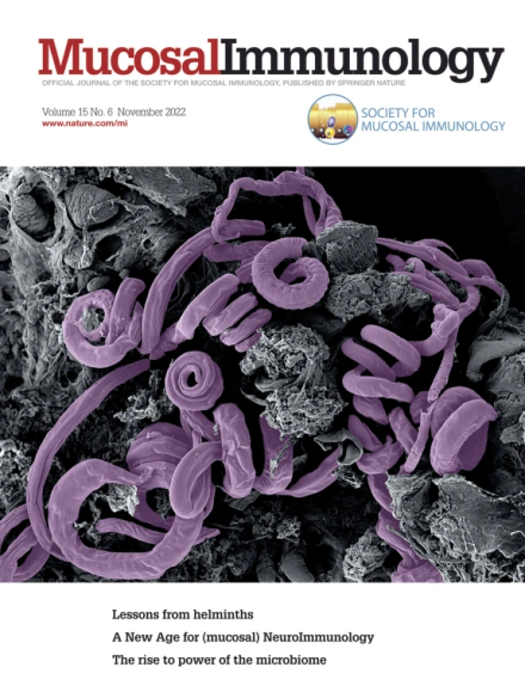
Mucosal Immunology
医学-免疫学
CiteScore
16.60
自引率
3.80%
发文量
100
审稿时长
12 days
期刊介绍:
Mucosal Immunology, the official publication of the Society of Mucosal Immunology (SMI), serves as a forum for both basic and clinical scientists to discuss immunity and inflammation involving mucosal tissues. It covers gastrointestinal, pulmonary, nasopharyngeal, oral, ocular, and genitourinary immunology through original research articles, scholarly reviews, commentaries, editorials, and letters. The journal gives equal consideration to basic, translational, and clinical studies and also serves as a primary communication channel for the SMI governing board and its members, featuring society news, meeting announcements, policy discussions, and job/training opportunities advertisements.
 求助内容:
 应助结果提醒方式:


 京公网安备 11010802042870号


