The cholesterol, high-density lipoprotein, and glucose (CHG) index as a novel metabolic marker for predicting adverse outcomes in myocardial infarction survivors: insights from two large prospective cohorts.
{"title":"The cholesterol, high-density lipoprotein, and glucose (CHG) index as a novel metabolic marker for predicting adverse outcomes in myocardial infarction survivors: insights from two large prospective cohorts.","authors":"Yanjun Song, Xinyue Chen, Zhen'ge Chang, Xiaohui Bian, Jining He, Bowen Li, Zhihao Zheng, Chunyue Wang, Zhangyu Lin, Chen Zhu, Rui Fu, Kefei Dou","doi":"10.1186/s12933-026-03104-4","DOIUrl":null,"url":null,"abstract":"<p><strong>Background: </strong>Post-myocardial infarction (MI) patients remain at high risk of mortality and recurrent cardiovascular events. Metabolic disorders in patients after MI are closely related to high residual cardiovascular risk. The cholesterol, high-density lipoprotein, and glucose (CHG) index, calculated as Ln {[TC (mg/dL) × FBG (mg/dL)]/[2 × HDL-C (mg/dL)]}, is a recently proposed composite metabolic index. This study aimed to investigate the association between the CHG index and adverse outcomes in MI populations.</p><p><strong>Methods: </strong>This study included two cohorts: 16,959 individuals with a history of MI from the UK Biobank and 6,253 post-MI patients with coronary artery disease from Fuwai Hospital. The primary endpoints in the UK Biobank cohort were all-cause mortality and cardiovascular mortality. In the Fuwai Hospital cohort, the primary endpoint was major adverse cardiovascular events (MACE, including all-cause mortality, non-fatal MI, and ischemia-mediated revascularization) and hard endpoint (including cardiovascular mortality and non-fatal MI). Cox proportional hazards models, Kaplan-Meier curves, and restricted cubic splines (RCS) were used to evaluate the associations between the CHG index and the endpoints. Time-dependent receiver operating characteristic (ROC) curves were employed to assess the predictive performance.</p><p><strong>Results: </strong>In the UK Biobank cohort (median follow-up of 13.4 years), after multivariate adjustment, compared to the Q1 of the CHG index, Q4 showed significantly increased risks of all-cause mortality (HR: 1.39, 95% CI: 1.33-1.41) and cardiovascular mortality (HR: 1.42, 95% CI: 1.14-1.74). In the Fuwai Hospital cohort (median follow-up of 3.1 years), the CHG Q4 group also demonstrated a significantly elevated risk of MACE (HR: 1.37, 95% CI: 1.17-1.61) and hard endpoint (HR: 1.87, 95% CI: 1.24-2.81). Kaplan-Meier curves showed significant separation in cumulative event rates across CHG quartiles in both cohorts (log-rank P < 0.05). RCS analyses demonstrated positive linear associations between CHG and all outcomes in both cohorts. Time-dependent ROC curves showed that the CHG index consistently outperformed the TyG index model in predicting adverse outcomes (all FDR-adjusted P < 0.05).</p><p><strong>Conclusions: </strong>In two large independent cohorts of individuals with prior MI, the CHG index was independently associated with risks of adverse events. While its independent discriminative power is modest, the index serves as a valuable adjunctive tool that enhances risk reclassification, warranting further validation in prospective clinical settings to confirm its utility in secondary prevention.</p>","PeriodicalId":9374,"journal":{"name":"Cardiovascular Diabetology","volume":" ","pages":""},"PeriodicalIF":10.6000,"publicationDate":"2026-02-24","publicationTypes":"Journal Article","fieldsOfStudy":null,"isOpenAccess":false,"openAccessPdf":"https://www.ncbi.nlm.nih.gov/pmc/articles/PMC12980928/pdf/","citationCount":"0","resultStr":null,"platform":"Semanticscholar","paperid":null,"PeriodicalName":"Cardiovascular Diabetology","FirstCategoryId":"3","ListUrlMain":"https://doi.org/10.1186/s12933-026-03104-4","RegionNum":1,"RegionCategory":"医学","ArticlePicture":[],"TitleCN":null,"AbstractTextCN":null,"PMCID":null,"EPubDate":"","PubModel":"","JCR":"Q1","JCRName":"CARDIAC & CARDIOVASCULAR SYSTEMS","Score":null,"Total":0}
引用次数: 0
Abstract
Background: Post-myocardial infarction (MI) patients remain at high risk of mortality and recurrent cardiovascular events. Metabolic disorders in patients after MI are closely related to high residual cardiovascular risk. The cholesterol, high-density lipoprotein, and glucose (CHG) index, calculated as Ln {[TC (mg/dL) × FBG (mg/dL)]/[2 × HDL-C (mg/dL)]}, is a recently proposed composite metabolic index. This study aimed to investigate the association between the CHG index and adverse outcomes in MI populations.
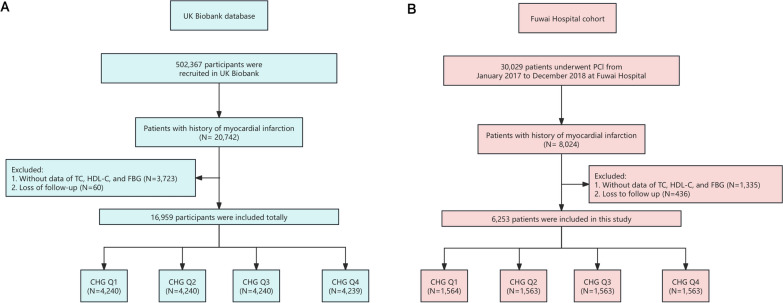
Methods: This study included two cohorts: 16,959 individuals with a history of MI from the UK Biobank and 6,253 post-MI patients with coronary artery disease from Fuwai Hospital. The primary endpoints in the UK Biobank cohort were all-cause mortality and cardiovascular mortality. In the Fuwai Hospital cohort, the primary endpoint was major adverse cardiovascular events (MACE, including all-cause mortality, non-fatal MI, and ischemia-mediated revascularization) and hard endpoint (including cardiovascular mortality and non-fatal MI). Cox proportional hazards models, Kaplan-Meier curves, and restricted cubic splines (RCS) were used to evaluate the associations between the CHG index and the endpoints. Time-dependent receiver operating characteristic (ROC) curves were employed to assess the predictive performance.
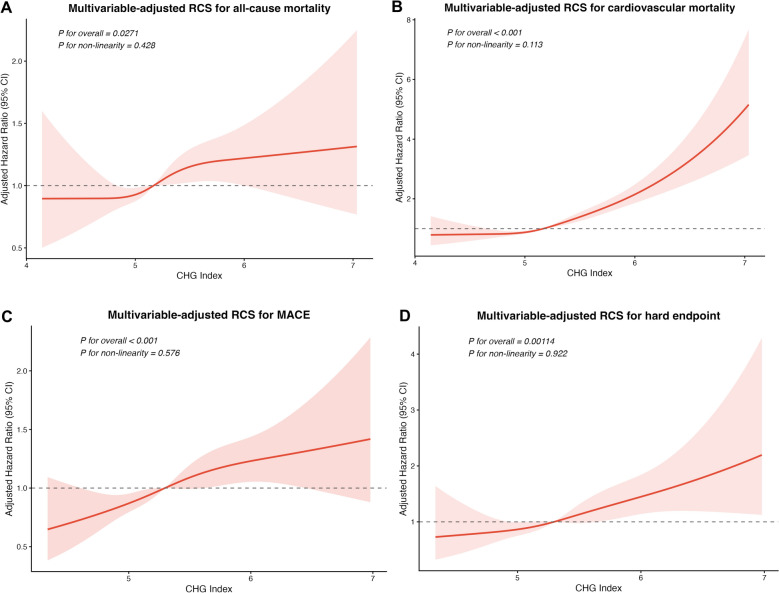
Results: In the UK Biobank cohort (median follow-up of 13.4 years), after multivariate adjustment, compared to the Q1 of the CHG index, Q4 showed significantly increased risks of all-cause mortality (HR: 1.39, 95% CI: 1.33-1.41) and cardiovascular mortality (HR: 1.42, 95% CI: 1.14-1.74). In the Fuwai Hospital cohort (median follow-up of 3.1 years), the CHG Q4 group also demonstrated a significantly elevated risk of MACE (HR: 1.37, 95% CI: 1.17-1.61) and hard endpoint (HR: 1.87, 95% CI: 1.24-2.81). Kaplan-Meier curves showed significant separation in cumulative event rates across CHG quartiles in both cohorts (log-rank P < 0.05). RCS analyses demonstrated positive linear associations between CHG and all outcomes in both cohorts. Time-dependent ROC curves showed that the CHG index consistently outperformed the TyG index model in predicting adverse outcomes (all FDR-adjusted P < 0.05).
Conclusions: In two large independent cohorts of individuals with prior MI, the CHG index was independently associated with risks of adverse events. While its independent discriminative power is modest, the index serves as a valuable adjunctive tool that enhances risk reclassification, warranting further validation in prospective clinical settings to confirm its utility in secondary prevention.
期刊介绍:
Cardiovascular Diabetology is a journal that welcomes manuscripts exploring various aspects of the relationship between diabetes, cardiovascular health, and the metabolic syndrome. We invite submissions related to clinical studies, genetic investigations, experimental research, pharmacological studies, epidemiological analyses, and molecular biology research in this field.


 求助内容:
求助内容: 应助结果提醒方式:

 京公网安备 11010802042870号


