
HydSL hydrogenase of Thiocapsa bogorovii may participate in sulfur respiration
IF 2.7
2区 生物学
Q2 BIOCHEMISTRY & MOLECULAR BIOLOGY
Biochimica et Biophysica Acta-Bioenergetics
Pub Date : 2026-04-01
Epub Date: 2026-02-20
DOI:10.1016/j.bbabio.2026.149585
引用次数: 0
Abstract
According to the modern classification of NiFe hydrogenases, the HydSL hydrogenase of Thiocapsa bogorovii is assigned to subgroup 1e, the so-called isp-type hydrogenases. This subgroup is proposed to unite hydrogenases involved in sulfur respiration; however, direct experimental evidence supporting this function remains limited. In this study, we isolated a protein complex containing the HydSL hydrogenase from T. bogorovii that exhibits high activity in the H₂ + S0 → H₂S reaction. Under native electrophoresis, the complex migrated as a single band, whereas SDS-PAGE resolved it into seven bands, four of which matched the molecular masses of HydS, Isp1, Isp2, and HydL proteins.
Incubation of T. bogorovii cells in a hydrogen atmosphere in darkness and in the presence of elemental sulfur resulted in increased expression of the hydS, hydL, isp1, and isp2 genes encoding the subunits and partner proteins of the complex. The elevated transcript levels correlated with increased cellular activity in the reduction of elemental sulfur to hydrogen sulfide. These observations indicate that the HydSL-containing protein complex may participate in sulfur respiration in T. bogorovii under dark, anaerobic conditions in the absence of oxygen and fermentable substrates. Based on these results and literature data, we propose a putative mechanism for the complex, consistent with its designation as a sulfhydrogenase.
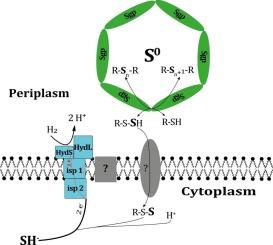
硫化物氢化酶可能参与硫呼吸作用。
根据NiFe氢化酶的现代分类,Thiocapsa bogorovii的HydSL氢化酶被分配到1e亚群,即所谓的isp型氢化酶。这个亚群被提议将参与硫呼吸的氢化酶联合起来;然而,支持这一功能的直接实验证据仍然有限。在这项研究中,我们从T. bogorovii中分离出一种含有HydSL氢化酶的蛋白质复合物,该蛋白复合物在H₂ + S0 → H₂S反应中表现出高活性。在天然电泳下,复合物以单带迁移,而SDS-PAGE将其分解为7个条带,其中4个条带与HydS、Isp1、Isp2和HydL蛋白的分子质量相匹配。将T. bogorovii细胞在黑暗的氢气环境和单质硫的存在下孵育,导致编码该复合物亚基和伴侣蛋白的hydS、hydL、isp1和isp2基因的表达增加。升高的转录物水平与单质硫还原为硫化氢的细胞活性增加相关。这些观察结果表明,在没有氧气和可发酵底物的黑暗厌氧条件下,含hydsl的蛋白质复合物可能参与了T. bogorovii的硫呼吸。基于这些结果和文献数据,我们提出了一个假设的机制,配合物,符合其名称为硫氢化酶。
本文章由计算机程序翻译,如有差异,请以英文原文为准。
求助全文
约1分钟内获得全文
求助全文
来源期刊
Biochimica et Biophysica Acta-Bioenergetics
生物-生化与分子生物学
CiteScore
9.50
自引率
7.00%
发文量
363
审稿时长
92 days
期刊介绍:
BBA Bioenergetics covers the area of biological membranes involved in energy transfer and conversion. In particular, it focuses on the structures obtained by X-ray crystallography and other approaches, and molecular mechanisms of the components of photosynthesis, mitochondrial and bacterial respiration, oxidative phosphorylation, motility and transport. It spans applications of structural biology, molecular modeling, spectroscopy and biophysics in these systems, through bioenergetic aspects of mitochondrial biology including biomedicine aspects of energy metabolism in mitochondrial disorders, neurodegenerative diseases like Parkinson''s and Alzheimer''s, aging, diabetes and even cancer.
 求助内容:
求助内容: 应助结果提醒方式:

 京公网安备 11010802042870号


