
Peri-dyeing: Laser dye fixation for efficient textile colouration and design
IF 10
1区 环境科学与生态学
Q1 ENGINEERING, ENVIRONMENTAL
Journal of Cleaner Production
Pub Date : 2026-03-05
Epub Date: 2026-02-23
DOI:10.1016/j.jclepro.2026.147845
引用次数: 0
Abstract
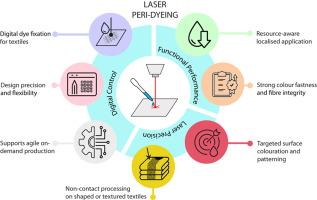
Conventional textile dyeing remains one of the most resource-intensive stages of garment production, characterised by high water and energy use and the generation of chemically contaminated effluent. This study explores an alternative approach to conventional dyeing through the development and evaluation of a laser dyeing process termed peri-dyeing, a digitally driven, non-contact colouration technique in which dye fixation was initiated by targeted laser irradiation directly at the fibre surface.
Optimisation of laser parameters and dye application methods enabled controlled surface colouration of wool fabrics. Colour measurements, SEM imaging, and tensile strength analysis confirmed that high dye fixation efficiencies (82–96%) were achieved without compromising fibre integrity. Standardised testing demonstrated strong wash and rub colour fastness, indicating technical performance compatible with commercial textile applications. Design sampling validated the technique's ability to produce fine linear detail, smooth tonal gradients, and multicolour imagery on both flat and textured substrates.
The peri-dyeing process demonstrates the technical feasibility of a digitally controlled approach to textile colouration that avoids immersion dye baths and enables targeted dye application. The results indicate potential for reduced resource use and increased production flexibility. The paper highlights opportunities for integration into direct-to-garment and on-demand manufacturing contexts, supporting the development of more efficient and adaptable textile colouration workflows.
半染色:激光染色固定,用于有效的纺织品着色和设计
传统的纺织染色仍然是服装生产中资源最密集的阶段之一,其特点是高用水和能源消耗以及产生化学污染的废水。本研究探索了一种替代传统染色的方法,通过开发和评估一种被称为预染色的激光染色工艺,这是一种数字驱动的非接触式染色技术,其中染料固定是由定向激光直接照射在纤维表面开始的。激光参数和染料应用方法的优化使羊毛织物的表面着色可控。颜色测量、扫描电镜成像和拉伸强度分析证实,在不影响纤维完整性的情况下,实现了高染料固定效率(82-96%)。标准化测试表明具有很强的洗涤和摩擦色牢度,表明技术性能与商业纺织品应用相兼容。设计取样验证了该技术在平面和纹理基板上产生精细线性细节、平滑色调梯度和多色图像的能力。预染色工艺证明了数字控制纺织品染色方法的技术可行性,该方法避免了浸没染料浴,并实现了目标染料的应用。结果表明,减少资源使用和提高生产灵活性的潜力。该论文强调了整合到直接到服装和按需制造环境的机会,支持更有效和适应性更强的纺织品着色工作流程的发展。
本文章由计算机程序翻译,如有差异,请以英文原文为准。
求助全文
约1分钟内获得全文
求助全文
来源期刊
Journal of Cleaner Production
环境科学-工程:环境
CiteScore
20.40
自引率
9.00%
发文量
4720
审稿时长
111 days
期刊介绍:
The Journal of Cleaner Production is an international, transdisciplinary journal that addresses and discusses theoretical and practical Cleaner Production, Environmental, and Sustainability issues. It aims to help societies become more sustainable by focusing on the concept of 'Cleaner Production', which aims at preventing waste production and increasing efficiencies in energy, water, resources, and human capital use. The journal serves as a platform for corporations, governments, education institutions, regions, and societies to engage in discussions and research related to Cleaner Production, environmental, and sustainability practices.
 求助内容:
求助内容: 应助结果提醒方式:

 京公网安备 11010802042870号


