Di Wang, Weihua Luo, Liangru Zhou, Gan Xu, XinYang Lv
{"title":"Health investments and well-being of middle-aged and elderly populations: a panel data analysis based on China.","authors":"Di Wang, Weihua Luo, Liangru Zhou, Gan Xu, XinYang Lv","doi":"10.1186/s12963-026-00457-6","DOIUrl":null,"url":null,"abstract":"<p><strong>Background: </strong>As the global population ages and life expectancies rise, improving the health and equity of middle-aged and older individuals has become a universal goal, especially with the economic benefits of the demographic dividend decreasing. Health investments (HI), which are crucial for improving health outcomes (HO) and protecting human capital, play a key role in achieving these objectives. This study aims to examine the impact of HI on the health status of middle-aged and elderly individuals, analyze issues of health equity among this population, and enhance their overall health level while fostering economic growth.</p><p><strong>Methods: </strong>This study, based on Grossman's health demand theory and China Health and Retirement Longitudinal Study (CHARLS) data from 2011 to 2020 (n = 11,138), examines middle-aged and elderly individuals (aged 45 years and above) across 28 Chinese provinces. A panel data model is used to assess HI and HO, with composite indices created using the entropy method. HI includes leisure, healthcare, and living environments, whereas HO covers self-reported short- and long-term health. A high-dimensional fixed-effects model is used to analyze the impact of HI on HO. Health equity is explored using the income Gini coefficient, health investment concentration index (I-CI), and health outcome concentration index (H-CI), with decomposition performed using the Shapley method.</p><p><strong>Results: </strong>HI positively affects HO in middle-aged and elderly individuals in China. The key factors that influence HO are gender, age, household registration (HR), and income. Income inequality is significant, with an average Gini coefficient of 0.492. The I-CI averages 0.081, indicating higher investment concentration among wealthier groups. The major factors that influence the I-CI are household registration (34.9%), income (33.1%), employment (18.8%), and education (11.7%). The H-CI averages 0.033, with better outcomes associated with higher education. The key factors influencing H-CI are age (46.7%), gender (16.7%), income (15.2%), and education (10.7%).</p><p><strong>Conclusion: </strong>HI significantly improves the HO and enhances the health human capital of middle-aged and elderly individuals. However, these investments tend to favor wealthier groups, whereas HO are more favorable among those with higher education. Income and education levels are the key drivers of inequity in both HI and HO.</p>","PeriodicalId":51476,"journal":{"name":"Population Health Metrics","volume":" ","pages":""},"PeriodicalIF":2.5000,"publicationDate":"2026-02-20","publicationTypes":"Journal Article","fieldsOfStudy":null,"isOpenAccess":false,"openAccessPdf":"https://www.ncbi.nlm.nih.gov/pmc/articles/PMC13032411/pdf/","citationCount":"0","resultStr":null,"platform":"Semanticscholar","paperid":null,"PeriodicalName":"Population Health Metrics","FirstCategoryId":"3","ListUrlMain":"https://doi.org/10.1186/s12963-026-00457-6","RegionNum":2,"RegionCategory":"医学","ArticlePicture":[],"TitleCN":null,"AbstractTextCN":null,"PMCID":null,"EPubDate":"","PubModel":"","JCR":"Q2","JCRName":"PUBLIC, ENVIRONMENTAL & OCCUPATIONAL HEALTH","Score":null,"Total":0}
引用次数: 0
Abstract
Background: As the global population ages and life expectancies rise, improving the health and equity of middle-aged and older individuals has become a universal goal, especially with the economic benefits of the demographic dividend decreasing. Health investments (HI), which are crucial for improving health outcomes (HO) and protecting human capital, play a key role in achieving these objectives. This study aims to examine the impact of HI on the health status of middle-aged and elderly individuals, analyze issues of health equity among this population, and enhance their overall health level while fostering economic growth.
Methods: This study, based on Grossman's health demand theory and China Health and Retirement Longitudinal Study (CHARLS) data from 2011 to 2020 (n = 11,138), examines middle-aged and elderly individuals (aged 45 years and above) across 28 Chinese provinces. A panel data model is used to assess HI and HO, with composite indices created using the entropy method. HI includes leisure, healthcare, and living environments, whereas HO covers self-reported short- and long-term health. A high-dimensional fixed-effects model is used to analyze the impact of HI on HO. Health equity is explored using the income Gini coefficient, health investment concentration index (I-CI), and health outcome concentration index (H-CI), with decomposition performed using the Shapley method.
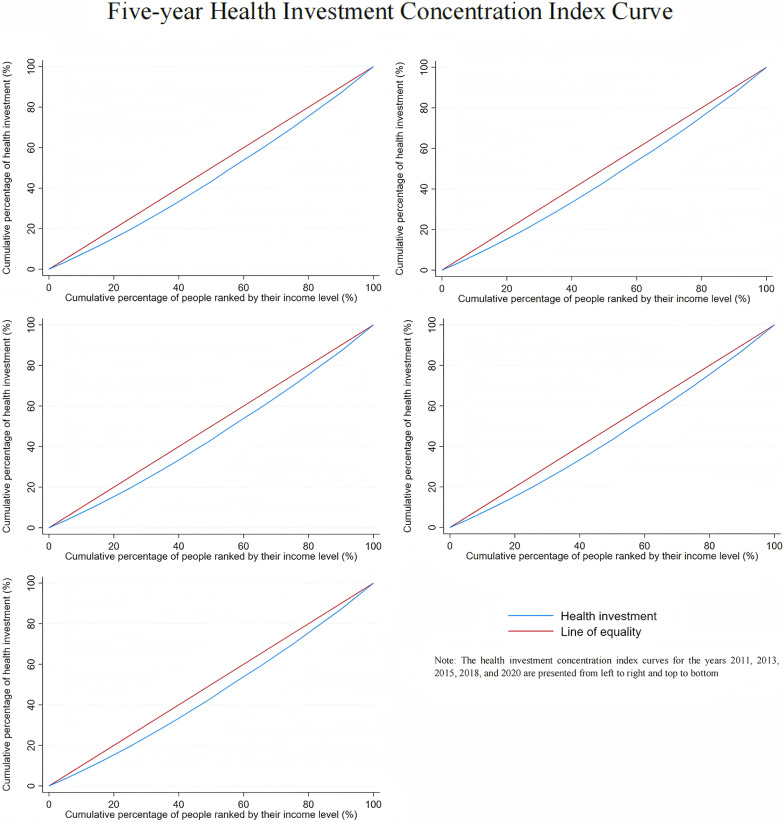
Results: HI positively affects HO in middle-aged and elderly individuals in China. The key factors that influence HO are gender, age, household registration (HR), and income. Income inequality is significant, with an average Gini coefficient of 0.492. The I-CI averages 0.081, indicating higher investment concentration among wealthier groups. The major factors that influence the I-CI are household registration (34.9%), income (33.1%), employment (18.8%), and education (11.7%). The H-CI averages 0.033, with better outcomes associated with higher education. The key factors influencing H-CI are age (46.7%), gender (16.7%), income (15.2%), and education (10.7%).
Conclusion: HI significantly improves the HO and enhances the health human capital of middle-aged and elderly individuals. However, these investments tend to favor wealthier groups, whereas HO are more favorable among those with higher education. Income and education levels are the key drivers of inequity in both HI and HO.
期刊介绍:
Population Health Metrics aims to advance the science of population health assessment, and welcomes papers relating to concepts, methods, ethics, applications, and summary measures of population health. The journal provides a unique platform for population health researchers to share their findings with the global community. We seek research that addresses the communication of population health measures and policy implications to stakeholders; this includes papers related to burden estimation and risk assessment, and research addressing population health across the full range of development. Population Health Metrics covers a broad range of topics encompassing health state measurement and valuation, summary measures of population health, descriptive epidemiology at the population level, burden of disease and injury analysis, disease and risk factor modeling for populations, and comparative assessment of risks to health at the population level. The journal is also interested in how to use and communicate indicators of population health to reduce disease burden, and the approaches for translating from indicators of population health to health-advancing actions. As a cross-cutting topic of importance, we are particularly interested in inequalities in population health and their measurement.


 求助内容:
求助内容: 应助结果提醒方式:

 京公网安备 11010802042870号


