
Thermal sensitivity of metabolic rate in a hemimetabolous insect: variation across life stages
IF 2.9
2区 生物学
Q2 BIOLOGY
Journal of thermal biology
Pub Date : 2026-02-01
Epub Date: 2026-02-13
DOI:10.1016/j.jtherbio.2026.104411
引用次数: 0
Abstract
Environmental temperature strongly influences insect metabolic rate (MR), yet the thermal sensitivity of MR across developmental stages remains understudied in hemimetabolous species. Here we quantified resting metabolic rate (RMR) thermal sensitivity in Rhodnius prolixus, a hemimetabolous insect and an important Chagas disease vector. For that, we measured real-time CO2 production by open flow-respirometry as a proxy for MR at six temperatures (10, 15, 20, 25, 30, and 35 °C) across all life stages. We found a stage-specific thermal sensitivity of the RMR. Instantaneous Q10 estimates revealed ontogenetic variation: early nymphs exhibited higher thermal sensitivity at cooler temperatures and lower sensitivity at warmer temperatures, while adults maintained constant Q10 values across the thermal range. These findings provide novel insights into thermal biology of hemimetabolous insects and show that developmental stage influences metabolic responses to temperature. Understanding these patterns is crucial for predicting how climate warming may affect the physiology, population dynamics and disease transmission potential of this vector species.
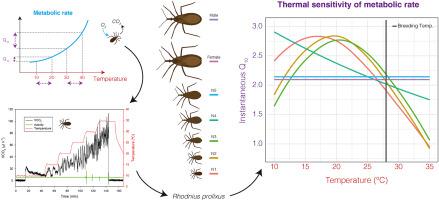
半代谢昆虫代谢率的热敏性:不同生命阶段的变化。
环境温度强烈影响昆虫代谢率(MR),但在半代谢物种中,MR在发育阶段的热敏性仍未得到充分研究。本文对半代谢昆虫、南美锥虫病重要传病媒介长角Rhodnius prolixus的静息代谢率(RMR)热敏感性进行了定量分析。为此,我们通过开放流量呼吸仪测量了所有生命阶段在6个温度(10、15、20、25、30和35°C)下的实时CO2产量,作为MR的代表。我们发现了RMR对特定阶段的热敏度。瞬时Q10估计揭示了个体发生的差异:早期若虫在较冷的温度下表现出较高的热敏性,而在较热的温度下表现出较低的敏感性,而成虫在整个温度范围内保持恒定的Q10值。这些发现为半代谢昆虫的热生物学提供了新的见解,并表明发育阶段影响对温度的代谢反应。了解这些模式对于预测气候变暖如何影响该病媒物种的生理、种群动态和疾病传播潜力至关重要。
本文章由计算机程序翻译,如有差异,请以英文原文为准。
求助全文
约1分钟内获得全文
求助全文
来源期刊
Journal of thermal biology
生物-动物学
CiteScore
5.30
自引率
7.40%
发文量
196
审稿时长
14.5 weeks
期刊介绍:
The Journal of Thermal Biology publishes articles that advance our knowledge on the ways and mechanisms through which temperature affects man and animals. This includes studies of their responses to these effects and on the ecological consequences. Directly relevant to this theme are:
• The mechanisms of thermal limitation, heat and cold injury, and the resistance of organisms to extremes of temperature
• The mechanisms involved in acclimation, acclimatization and evolutionary adaptation to temperature
• Mechanisms underlying the patterns of hibernation, torpor, dormancy, aestivation and diapause
• Effects of temperature on reproduction and development, growth, ageing and life-span
• Studies on modelling heat transfer between organisms and their environment
• The contributions of temperature to effects of climate change on animal species and man
• Studies of conservation biology and physiology related to temperature
• Behavioural and physiological regulation of body temperature including its pathophysiology and fever
• Medical applications of hypo- and hyperthermia
Article types:
• Original articles
• Review articles
 求助内容:
求助内容: 应助结果提醒方式:

 京公网安备 11010802042870号


