
Advances in response mechanisms of fish to ammonia stress: A review
IF 4.3
3区 环境科学与生态学
Q2 BIOCHEMISTRY & MOLECULAR BIOLOGY
Comparative Biochemistry and Physiology C-toxicology & Pharmacology
Pub Date : 2026-06-01
Epub Date: 2026-02-17
DOI:10.1016/j.cbpc.2026.110487
引用次数: 0
Abstract
Ammonia stress has emerged as a critical challenge in global aquaculture, driving extensive research into fish response mechanisms spanning physiological, molecular, and ecological dimensions. This review synthesizes advances in understanding multi-tiered adaptations, including branchial ammonia excretion, urea/glutamine conversion pathways, and microbial symbiosis-mediated detoxification. Key findings highlight species-specific strategies: teleosts prioritize oxidative stress mitigation via Nrf2/glutathione redox regulation, while ureogenic species enhance urea cycle enzyme activities. Microbial communities in aquatic ecosystems further modulate ammonia dynamics through nitrification and denitrification processes. Current mitigation approaches ranging from bioaugmentation and photocatalytic oxidation to dietary antioxidants like probiotics and polyphenols demonstrate efficacy but face limitations in scalability and ecological compatibility. Emerging technologies such as CRISPR-edited ammonia-tolerant strains, real-time water quality monitoring, and circular bioeconomy models (e.g., algal bioconversion of effluents) may represent paradigm-shifting solutions. Future research must integrate multi-omics platforms with ecological modeling to decode evolutionary trade-offs between detoxification energetics and growth performance, ultimately enabling precision aquaculture systems that harmonize productivity with environmental resilience. This comprehensive analysis not only refines theoretical frameworks for ammonia toxicity but also contributes to developing effective strategies for sustainable aquaculture management and addressing the ongoing challenge of ammonia pollution.
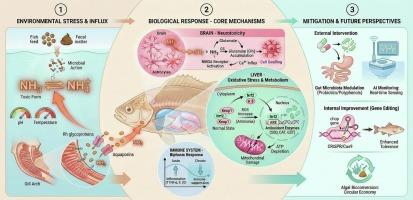
鱼类对氨胁迫的反应机制研究进展
氨胁迫已成为全球水产养殖面临的重大挑战,推动了对鱼类生理、分子和生态等方面反应机制的广泛研究。本文综述了对多层适应的理解进展,包括鳃氨排泄、尿素/谷氨酰胺转化途径和微生物共生介导的解毒。主要发现强调了物种特异性策略:硬骨鱼优先通过Nrf2/谷胱甘肽氧化还原调节来缓解氧化应激,而尿源物种则增强尿素循环酶的活性。水生生态系统中的微生物群落通过硝化和反硝化过程进一步调节氨动力学。目前的缓解方法,从生物增强和光催化氧化到膳食抗氧化剂,如益生菌和多酚,都证明了有效性,但在可扩展性和生态兼容性方面存在局限性。诸如crispr编辑的耐氨菌株、实时水质监测和循环生物经济模型(如废水的藻类生物转化)等新兴技术可能代表着范式转变的解决方案。未来的研究必须将多组学平台与生态模型相结合,以解码解毒能量和生长性能之间的进化权衡,最终实现协调生产力与环境复原力的精准水产养殖系统。这一综合分析不仅完善了氨毒性的理论框架,而且有助于制定有效的可持续水产养殖管理战略和应对氨污染的持续挑战。
本文章由计算机程序翻译,如有差异,请以英文原文为准。
求助全文
约1分钟内获得全文
求助全文
来源期刊
CiteScore
7.50
自引率
5.10%
发文量
206
审稿时长
30 days
期刊介绍:
Part C: Toxicology and Pharmacology. This journal is concerned with chemical and drug action at different levels of organization, biotransformation of xenobiotics, mechanisms of toxicity, including reactive oxygen species and carcinogenesis, endocrine disruptors, natural products chemistry, and signal transduction with a molecular approach to these fields.
 求助内容:
求助内容: 应助结果提醒方式:

 京公网安备 11010802042870号


