
Assessing the ecological risks of ZnO and CuO nanoparticles to black sea picophytoplankton

IF 4.3 3区 环境科学与生态学 Q2 BIOCHEMISTRY & MOLECULAR BIOLOGY
Natalia Shoman , Ekaterina Solomonova , Arkady Akimov
{"title":"Assessing the ecological risks of ZnO and CuO nanoparticles to black sea picophytoplankton","authors":"Natalia Shoman ,&nbsp;Ekaterina Solomonova ,&nbsp;Arkady Akimov","doi":"10.1016/j.cbpc.2026.110490","DOIUrl":null,"url":null,"abstract":"<div><div>The toxic effect of zinc oxide (ZnO NPs) and copper oxide (CuO NPs) nanoparticles on natural communities of Black Sea picophytoplankton was investigated during a year-long cycle of in-situ experiments. The results revealed pronounced seasonal and taxonomic specificity of toxicity. It was established that CuO NPs exert a complex toxic effect on algae, disrupting most key physiological processes in the cells. Pronounced oxidative stress, suppression of pigment synthesis, changes in morphology, dose-dependent inhibition of photosynthetic activity (EC<sub>50</sub> = 18.3 μg L<sup>−1</sup>), and a sharp restructuring of the community in favor of picoeukaryotes (up to 90–98% at 20 μg L<sup>−1</sup>) were observed. In contrast, ZnO NPs acted selectively on the algal community, primarily suppressing the growth of phycoerythrin-containing (PEC) forms of cyanobacteria, while phycocyanin-containing (PCC) forms exhibited resistance. The peak sensitivity of <em>Synechococcus</em> sp. cyanobacteria to CuO NPs was observed in winter-spring (EC50 6–14 μg L<sup>−1</sup>), whereas their resistance to ZnO NPs increased in summer (EC<sub>50</sub> up to 110 μg L<sup>−1</sup>). Picoeukaryotes, on the contrary, demonstrated the highest vulnerability to ZnO NPs during periods of ecological stress (EC<sub>50</sub> 12–15 μg L<sup>−1</sup> in July and December). The nanomaterials also induced a cellular morphological stress response, manifested in a significant increase in <em>Synechococcus</em> sp. cell size (up to 2.5 times at 60 μg L<sup>−1</sup> CuO NPs) and a decrease in pigment indices. The obtained data show that the ecotoxicological assessment of nanomaterials cannot be based on constant values and must necessarily account for seasonal fluctuations in the resilience of aquatic organisms, which are linked to the natural life cycles of planktonic communities and changes in abiotic environmental parameters. The results are of particular relevance due to their direct ecological relevance. The calculated EC<sub>50</sub> threshold concentrations correspond to real levels of metal nanoparticle pollution in coastal waters.</div></div>","PeriodicalId":10602,"journal":{"name":"Comparative Biochemistry and Physiology C-toxicology & Pharmacology","volume":"304 ","pages":"Article 110490"},"PeriodicalIF":4.3000,"publicationDate":"2026-06-01","publicationTypes":"Journal Article","fieldsOfStudy":null,"isOpenAccess":false,"openAccessPdf":"","citationCount":"0","resultStr":null,"platform":"Semanticscholar","paperid":null,"PeriodicalName":"Comparative Biochemistry and Physiology C-toxicology & Pharmacology","FirstCategoryId":"93","ListUrlMain":"https://www.sciencedirect.com/science/article/pii/S1532045626000487","RegionNum":3,"RegionCategory":"环境科学与生态学","ArticlePicture":[],"TitleCN":null,"AbstractTextCN":null,"PMCID":null,"EPubDate":"2026/2/16 0:00:00","PubModel":"Epub","JCR":"Q2","JCRName":"BIOCHEMISTRY & MOLECULAR BIOLOGY","Score":null,"Total":0}
引用次数: 0

Abstract

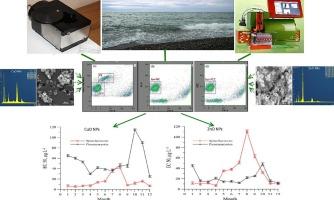
The toxic effect of zinc oxide (ZnO NPs) and copper oxide (CuO NPs) nanoparticles on natural communities of Black Sea picophytoplankton was investigated during a year-long cycle of in-situ experiments. The results revealed pronounced seasonal and taxonomic specificity of toxicity. It was established that CuO NPs exert a complex toxic effect on algae, disrupting most key physiological processes in the cells. Pronounced oxidative stress, suppression of pigment synthesis, changes in morphology, dose-dependent inhibition of photosynthetic activity (EC50 = 18.3 μg L−1), and a sharp restructuring of the community in favor of picoeukaryotes (up to 90–98% at 20 μg L−1) were observed. In contrast, ZnO NPs acted selectively on the algal community, primarily suppressing the growth of phycoerythrin-containing (PEC) forms of cyanobacteria, while phycocyanin-containing (PCC) forms exhibited resistance. The peak sensitivity of Synechococcus sp. cyanobacteria to CuO NPs was observed in winter-spring (EC50 6–14 μg L−1), whereas their resistance to ZnO NPs increased in summer (EC50 up to 110 μg L−1). Picoeukaryotes, on the contrary, demonstrated the highest vulnerability to ZnO NPs during periods of ecological stress (EC50 12–15 μg L−1 in July and December). The nanomaterials also induced a cellular morphological stress response, manifested in a significant increase in Synechococcus sp. cell size (up to 2.5 times at 60 μg L−1 CuO NPs) and a decrease in pigment indices. The obtained data show that the ecotoxicological assessment of nanomaterials cannot be based on constant values and must necessarily account for seasonal fluctuations in the resilience of aquatic organisms, which are linked to the natural life cycles of planktonic communities and changes in abiotic environmental parameters. The results are of particular relevance due to their direct ecological relevance. The calculated EC50 threshold concentrations correspond to real levels of metal nanoparticle pollution in coastal waters.
Abstract Image

氧化锌和氧化铜纳米颗粒对黑海浮游植物的生态风险评价。
通过为期一年的原位实验,研究了氧化锌(ZnO NPs)和氧化铜(CuO NPs)纳米颗粒对黑海浮游植物天然群落的毒性作用。结果显示毒性具有明显的季节性和分类学特异性。已经证实,CuO NPs对藻类具有复杂的毒性作用,破坏了细胞中大多数关键的生理过程。观察到明显的氧化应激,色素合成的抑制,形态的变化,光合活性的剂量依赖性抑制(EC50 = 18.3 μg L-1),以及有利于微真核生物的群落的急剧重组(在20 μg L-1下高达90-98%)。相比之下,ZnO NPs选择性地作用于藻类群落,主要抑制含藻蓝蛋白(PEC)蓝藻的生长,而含藻蓝蛋白(PCC)蓝藻表现出抗性。蓝藻聚球菌对氧化锌NPs的敏感性高峰出现在冬春季(EC50为6 ~ 14 μg L-1),抗性高峰出现在夏季(EC50为110 μg L-1)。相反,微真核生物在生态胁迫期间对ZnO NPs的易损性最高(7月和12月EC50 12-15 μg L-1)。在60 μg L-1 CuO NPs浓度下,聚珠球菌细胞大小增加2.5倍,色素指数下降。所获得的数据表明,纳米材料的生态毒理学评估不能以恒定值为基础,必须考虑到水生生物恢复力的季节性波动,这与浮游生物群落的自然生命周期和非生物环境参数的变化有关。由于其直接的生态相关性,结果具有特别的相关性。计算出的EC50阈值浓度与沿海水域中金属纳米颗粒污染的实际水平相对应。
本文章由计算机程序翻译,如有差异,请以英文原文为准。
求助全文
约1分钟内获得全文 求助全文
来源期刊
CiteScore
7.50
自引率
5.10%
发文量
206
审稿时长
30 days
期刊介绍: Part C: Toxicology and Pharmacology. This journal is concerned with chemical and drug action at different levels of organization, biotransformation of xenobiotics, mechanisms of toxicity, including reactive oxygen species and carcinogenesis, endocrine disruptors, natural products chemistry, and signal transduction with a molecular approach to these fields.

×
引用
GB/T 7714-2015
复制
MLA
复制
APA
复制
导出至
BibTeX EndNote RefMan NoteFirst NoteExpress
×
提示
您的信息不完整,为了账户安全,请先补充。
现在去补充
×
提示
您因"违规操作"
具体请查看互助需知
我知道了
×
提示
确定
请完成安全验证×
copy
已复制链接
快去分享给好友吧!
我知道了
右上角分享
点击右上角分享
0
联系我们:info@booksci.cn Book学术提供免费学术资源搜索服务,方便国内外学者检索中英文文献。致力于提供最便捷和优质的服务体验。 Copyright © 2023 布克学术 All rights reserved.
京ICP备2023020795号-1
ghs 京公网安备 11010802042870号
Book学术文献互助
Book学术文献互助群
群 号:604180095
Book学术官方微信
小红书


