
Effects of hibernation temperature and duration on oxidative status in the common wall lizard (Podarcis muralis)
IF 2.9
2区 生物学
Q2 BIOLOGY
Journal of thermal biology
Pub Date : 2026-02-01
Epub Date: 2026-02-12
DOI:10.1016/j.jtherbio.2026.104416
引用次数: 0
Abstract
Global warming is expected to alter phenology in temperate ectotherms by advancing spring arousal and delaying autumn entry into hibernation. However, the physiological consequences of such shifts remain poorly understood in reptiles, particularly with respect to oxidative balance. We investigated the effects of hibernation temperature and duration on oxidative status in the common wall lizard (Podarcis muralis). Oxidative markers were measured in the liver and tail during the pre-hibernation period and after exposure to laboratory-simulated winter regimes differing in temperature (∼2.5 °C vs. 5.5 °C) and duration (three vs. four months), representing short-cold, short-mild, long-cold, and long-mild winter scenarios. Hibernation duration exerted generally inconsistent effects on antioxidant defenses, with changes detected in liver superoxide dismutase, catalase, and glutathione, as well as in tail superoxide dismutase and glutathione. Temperature effects were modest, manifesting as upward trends in liver glutathione content and tail catalase activity, without significant interactions with hibernation duration. Cold-winter regimes were associated with increased lipid oxidative damage in the liver, although this response was not consistent across all treatments. Importantly, most oxidative parameters remained comparable to pre-hibernation values, with a significant reduction in glutathione levels observed only under short-cold conditions. Overall, the maintenance of redox homeostasis across contrasting thermal and temporal winter regimes indicates substantial physiological plasticity and resilience of P. muralis to altered thermal environments during hibernation, highlighting the capacity of reptiles to buffer oxidative challenges imposed by climate-driven changes in winter conditions.
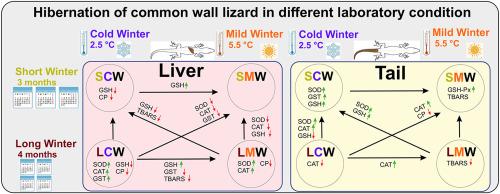
冬眠温度和持续时间对壁虎氧化状态的影响。
预计全球变暖将通过提前春季觉醒和推迟秋季进入冬眠来改变温带变温动物的物候。然而,这种转变的生理后果在爬行动物中仍然知之甚少,特别是在氧化平衡方面。研究了冬眠温度和冬眠时间对普通壁虎氧化状态的影响。在冬眠前和暴露于不同温度(~ 2.5°C vs. 5.5°C)和持续时间(3个月vs. 4个月)的实验室模拟冬季环境后,研究人员测量了肝脏和尾巴中的氧化标志物,分别代表了短冷、短温和、长冷和长温和的冬季情景。冬眠时间对抗氧化防御的影响普遍不一致,肝脏超氧化物歧化酶、过氧化氢酶和谷胱甘肽,以及尾部超氧化物歧化酶和谷胱甘肽的变化。温度影响不大,表现为肝脏谷胱甘肽含量和尾部过氧化氢酶活性呈上升趋势,与冬眠时间无显著相互作用。低温冬季治疗与肝脏脂质氧化损伤增加有关,尽管这种反应在所有治疗中并不一致。重要的是,大多数氧化参数保持与冬眠前的值相当,仅在短冷条件下观察到谷胱甘肽水平显著降低。总的来说,在不同的温度和时间的冬季制度下,氧化还原稳态的维持表明,在冬眠期间,壁虎对改变的热环境具有实质性的生理可塑性和恢复力,突出了爬行动物缓冲冬季气候驱动变化所带来的氧化挑战的能力。
本文章由计算机程序翻译,如有差异,请以英文原文为准。
求助全文
约1分钟内获得全文
求助全文
来源期刊
Journal of thermal biology
生物-动物学
CiteScore
5.30
自引率
7.40%
发文量
196
审稿时长
14.5 weeks
期刊介绍:
The Journal of Thermal Biology publishes articles that advance our knowledge on the ways and mechanisms through which temperature affects man and animals. This includes studies of their responses to these effects and on the ecological consequences. Directly relevant to this theme are:
• The mechanisms of thermal limitation, heat and cold injury, and the resistance of organisms to extremes of temperature
• The mechanisms involved in acclimation, acclimatization and evolutionary adaptation to temperature
• Mechanisms underlying the patterns of hibernation, torpor, dormancy, aestivation and diapause
• Effects of temperature on reproduction and development, growth, ageing and life-span
• Studies on modelling heat transfer between organisms and their environment
• The contributions of temperature to effects of climate change on animal species and man
• Studies of conservation biology and physiology related to temperature
• Behavioural and physiological regulation of body temperature including its pathophysiology and fever
• Medical applications of hypo- and hyperthermia
Article types:
• Original articles
• Review articles
 求助内容:
求助内容: 应助结果提醒方式:

 京公网安备 11010802042870号


