
Machine learning assisted multiphysics simulation for electroplating copper in high aspect ratio through silicon via

IF 5.6 3区 材料科学 Q1 ELECTROCHEMISTRY
Electrochimica Acta Pub Date : 2026-05-01 Epub Date: 2026-02-16 DOI:10.1016/j.electacta.2026.148450
Xiaoyue Ding , Wei Li , Yang Xi , Hanwen Cui , Zhaotian Li , Huai Zheng , Yingxia Liu , Xi Tang , Xinlu Teng , Yikang Zhou , Yuzheng Guo , Sheng Liu , Zhaofu Zhang
{"title":"Machine learning assisted multiphysics simulation for electroplating copper in high aspect ratio through silicon via","authors":"Xiaoyue Ding ,&nbsp;Wei Li ,&nbsp;Yang Xi ,&nbsp;Hanwen Cui ,&nbsp;Zhaotian Li ,&nbsp;Huai Zheng ,&nbsp;Yingxia Liu ,&nbsp;Xi Tang ,&nbsp;Xinlu Teng ,&nbsp;Yikang Zhou ,&nbsp;Yuzheng Guo ,&nbsp;Sheng Liu ,&nbsp;Zhaofu Zhang","doi":"10.1016/j.electacta.2026.148450","DOIUrl":null,"url":null,"abstract":"<div><div>During the electroplating copper process of through silicon via (TSV), the process induced defects such as voids and seams, which originate from the inappropriate process parameters, critically compromise the structural integrity and long-term reliability of integrated chips. To solve the present challenges, this study integrates the multiphysics finite element simulation method with the machine learning technology to systematically elucidate the regulatory mechanisms of electroplating additives during the filling process. The results indicate that appropriately increasing the concentration of the suppressor can achieve defect-free filling. In further research, to overcome the limitations of experiment and simulation approaches in terms of material consumption and computational demand, this study employed the data-driven machine learning model for rapid and accurate evaluation of electroplating filling quality, achieving a prediction accuracy of up to 98%. This study provides theoretical support for understanding the defect-free electroplating filling mechanisms of high aspect ratio TSV and its intelligent optimization, offering the valuable reference for the three-dimensional (3D) advanced packaging technologies.</div></div>","PeriodicalId":305,"journal":{"name":"Electrochimica Acta","volume":"557 ","pages":"Article 148450"},"PeriodicalIF":5.6000,"publicationDate":"2026-05-01","publicationTypes":"Journal Article","fieldsOfStudy":null,"isOpenAccess":false,"openAccessPdf":"","citationCount":"0","resultStr":null,"platform":"Semanticscholar","paperid":null,"PeriodicalName":"Electrochimica Acta","FirstCategoryId":"88","ListUrlMain":"https://www.sciencedirect.com/science/article/pii/S0013468626003439","RegionNum":3,"RegionCategory":"材料科学","ArticlePicture":[],"TitleCN":null,"AbstractTextCN":null,"PMCID":null,"EPubDate":"2026/2/16 0:00:00","PubModel":"Epub","JCR":"Q1","JCRName":"ELECTROCHEMISTRY","Score":null,"Total":0}
引用次数: 0

Abstract

During the electroplating copper process of through silicon via (TSV), the process induced defects such as voids and seams, which originate from the inappropriate process parameters, critically compromise the structural integrity and long-term reliability of integrated chips. To solve the present challenges, this study integrates the multiphysics finite element simulation method with the machine learning technology to systematically elucidate the regulatory mechanisms of electroplating additives during the filling process. The results indicate that appropriately increasing the concentration of the suppressor can achieve defect-free filling. In further research, to overcome the limitations of experiment and simulation approaches in terms of material consumption and computational demand, this study employed the data-driven machine learning model for rapid and accurate evaluation of electroplating filling quality, achieving a prediction accuracy of up to 98%. This study provides theoretical support for understanding the defect-free electroplating filling mechanisms of high aspect ratio TSV and its intelligent optimization, offering the valuable reference for the three-dimensional (3D) advanced packaging technologies.
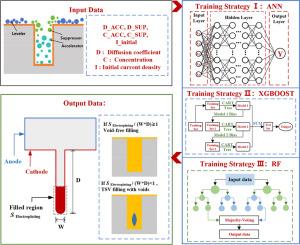
Abstract Image

机器学习辅助下高纵横比硅孔电镀铜的多物理场模拟
在TSV镀铜工艺中,由于工艺参数的不合理而产生的孔洞和接缝等缺陷严重影响了集成芯片的结构完整性和长期可靠性。针对这一挑战,本研究将多物理场有限元模拟方法与机器学习技术相结合,系统阐明电镀添加剂在填充过程中的调控机制。结果表明,适当提高抑制因子的浓度可以实现无缺陷填充。在进一步的研究中,为了克服实验和模拟方法在材料消耗和计算需求方面的局限性,本研究采用数据驱动的机器学习模型对电镀填充质量进行快速准确的评估,预测准确率高达98%。本研究为了解高纵横比TSV无缺陷电镀填充机理及其智能优化提供了理论支持,为三维先进封装技术提供了有价值的参考。
本文章由计算机程序翻译,如有差异,请以英文原文为准。
求助全文
约1分钟内获得全文 求助全文
来源期刊
Electrochimica Acta
Electrochimica Acta 工程技术-电化学
CiteScore
11.30
自引率
6.10%
发文量
1634
审稿时长
41 days
期刊介绍: Electrochimica Acta is an international journal. It is intended for the publication of both original work and reviews in the field of electrochemistry. Electrochemistry should be interpreted to mean any of the research fields covered by the Divisions of the International Society of Electrochemistry listed below, as well as emerging scientific domains covered by ISE New Topics Committee.

×
引用
GB/T 7714-2015
复制
MLA
复制
APA
复制
导出至
BibTeX EndNote RefMan NoteFirst NoteExpress
×
提示
您的信息不完整,为了账户安全,请先补充。
现在去补充
×
提示
您因"违规操作"
具体请查看互助需知
我知道了
×
提示
确定
请完成安全验证×
copy
已复制链接
快去分享给好友吧!
我知道了
右上角分享
点击右上角分享
0
联系我们:info@booksci.cn Book学术提供免费学术资源搜索服务,方便国内外学者检索中英文文献。致力于提供最便捷和优质的服务体验。 Copyright © 2023 布克学术 All rights reserved.
京ICP备2023020795号-1
ghs 京公网安备 11010802042870号
Book学术文献互助
Book学术文献互助群
群 号:604180095
Book学术官方微信
小红书


