
Nb⁵⁺ concentration-gradient driven lattice and charge coupling for structural and interfacial stability in cobalt-free high-nickel cathodes
IF 20.2
1区 材料科学
Q1 CHEMISTRY, PHYSICAL
引用次数: 0
Abstract
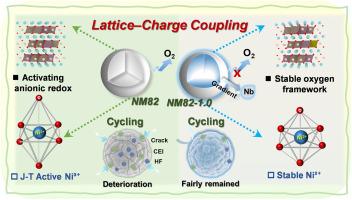
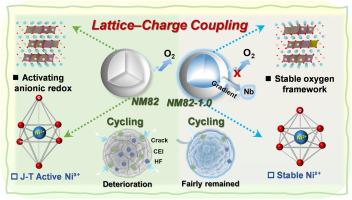
Nickel-rich layered oxides are key cathodes for high-energy-density lithium-ion batteries, but cobalt removal exacerbates lattice and interfacial degradation, especially under high-voltage operation. This study introduces a Nb⁵⁺ concentration-gradient doping strategy based on a “lattice-charge” coupling concept to achieve multiscale stabilization of cobalt-free LiNi₀.₈Mn₀.₂O₂ (NM82). A decreasing Nb gradient from surface to bulk forms a “surface-reinforced, bulk-stabilized” structure. The Nb-rich surface preferentially occupies Ni sites, forming a robust Nb-O covalent network that strengthens transition metal-oxygen bonding, suppresses oxygen release, and mitigates interfacial side reactions. Concurrently, the Nb-lean bulk maintains efficient Li⁺ transport and electronic conductivity. High-valence Nb⁵⁺ also modulates Ni valence via charge compensation, reducing Ni³⁺ content to suppress Jahn-Teller distortion and stabilize the NiO₆ octahedral framework. This enhances reversibility of the H2→H3 phase transition. Electrochemical and structural analyses, supported by first-principles calculations, confirm a “lattice reinforcement–charge regulation” mechanism that strengthens the oxygen framework and improves thermal and cycling stability. The optimized NM82-1.0 cathode retains 95.4% capacity after 100 cycles at 4.3 V and 89.2% at 4.5 V, shows a >25 °C increase in exothermic peak temperature, and reduces precursor costs by over 13% versus commercial NCM. This work highlights the critical role of high-valence gradient doping in lattice–charge co-stabilization and provides a viable route for developing robust, cobalt-free nickel-rich cathodes.
Nb +浓度梯度驱动的晶格和电荷耦合用于无钴高镍阴极的结构和界面稳定性
富镍层状氧化物是高能量密度锂离子电池的关键阴极,但去除钴会加剧晶格和界面的退化,特别是在高压操作下。本研究引入了一种基于“晶格-电荷”耦合概念的Nb 5 +浓度梯度掺杂策略,以实现无钴LiNi 0 .₈Mn 0的多尺度稳定。₂O₂(NM82)。从表面到体块的递减Nb梯度形成了“表面增强、体块稳定”的结构。富铌表面优先占据Ni位点,形成强大的Nb-O共价网络,加强过渡金属-氧键,抑制氧释放,减轻界面副反应。同时,铌-贫体保持了Li⁺高效的传输和电子导电性。高价Nb 5 +还通过电荷补偿调节Ni价,降低Ni +含量,抑制Jahn-Teller畸变,稳定NiO₆八面体框架。这增强了H2→H3相变的可逆性。在第一性原理计算的支持下,电化学和结构分析证实了一种“晶格增强-电荷调节”机制,该机制可以增强氧框架,提高热稳定性和循环稳定性。优化后的NM82-1.0阴极在4.3 V和4.5 V下循环100次后容量分别保持95.4%和89.2%,放热峰值温度提高了>;25 °C,与商用NCM相比,前驱体成本降低了13%以上。这项工作强调了高价梯度掺杂在晶格电荷共稳定中的关键作用,并为开发坚固的无钴富镍阴极提供了一条可行的途径。
本文章由计算机程序翻译,如有差异,请以英文原文为准。
求助全文
约1分钟内获得全文
求助全文
来源期刊
Energy Storage Materials
Materials Science-General Materials Science
CiteScore
33.00
自引率
5.90%
发文量
652
审稿时长
27 days
期刊介绍:
Energy Storage Materials is a global interdisciplinary journal dedicated to sharing scientific and technological advancements in materials and devices for advanced energy storage and related energy conversion, such as in metal-O2 batteries. The journal features comprehensive research articles, including full papers and short communications, as well as authoritative feature articles and reviews by leading experts in the field.
Energy Storage Materials covers a wide range of topics, including the synthesis, fabrication, structure, properties, performance, and technological applications of energy storage materials. Additionally, the journal explores strategies, policies, and developments in the field of energy storage materials and devices for sustainable energy.
Published papers are selected based on their scientific and technological significance, their ability to provide valuable new knowledge, and their relevance to the international research community.
 求助内容:
求助内容: 应助结果提醒方式:

 京公网安备 11010802042870号


