Comparison of the Effectiveness of Grape Seed Extract and Low-Level Laser Therapy in the Management of Dentin Hypersensitivity: A Randomized Controlled Trial.
Tun Yi Darren Ong, Wei Nee Lim, Li Jia Ong, Ju Wen Lim, Gursimrendeep Kaur, Anchu Rachel Thomas, Venkata Bharatwaj Narasu
{"title":"Comparison of the Effectiveness of Grape Seed Extract and Low-Level Laser Therapy in the Management of Dentin Hypersensitivity: A Randomized Controlled Trial.","authors":"Tun Yi Darren Ong, Wei Nee Lim, Li Jia Ong, Ju Wen Lim, Gursimrendeep Kaur, Anchu Rachel Thomas, Venkata Bharatwaj Narasu","doi":"10.1155/sci5/6656174","DOIUrl":null,"url":null,"abstract":"<p><strong>Objective: </strong>To evaluate the effectiveness of grape seed extract (GSE) and its combination with low-level laser therapy (LLLT) in alleviating pain from dentin hypersensitivity (DH) compared to LLLT alone.</p><p><strong>Methods: </strong>Patients aged 20-50 years with at least three sensitive teeth in different quadrants and baseline pain scores ≥ 2 on the visual analog scale (VAS) were recruited. Each tooth was randomly allocated to one of three groups: LLLT + placebo, GSE + placebo, or GSE + LLLT. Pain scores were recorded on Days 1, 3, and 7 using cold and air spray tests.</p><p><strong>Results: </strong>The GSE + LLLT group demonstrated the greatest reduction in pain sensitivity, showing a 72.8% decrease for air spray and 59.51% for the cold test at Day 3, compared to the LLLT or GSE groups alone. However, there were no statistically significant differences (<i>P</i> > 0.05) in pain score reduction among the groups at any time point.</p><p><strong>Discussion: </strong>The combination of GSE and LLLT may enhance early pain reduction in DH compared to individual treatments, but the improvement was not statistically significant. GSE presents a potentially feasible and patient-friendly alternative for DH management, warranting further clinical validation.</p><p><strong>Statistical analysis used: </strong>Data were collected and analyzed using IBM Statistical Package for the Social Sciences (SPSS) software program, Version 20.0 (IBM, Chicago, Illinois). General linear model-repeated measure ANOVA was carried out to assess the reduction in DH pain score among individual interventions and the comparison between the three interventions. The significance level was set at <i>p</i> < 0.05.</p><p><strong>Conclusion: </strong>While GSE combined with LLLT showed the greatest numerical reduction in DH pain scores, the difference was not statistically significant. Further large-scale studies are recommended to confirm the clinical benefits of this combination.</p><p><strong>Trial registration: </strong>ClinicalTrials.gov identifier: NCT05927831.</p>","PeriodicalId":21726,"journal":{"name":"Scientifica","volume":"2026 ","pages":"6656174"},"PeriodicalIF":2.3000,"publicationDate":"2026-02-12","publicationTypes":"Journal Article","fieldsOfStudy":null,"isOpenAccess":false,"openAccessPdf":"https://www.ncbi.nlm.nih.gov/pmc/articles/PMC12901653/pdf/","citationCount":"0","resultStr":null,"platform":"Semanticscholar","paperid":null,"PeriodicalName":"Scientifica","FirstCategoryId":"1085","ListUrlMain":"https://doi.org/10.1155/sci5/6656174","RegionNum":0,"RegionCategory":null,"ArticlePicture":[],"TitleCN":null,"AbstractTextCN":null,"PMCID":null,"EPubDate":"2026/1/1 0:00:00","PubModel":"eCollection","JCR":"Q2","JCRName":"BIOLOGY","Score":null,"Total":0}
引用次数: 0
Abstract
Objective: To evaluate the effectiveness of grape seed extract (GSE) and its combination with low-level laser therapy (LLLT) in alleviating pain from dentin hypersensitivity (DH) compared to LLLT alone.
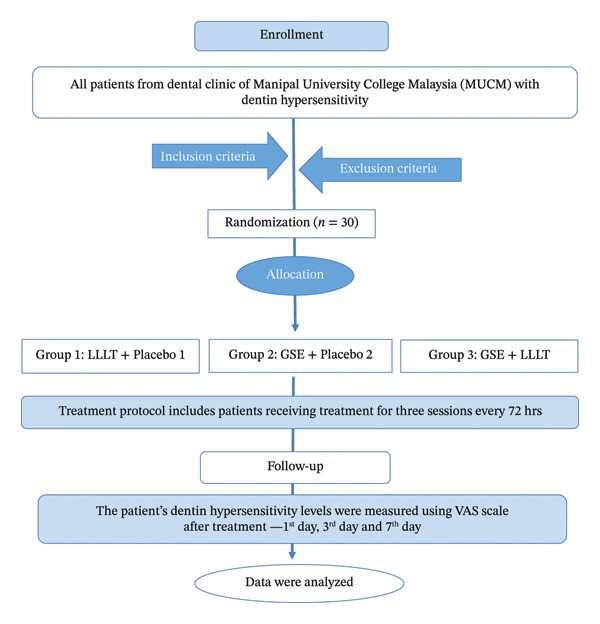
Methods: Patients aged 20-50 years with at least three sensitive teeth in different quadrants and baseline pain scores ≥ 2 on the visual analog scale (VAS) were recruited. Each tooth was randomly allocated to one of three groups: LLLT + placebo, GSE + placebo, or GSE + LLLT. Pain scores were recorded on Days 1, 3, and 7 using cold and air spray tests.
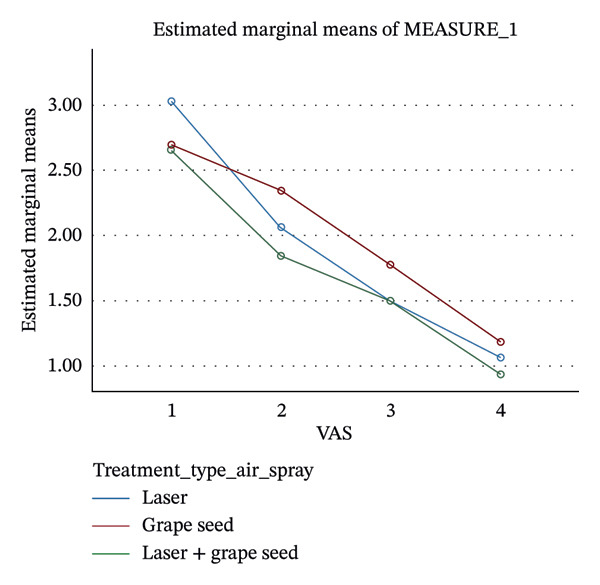
Results: The GSE + LLLT group demonstrated the greatest reduction in pain sensitivity, showing a 72.8% decrease for air spray and 59.51% for the cold test at Day 3, compared to the LLLT or GSE groups alone. However, there were no statistically significant differences (P > 0.05) in pain score reduction among the groups at any time point.
Discussion: The combination of GSE and LLLT may enhance early pain reduction in DH compared to individual treatments, but the improvement was not statistically significant. GSE presents a potentially feasible and patient-friendly alternative for DH management, warranting further clinical validation.
Statistical analysis used: Data were collected and analyzed using IBM Statistical Package for the Social Sciences (SPSS) software program, Version 20.0 (IBM, Chicago, Illinois). General linear model-repeated measure ANOVA was carried out to assess the reduction in DH pain score among individual interventions and the comparison between the three interventions. The significance level was set at p < 0.05.
Conclusion: While GSE combined with LLLT showed the greatest numerical reduction in DH pain scores, the difference was not statistically significant. Further large-scale studies are recommended to confirm the clinical benefits of this combination.
期刊介绍:
Scientifica is a peer-reviewed, Open Access journal that publishes research articles, review articles, and clinical studies covering a wide range of subjects in the life sciences, environmental sciences, health sciences, and medicine. The journal is divided into the 65 subject areas.



 求助内容:
求助内容: 应助结果提醒方式:

 京公网安备 11010802042870号


