{"title":"The Influence of Circadian Onset Time on Admission Severity in Acute Ischemic Stroke: A Retrospective Cohort Study.","authors":"Shaoling Li, Shiyu Hu, Yuqi Liao, Manjuan Yao, Lijie Ren","doi":"10.1177/11795735261421368","DOIUrl":null,"url":null,"abstract":"<p><strong>Background: </strong>Stroke onset demonstrates a circadian pattern, but the relationship between onset time and stroke severity at admission remains insufficiently understood.</p><p><strong>Objectives: </strong>This study aimed to examine the association between time of stroke onset and admission severity in patients with acute ischemic stroke (AIS), and to determine whether this association varies across clinical subgroups.</p><p><strong>Design: </strong>A retrospective observational study.</p><p><strong>Methods: </strong>We conducted a multicenter retrospective cohort study including 14,048 patients diagnosed with AIS and admitted to 36 hospitals in Shenzhen, China, between January 1, 2022, and May 31, 2024. Stroke onset time was classified into 4 periods: Morning (05:00-10:59), Afternoon (11:00-16:59), Evening (17:00-22:59), and Night (23:00-04:59). The primary outcome was neurological severity at admission, measured by the NIHSS score. Associations between onset time and outcomes were evaluated using multivariable ordinal logistic and linear regression models, adjusted for demographic and clinical covariates. Subgroup analyses and sensitivity analyses using multiple imputation were also conducted.</p><p><strong>Results: </strong>Stroke onset in the Morning was associated with lower NIHSS scores (adjusted odds ratio [aOR] = 0.88; 95% confidence interval [CI]: 0.82-0.94; <i>P</i> < .001) and lower mRS scores (aOR = 0.81; 95% CI: 0.76-0.86; <i>P</i> < .001). In contrast, Night onset was associated with higher NIHSS scores (aOR = 1.20; 95% CI: 1.09-1.32; <i>P</i> < .001) and mRS scores (aOR = 1.25; 95% CI: 1.15-1.37; <i>P</i> < .001). These associations were consistent across strata defined by age and sex, and among patients with hypertension or diabetes. However, the circadian pattern was attenuated in patients with coronary artery disease, dyslipidemia, or atrial fibrillation.</p><p><strong>Conclusion: </strong>Admission stroke severity follows a circadian pattern, with milder presentations in the Morning and more severe impairments during Night hours. These findings highlight the potential role of circadian biology in stroke pathophysiology and support incorporating time-of-onset considerations into clinical risk stratification and acute management strategies.</p>","PeriodicalId":15218,"journal":{"name":"Journal of Central Nervous System Disease","volume":"18 ","pages":"11795735261421368"},"PeriodicalIF":2.8000,"publicationDate":"2026-02-11","publicationTypes":"Journal Article","fieldsOfStudy":null,"isOpenAccess":false,"openAccessPdf":"https://www.ncbi.nlm.nih.gov/pmc/articles/PMC12894651/pdf/","citationCount":"0","resultStr":null,"platform":"Semanticscholar","paperid":null,"PeriodicalName":"Journal of Central Nervous System Disease","FirstCategoryId":"1085","ListUrlMain":"https://doi.org/10.1177/11795735261421368","RegionNum":0,"RegionCategory":null,"ArticlePicture":[],"TitleCN":null,"AbstractTextCN":null,"PMCID":null,"EPubDate":"2026/1/1 0:00:00","PubModel":"eCollection","JCR":"Q2","JCRName":"CLINICAL NEUROLOGY","Score":null,"Total":0}
引用次数: 0
Abstract
Background: Stroke onset demonstrates a circadian pattern, but the relationship between onset time and stroke severity at admission remains insufficiently understood.
Objectives: This study aimed to examine the association between time of stroke onset and admission severity in patients with acute ischemic stroke (AIS), and to determine whether this association varies across clinical subgroups.
Design: A retrospective observational study.
Methods: We conducted a multicenter retrospective cohort study including 14,048 patients diagnosed with AIS and admitted to 36 hospitals in Shenzhen, China, between January 1, 2022, and May 31, 2024. Stroke onset time was classified into 4 periods: Morning (05:00-10:59), Afternoon (11:00-16:59), Evening (17:00-22:59), and Night (23:00-04:59). The primary outcome was neurological severity at admission, measured by the NIHSS score. Associations between onset time and outcomes were evaluated using multivariable ordinal logistic and linear regression models, adjusted for demographic and clinical covariates. Subgroup analyses and sensitivity analyses using multiple imputation were also conducted.
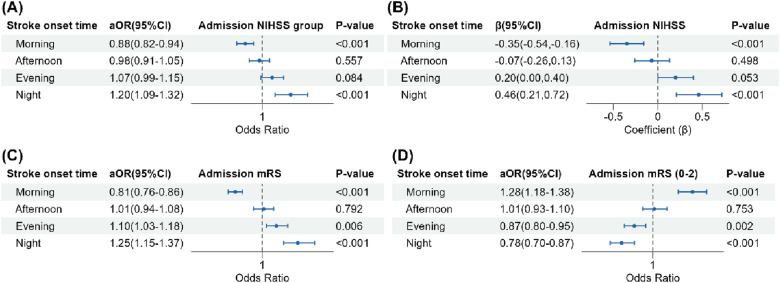
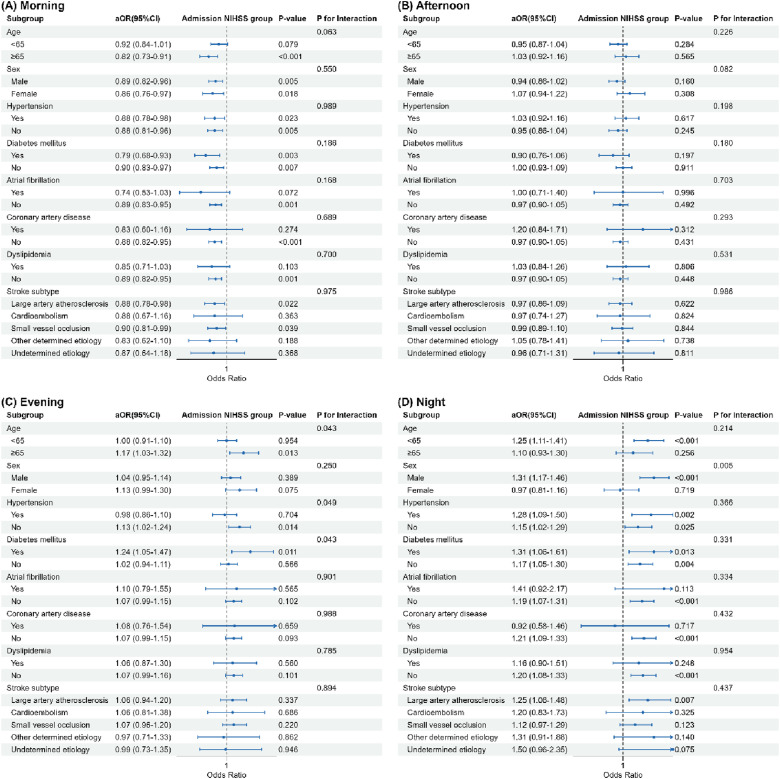
Results: Stroke onset in the Morning was associated with lower NIHSS scores (adjusted odds ratio [aOR] = 0.88; 95% confidence interval [CI]: 0.82-0.94; P < .001) and lower mRS scores (aOR = 0.81; 95% CI: 0.76-0.86; P < .001). In contrast, Night onset was associated with higher NIHSS scores (aOR = 1.20; 95% CI: 1.09-1.32; P < .001) and mRS scores (aOR = 1.25; 95% CI: 1.15-1.37; P < .001). These associations were consistent across strata defined by age and sex, and among patients with hypertension or diabetes. However, the circadian pattern was attenuated in patients with coronary artery disease, dyslipidemia, or atrial fibrillation.
Conclusion: Admission stroke severity follows a circadian pattern, with milder presentations in the Morning and more severe impairments during Night hours. These findings highlight the potential role of circadian biology in stroke pathophysiology and support incorporating time-of-onset considerations into clinical risk stratification and acute management strategies.



 求助内容:
求助内容: 应助结果提醒方式:

 京公网安备 11010802042870号


