Yahia Imam, Rajvir Singh, Prem Chandra, Ishrat Hakeem, Saadat Kamran, Ahmad Muhammad, Salman Al Jerdi, Suhail Hussain, Khawaja Hassan Haroon, Jon D Perkins, Ahmed Elsotouhy, Mohamed Sayed Abdelmoneim, Zain A Bhutta, Mostafa Mahmoud, Ehab Mahmoud, Osman Koc, Dirk Deleu
{"title":"Deriving a Simple Clinical Predictive Score for Posterior Circulation Ischemic Stroke (PCS-SCORE).","authors":"Yahia Imam, Rajvir Singh, Prem Chandra, Ishrat Hakeem, Saadat Kamran, Ahmad Muhammad, Salman Al Jerdi, Suhail Hussain, Khawaja Hassan Haroon, Jon D Perkins, Ahmed Elsotouhy, Mohamed Sayed Abdelmoneim, Zain A Bhutta, Mostafa Mahmoud, Ehab Mahmoud, Osman Koc, Dirk Deleu","doi":"10.1177/11795735261424050","DOIUrl":null,"url":null,"abstract":"<p><strong>Background: </strong>Posterior circulation ischemic stroke (PCS) accounts for up to 25% of all ischemic strokes but remains frequently under-recognized due to atypical symptoms and poor representation in conventional stroke scales. Early diagnosis is critical yet challenging. This study aimed to derive a pragmatic clinical scoring tool, the PCS-SCORE, to identify patients at high risk of PCS based solely on bedside features.</p><p><strong>Methods: </strong>We retrospectively analyzed 5163 patients from a prospective stroke registry, including 1571 with -confirmed PCS. Key predictors were identified through multivariable logistic regression and lasso modeling. Variables were weighted according to regression coefficients and clinical relevance. The final PCS-SCORE (0-9 points) included: diabetes (1 point), hypertension (1), male sex (1), double/blurred vision (2), vertigo with vomiting (2), and incoordination (2).</p><p><strong>Results: </strong>At a score threshold >3, the PCS-SCORE achieved an area under the curve (AUC) of 0.76, with 87.9% specificity and 43.4% sensitivity. Raising the threshold to >4 increased specificity to 94.4% (sensitivity 27.9%). Higher scores corresponded with progressively increased likelihood of PCS, enabling confident identification of high-risk patients.</p><p><strong>Conclusion: </strong>The PCS-SCORE is a simple, highly specific bedside tool for early detection of posterior circulation strokes. Its rule-in strength makes it especially useful in prehospital settings, resource-limited environments, and crowded emergency departments. Prospective validation is ongoing.</p>","PeriodicalId":15218,"journal":{"name":"Journal of Central Nervous System Disease","volume":"18 ","pages":"11795735261424050"},"PeriodicalIF":2.8000,"publicationDate":"2026-02-12","publicationTypes":"Journal Article","fieldsOfStudy":null,"isOpenAccess":false,"openAccessPdf":"https://www.ncbi.nlm.nih.gov/pmc/articles/PMC12901941/pdf/","citationCount":"0","resultStr":null,"platform":"Semanticscholar","paperid":null,"PeriodicalName":"Journal of Central Nervous System Disease","FirstCategoryId":"1085","ListUrlMain":"https://doi.org/10.1177/11795735261424050","RegionNum":0,"RegionCategory":null,"ArticlePicture":[],"TitleCN":null,"AbstractTextCN":null,"PMCID":null,"EPubDate":"2026/1/1 0:00:00","PubModel":"eCollection","JCR":"Q2","JCRName":"CLINICAL NEUROLOGY","Score":null,"Total":0}
引用次数: 0
Abstract
Background: Posterior circulation ischemic stroke (PCS) accounts for up to 25% of all ischemic strokes but remains frequently under-recognized due to atypical symptoms and poor representation in conventional stroke scales. Early diagnosis is critical yet challenging. This study aimed to derive a pragmatic clinical scoring tool, the PCS-SCORE, to identify patients at high risk of PCS based solely on bedside features.
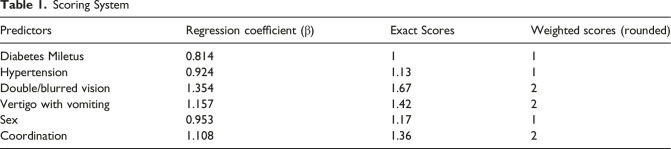
Methods: We retrospectively analyzed 5163 patients from a prospective stroke registry, including 1571 with -confirmed PCS. Key predictors were identified through multivariable logistic regression and lasso modeling. Variables were weighted according to regression coefficients and clinical relevance. The final PCS-SCORE (0-9 points) included: diabetes (1 point), hypertension (1), male sex (1), double/blurred vision (2), vertigo with vomiting (2), and incoordination (2).
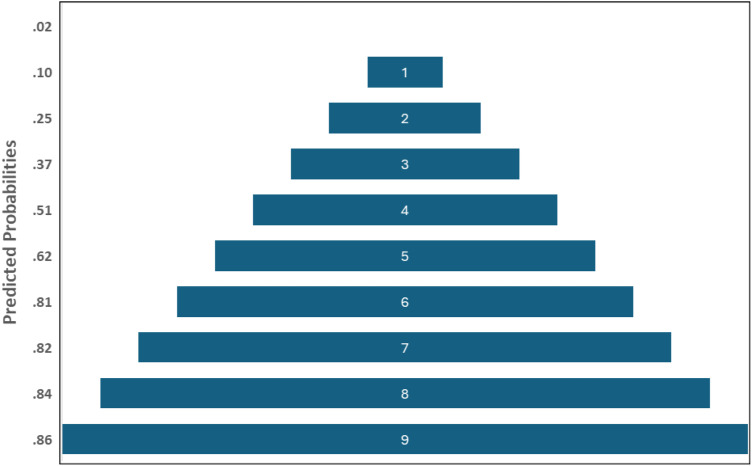
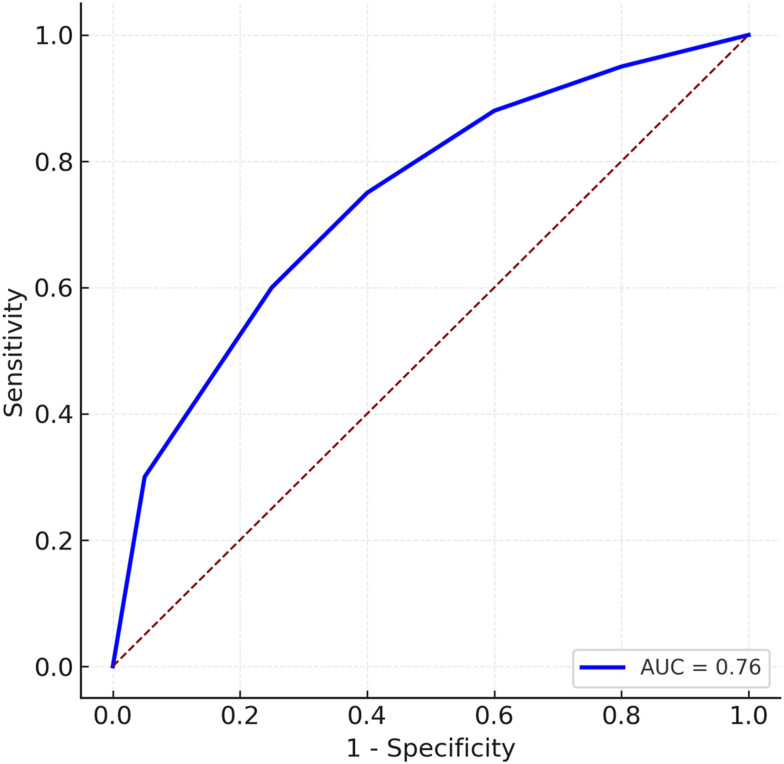
Results: At a score threshold >3, the PCS-SCORE achieved an area under the curve (AUC) of 0.76, with 87.9% specificity and 43.4% sensitivity. Raising the threshold to >4 increased specificity to 94.4% (sensitivity 27.9%). Higher scores corresponded with progressively increased likelihood of PCS, enabling confident identification of high-risk patients.
Conclusion: The PCS-SCORE is a simple, highly specific bedside tool for early detection of posterior circulation strokes. Its rule-in strength makes it especially useful in prehospital settings, resource-limited environments, and crowded emergency departments. Prospective validation is ongoing.


 求助内容:
求助内容: 应助结果提醒方式:

 京公网安备 11010802042870号


