Raniel Agustin Valencia, Seon Ho Kim, Janine Isidro Berdos, Myung Hoo Kim, Sung Sill Lee, Sang Suk Lee
{"title":"Metabolic and metataxonomic changes in lactating holstein dairy cows during the transition from heat stress to the recovery period.","authors":"Raniel Agustin Valencia, Seon Ho Kim, Janine Isidro Berdos, Myung Hoo Kim, Sung Sill Lee, Sang Suk Lee","doi":"10.5187/jast.2024.e97","DOIUrl":null,"url":null,"abstract":"<p><p>This study investigated the changes in rumen fermentation characteristics, blood parameters, and rumen microbial communities of Holstein dairy cows in the early lactation stage during heat stress conditions and subsequent recovery. This study aimed to fill the significant knowledge gaps regarding the recovery of dairy cattle from heat stress during the early stages of lactation. Metataxonomic analysis was used to identify potential biomarkers and metabolites associated with metabolic disease prediction. The temperature-humidity index was recorded on a dairy farm to define the heat stress and recovery periods. Using the Bray-Curtis dissimilarity index, principal coordinate analysis revealed that both the heat stress and recovery periods affected the overall composition of the rumen bacterial community. The first three principal coordinates explained 33.10%, 19.10%, and 12.30% of the total variation, indicating the significant (<i>p</i> < 0.01) influence of temperature changes on the dominance of rumen microbes and the rumen environment. However, alpha diversity measurements were unaffected in both periods. Metataxonomic analysis (average relative abundance 2%) of cows in both periods revealed ten predominant genera: <i>Prevotella</i>, <i>Ruminococcus</i>, <i>Selenomonas</i>, <i>Gilliamella</i>, <i>Duncaniella</i>, <i>Succiniclasticum</i>, <i>Paraprevotella</i>, <i>Bacteriodes</i>, <i>Lentimicrobium</i>, and <i>Treponema</i>. During heat stress, significant alterations were observed in the levels of three organic acids, six fatty acids, and thirteen amino acids. Furthermore, heat stress caused a significant increase in blood serum HSP27 and HSP70 levels (both <i>p</i> < 0.01), whereas blood serum glucose (<i>p</i> = 0.001) and blood urea nitrogen (<i>p</i> < 0.001) decreased. Heat stress significantly increased blood serum ketone concentrations (<i>p</i> = 0.005), tended to decrease cholesterol levels (<i>p</i> = 0.053), reduced blood urea nitrogen concentrations (<i>p</i> < 0.001), and affected total protein (<i>p</i> = 0.002), aspartate aminotransferase (<i>p</i> = 0.049), and total bilirubin concentrations (<i>p</i> = 0.010). The levels of blood serum minerals, such as calcium, phosphorus, and magnesium, as well as ruminal pH, ammonia-N, acetate, and butyrate, were not affected during either period. Heat stress influenced propionate (<i>p</i> = 0.006) and total volatile fatty acids (<i>p</i> = 0.030). Overall, heat stress during early lactation resulted in significant shifts within the rumen bacterial community structure, accompanied by corresponding changes in blood metabolite profiles.</p>","PeriodicalId":14923,"journal":{"name":"Journal of Animal Science and Technology","volume":"68 1","pages":"324-356"},"PeriodicalIF":3.2000,"publicationDate":"2026-01-01","publicationTypes":"Journal Article","fieldsOfStudy":null,"isOpenAccess":false,"openAccessPdf":"https://www.ncbi.nlm.nih.gov/pmc/articles/PMC12902393/pdf/","citationCount":"0","resultStr":null,"platform":"Semanticscholar","paperid":null,"PeriodicalName":"Journal of Animal Science and Technology","FirstCategoryId":"97","ListUrlMain":"https://doi.org/10.5187/jast.2024.e97","RegionNum":3,"RegionCategory":"农林科学","ArticlePicture":[],"TitleCN":null,"AbstractTextCN":null,"PMCID":null,"EPubDate":"2026/1/31 0:00:00","PubModel":"Epub","JCR":"Q1","JCRName":"AGRICULTURE, DAIRY & ANIMAL SCIENCE","Score":null,"Total":0}
引用次数: 0
Abstract
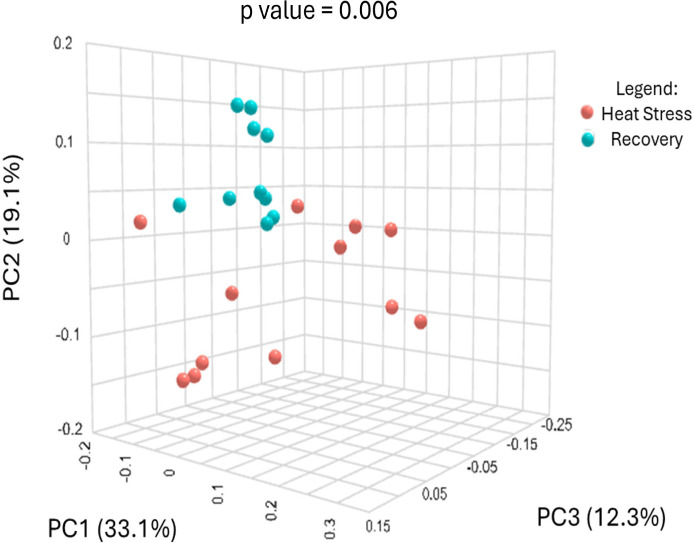
This study investigated the changes in rumen fermentation characteristics, blood parameters, and rumen microbial communities of Holstein dairy cows in the early lactation stage during heat stress conditions and subsequent recovery. This study aimed to fill the significant knowledge gaps regarding the recovery of dairy cattle from heat stress during the early stages of lactation. Metataxonomic analysis was used to identify potential biomarkers and metabolites associated with metabolic disease prediction. The temperature-humidity index was recorded on a dairy farm to define the heat stress and recovery periods. Using the Bray-Curtis dissimilarity index, principal coordinate analysis revealed that both the heat stress and recovery periods affected the overall composition of the rumen bacterial community. The first three principal coordinates explained 33.10%, 19.10%, and 12.30% of the total variation, indicating the significant (p < 0.01) influence of temperature changes on the dominance of rumen microbes and the rumen environment. However, alpha diversity measurements were unaffected in both periods. Metataxonomic analysis (average relative abundance 2%) of cows in both periods revealed ten predominant genera: Prevotella, Ruminococcus, Selenomonas, Gilliamella, Duncaniella, Succiniclasticum, Paraprevotella, Bacteriodes, Lentimicrobium, and Treponema. During heat stress, significant alterations were observed in the levels of three organic acids, six fatty acids, and thirteen amino acids. Furthermore, heat stress caused a significant increase in blood serum HSP27 and HSP70 levels (both p < 0.01), whereas blood serum glucose (p = 0.001) and blood urea nitrogen (p < 0.001) decreased. Heat stress significantly increased blood serum ketone concentrations (p = 0.005), tended to decrease cholesterol levels (p = 0.053), reduced blood urea nitrogen concentrations (p < 0.001), and affected total protein (p = 0.002), aspartate aminotransferase (p = 0.049), and total bilirubin concentrations (p = 0.010). The levels of blood serum minerals, such as calcium, phosphorus, and magnesium, as well as ruminal pH, ammonia-N, acetate, and butyrate, were not affected during either period. Heat stress influenced propionate (p = 0.006) and total volatile fatty acids (p = 0.030). Overall, heat stress during early lactation resulted in significant shifts within the rumen bacterial community structure, accompanied by corresponding changes in blood metabolite profiles.
期刊介绍:
Journal of Animal Science and Technology (J. Anim. Sci. Technol. or JAST) is a peer-reviewed, open access journal publishing original research, review articles and notes in all fields of animal science.
Topics covered by the journal include: genetics and breeding, physiology, nutrition of monogastric animals, nutrition of ruminants, animal products (milk, meat, eggs and their by-products) and their processing, grasslands and roughages, livestock environment, animal biotechnology, animal behavior and welfare.
Articles generally report research involving beef cattle, dairy cattle, pigs, companion animals, goats, horses, and sheep. However, studies involving other farm animals, aquatic and wildlife species, and laboratory animal species that address fundamental questions related to livestock and companion animal biology will also be considered for publication.
The Journal of Animal Science and Technology (J. Anim. Technol. or JAST) has been the official journal of The Korean Society of Animal Science and Technology (KSAST) since 2000, formerly known as The Korean Journal of Animal Sciences (launched in 1956).



 求助内容:
求助内容: 应助结果提醒方式:

 京公网安备 11010802042870号


