{"title":"Osteogenic Response of Saos-2 Cells to Calcium Silicate-based versus Hydroxyapatite-based Cements: A Comparative Study.","authors":"Maryam Torshabi, Maryam Eydi, Saeed Asgary, Zohreh Fazli, Safoora Modagheghi, Azam Valian, Hanieh Nojehdehian","doi":"10.22037/iej.v21i1.46947","DOIUrl":null,"url":null,"abstract":"<p><strong>Introduction: </strong>Bioceramic materials are integral to regenerative endodontics, yet comparative data on their osteogenic potential remain limited. This study compared the osteogenic potential of four bioceramics: hydroxyapatite (HA), a nano-hydroxyapatite/chitosan composite (n-HA/CSS), Angelus mineral trioxide aggregate (MTA), and calcium-enriched mixture (CEM) cement.</p><p><strong>Materials and methods: </strong>Human osteoblast-like Saos-2 cells were exposed to materials <i>via</i> direct contact and extract models. Cell viability and proliferation were assessed using the MTT assay, attachment and morphology were examined by scanning electron microscopy (SEM), and osteogenic differentiation was evaluated by real-time PCR for alkaline phosphatase (ALP), bone sialoprotein (BSP), and osteocalcin (OC) at 3 and 6 days.</p><p><strong>Results: </strong>All materials were non-cytotoxic. In direct culture, CEM significantly enhanced cell proliferation by day 3 (~3-fold, <i>P</i><0.001). SEM revealed superior cell attachment and extracellular matrix secretion on n-HA/CS and CEM surfaces. Gene expression analysis demonstrated that CEM robustly upregulated ALP (~12-fold <i>vs.</i> control, <i>P</i><0.001), a level 6-fold higher than MTA (<i>P</i><0.05). Furthermore, both CEM and n-HA/CS promoted pronounced expression of the late markers BSP (~5-fold, <i>P</i><0.001) and OC (10-fold and 12-fold, <i>P</i><0.001 and <i>P</i><0.001, respectively). MTA consistently elicited the lowest osteogenic response.</p><p><strong>Conclusions: </strong>CEM and the n-HA/CS were identified as the strongest promoters of osteoblast proliferation and differentiation, indicating their superior bioactivity over MTA and HA and their potential for endodontic and surgical hard tissue regeneration.</p>","PeriodicalId":14534,"journal":{"name":"Iranian Endodontic Journal","volume":"21 1","pages":"e3"},"PeriodicalIF":0.0000,"publicationDate":"2026-01-01","publicationTypes":"Journal Article","fieldsOfStudy":null,"isOpenAccess":false,"openAccessPdf":"https://www.ncbi.nlm.nih.gov/pmc/articles/PMC12900523/pdf/","citationCount":"0","resultStr":null,"platform":"Semanticscholar","paperid":null,"PeriodicalName":"Iranian Endodontic Journal","FirstCategoryId":"1085","ListUrlMain":"https://doi.org/10.22037/iej.v21i1.46947","RegionNum":0,"RegionCategory":null,"ArticlePicture":[],"TitleCN":null,"AbstractTextCN":null,"PMCID":null,"EPubDate":"2023/12/28 0:00:00","PubModel":"Epub","JCR":"Q3","JCRName":"Dentistry","Score":null,"Total":0}
引用次数: 0
Abstract
Introduction: Bioceramic materials are integral to regenerative endodontics, yet comparative data on their osteogenic potential remain limited. This study compared the osteogenic potential of four bioceramics: hydroxyapatite (HA), a nano-hydroxyapatite/chitosan composite (n-HA/CSS), Angelus mineral trioxide aggregate (MTA), and calcium-enriched mixture (CEM) cement.
Materials and methods: Human osteoblast-like Saos-2 cells were exposed to materials via direct contact and extract models. Cell viability and proliferation were assessed using the MTT assay, attachment and morphology were examined by scanning electron microscopy (SEM), and osteogenic differentiation was evaluated by real-time PCR for alkaline phosphatase (ALP), bone sialoprotein (BSP), and osteocalcin (OC) at 3 and 6 days.
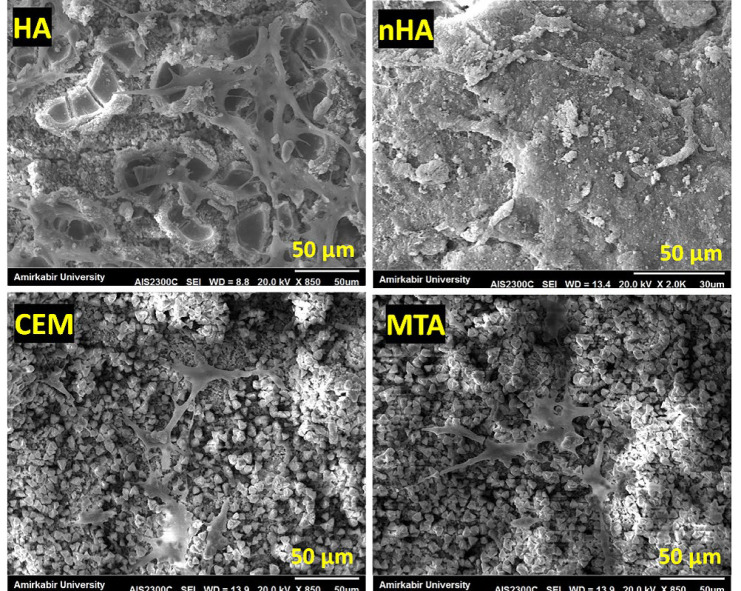
Results: All materials were non-cytotoxic. In direct culture, CEM significantly enhanced cell proliferation by day 3 (~3-fold, P<0.001). SEM revealed superior cell attachment and extracellular matrix secretion on n-HA/CS and CEM surfaces. Gene expression analysis demonstrated that CEM robustly upregulated ALP (~12-fold vs. control, P<0.001), a level 6-fold higher than MTA (P<0.05). Furthermore, both CEM and n-HA/CS promoted pronounced expression of the late markers BSP (~5-fold, P<0.001) and OC (10-fold and 12-fold, P<0.001 and P<0.001, respectively). MTA consistently elicited the lowest osteogenic response.
Conclusions: CEM and the n-HA/CS were identified as the strongest promoters of osteoblast proliferation and differentiation, indicating their superior bioactivity over MTA and HA and their potential for endodontic and surgical hard tissue regeneration.
期刊介绍:
The Iranian Endodontic Journal (IEJ) is an international peer-reviewed biomedical publication, the aim of which is to provide a scientific medium of communication for researchers throughout the globe. IEJ aims to publish the highest quality articles, both clinical and scientific, on all aspects of Endodontics. The journal is an official Journal of the Iranian Center for Endodontic Research (ICER) and the Iranian Association of Endodontists (IAE). The Journal welcomes articles related to the scientific or applied aspects of endodontics e.g. original researches, systematic reviews, meta-analyses, review articles, clinical trials, case series/reports, hypotheses, letters to the editor, etc. From the beginning (i.e. since 2006), the IEJ was the first open access endodontic journal in the world, which gave readers free and instant access to published articles and enabling them faster discovery of the latest endodontic research.




 求助内容:
求助内容: 应助结果提醒方式:

 京公网安备 11010802042870号


