Alexander S Blanco, David R Wilson, Scott W Rainsford, Grant L Harley, Roshan P Bhatta, Corbin W Halsey, Gabriella M Eldridge, Daisy P Estrada Garza, L May Brown, Madeleine F Stanley, Jeffrey A Logan, Aaron M Sparks, Henry D Adams, Daniel M Johnson, Andrew T Hudak, Li Huang, Alistair M S Smith
{"title":"Assessing the potential fire tolerance of conifer saplings in cold and wet environments using a pyro-ecophysiology approach.","authors":"Alexander S Blanco, David R Wilson, Scott W Rainsford, Grant L Harley, Roshan P Bhatta, Corbin W Halsey, Gabriella M Eldridge, Daisy P Estrada Garza, L May Brown, Madeleine F Stanley, Jeffrey A Logan, Aaron M Sparks, Henry D Adams, Daniel M Johnson, Andrew T Hudak, Li Huang, Alistair M S Smith","doi":"10.1186/s42408-025-00443-7","DOIUrl":null,"url":null,"abstract":"<p><strong>Background: </strong>Climate change is expected to alter fire return intervals in cold and wet forests in the northwestern United States. This coupled with an expected rise in prescribed fires to restore healthy forests, disproportionately increases risk to saplings of tree species adapted to colder and wetter environments that have low fire resistance. To assess this potential impact, we evaluated the impacts of increasing fire intensity on <i>Picea engelmannii</i> and <i>Thuja plicata</i> sapling physiology, morphology, and mortality. This was achieved using established pyro-ecophysiology experiments where saplings were subjected to controlled surface fires across a range of fire intensities and post-fire growth, physiology and mortality were assessed up to 7 months post-fire.</p><p><strong>Results: </strong>In this study we demonstrate that the probability of mortality in the saplings of these two conifer species displays a sigmoidal increase with increasing fire intensity. At fire radiative energy dosage levels < 0.6 MJ m<sup>-2</sup>, the observed mortality in both species was lower than predicted by existing crown scorch-based models due to their limited sensitivity at small diameters. Prior to sapling death, chlorophyll fluorescence transiently recovers before a rapid decline, though the timing varies by species and fire intensity dosage. A new general sapling mortality model derived from 7 conifer species is presented.</p><p><strong>Conclusions: </strong>Our results provide predictive tools that managers could use to make informed decisions on the potential impacts of fires on conifer saplings growing in cold and wet environments. Results from both species suggest that chlorophyll fluorescence temporal trends could serve as a potential early warning indicator of fire-induced tree mortality, however, future work should explore whether similar responses are observable using remote sensing data from solar-induced chlorophyll fluorescence and assess potential mechanisms underlying this signal. The general sapling mortality model presented in this paper appears to provide an improved method of predicting conifer sapling mortality over existing approaches, however, research is needed to develop coefficients to adjust the model with tree age and environmental factors. Further studies could also explore whether phenotypic plasticity is driving observed tree responses to fire from plants grown from similar environments.</p><p><strong>Supplementary information: </strong>The online version contains supplementary material available at 10.1186/s42408-025-00443-7.</p>","PeriodicalId":12273,"journal":{"name":"Fire Ecology","volume":"22 1","pages":"14"},"PeriodicalIF":5.0000,"publicationDate":"2026-01-01","publicationTypes":"Journal Article","fieldsOfStudy":null,"isOpenAccess":false,"openAccessPdf":"https://www.ncbi.nlm.nih.gov/pmc/articles/PMC12894159/pdf/","citationCount":"0","resultStr":null,"platform":"Semanticscholar","paperid":null,"PeriodicalName":"Fire Ecology","FirstCategoryId":"93","ListUrlMain":"https://doi.org/10.1186/s42408-025-00443-7","RegionNum":3,"RegionCategory":"环境科学与生态学","ArticlePicture":[],"TitleCN":null,"AbstractTextCN":null,"PMCID":null,"EPubDate":"2026/1/13 0:00:00","PubModel":"Epub","JCR":"Q1","JCRName":"ECOLOGY","Score":null,"Total":0}
引用次数: 0
Abstract
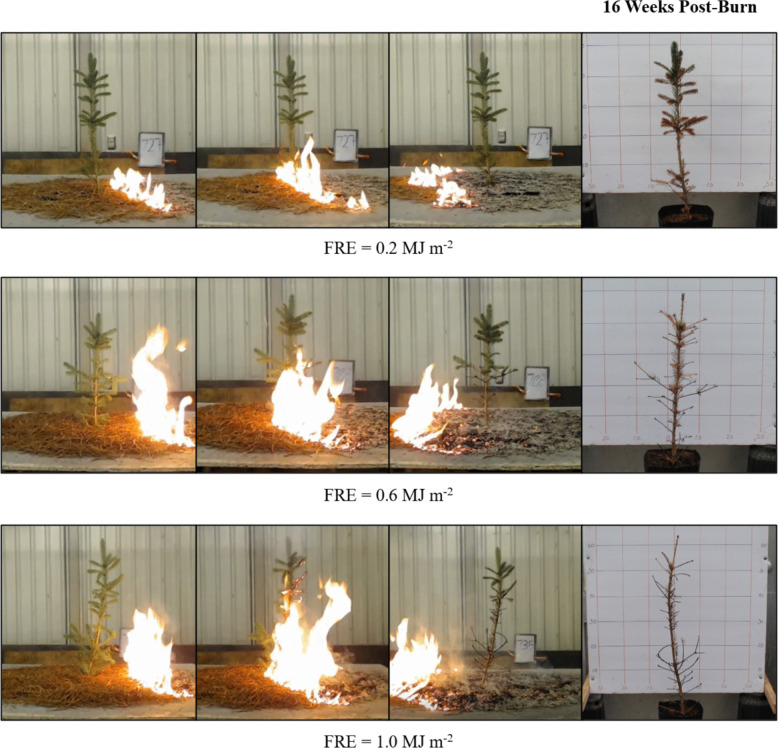
Background: Climate change is expected to alter fire return intervals in cold and wet forests in the northwestern United States. This coupled with an expected rise in prescribed fires to restore healthy forests, disproportionately increases risk to saplings of tree species adapted to colder and wetter environments that have low fire resistance. To assess this potential impact, we evaluated the impacts of increasing fire intensity on Picea engelmannii and Thuja plicata sapling physiology, morphology, and mortality. This was achieved using established pyro-ecophysiology experiments where saplings were subjected to controlled surface fires across a range of fire intensities and post-fire growth, physiology and mortality were assessed up to 7 months post-fire.
Results: In this study we demonstrate that the probability of mortality in the saplings of these two conifer species displays a sigmoidal increase with increasing fire intensity. At fire radiative energy dosage levels < 0.6 MJ m-2, the observed mortality in both species was lower than predicted by existing crown scorch-based models due to their limited sensitivity at small diameters. Prior to sapling death, chlorophyll fluorescence transiently recovers before a rapid decline, though the timing varies by species and fire intensity dosage. A new general sapling mortality model derived from 7 conifer species is presented.
Conclusions: Our results provide predictive tools that managers could use to make informed decisions on the potential impacts of fires on conifer saplings growing in cold and wet environments. Results from both species suggest that chlorophyll fluorescence temporal trends could serve as a potential early warning indicator of fire-induced tree mortality, however, future work should explore whether similar responses are observable using remote sensing data from solar-induced chlorophyll fluorescence and assess potential mechanisms underlying this signal. The general sapling mortality model presented in this paper appears to provide an improved method of predicting conifer sapling mortality over existing approaches, however, research is needed to develop coefficients to adjust the model with tree age and environmental factors. Further studies could also explore whether phenotypic plasticity is driving observed tree responses to fire from plants grown from similar environments.
Supplementary information: The online version contains supplementary material available at 10.1186/s42408-025-00443-7.
期刊介绍:
Fire Ecology is the international scientific journal supported by the Association for Fire Ecology. Fire Ecology publishes peer-reviewed articles on all ecological and management aspects relating to wildland fire. We welcome submissions on topics that include a broad range of research on the ecological relationships of fire to its environment, including, but not limited to:
Ecology (physical and biological fire effects, fire regimes, etc.)
Social science (geography, sociology, anthropology, etc.)
Fuel
Fire science and modeling
Planning and risk management
Law and policy
Fire management
Inter- or cross-disciplinary fire-related topics
Technology transfer products.



 求助内容:
求助内容: 应助结果提醒方式:

 京公网安备 11010802042870号


