
A CRISPR/Cas12a–personal glucose meter biosensor for rapid and quantitative detection of Burkholderia pseudomallei DNA
IF 3.7
1区 化学
Q1 CHEMISTRY, ANALYTICAL
Sensors and Actuators B: Chemical
Pub Date : 2026-05-15
Epub Date: 2026-02-13
DOI:10.1016/j.snb.2026.139622
引用次数: 0
Abstract
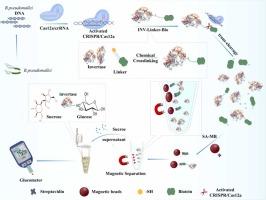
Melioidosis, caused by Burkholderia pseudomallei (B. pseudomallei), is a fatal tropical infectious disease whose diagnosis is hindered by the lack of rapid and accessible detection methods. Here, we present a novel CRISPR/Cas12a-based biosensing platform integrated with a personal glucose meter (PGM) for rapid, quantitative, and amplification-free detection of B. pseudomallei DNA. In this system, target DNA activates Cas12a trans-cleavage, releasing invertase from an invertase-Linker-biotin probe. Subsequent magnetic separation removes the uncleaved complexes, and the invertase remaining in the solution catalyzes the conversion of sucrose to glucose, which is quantitatively measured by the PGM. The assay is completed within 50 min and achieves a detection limit of 0.1 pM with a linear dynamic range from 1 pM to 10 nM. The biosensor exhibits excellent specificity against single- and multi-base mismatched sequences, outstanding precision (CV < 10 %), and strong correlation with qPCR results in clinical samples (recovery: 98 % - 113 %). The reagents remain stable over four weeks of storage (CV = 4.4 %), confirming the robustness of the system. This amplification-free platform, independent of specialized laboratory instrumentation, represents an important step toward accessible molecular diagnostics, demonstrating the potential as a rapid, low-cost, and user-friendly solution for early melioidosis detection and potentially other infectious diseases. From a sensor-engineering standpoint, the CRISPR/Cas12a–PGM architecture constitutes a generalizable chemical/biosensing platform that can be readily reprogrammed for different nucleic-acid targets by simply switching the crRNA.
CRISPR/ cas12a -个人血糖仪生物传感器快速定量检测假马氏伯克氏菌DNA
类鼻疽是一种致命的热带传染病,由假氏伯克霍尔德菌(B. pseudomallei)引起,其诊断因缺乏快速和可获得的检测方法而受到阻碍。在这里,我们提出了一种基于CRISPR/ cas12的新型生物传感平台,该平台集成了个人血糖仪(PGM),用于快速,定量和无扩增的假假芽孢杆菌DNA检测。在这个系统中,目标DNA激活Cas12a反式切割,从一个转化酶- linker -生物素探针释放转化酶。随后的磁分离去除未裂解的配合物,而留在溶液中的转化酶催化蔗糖转化为葡萄糖,这是通过PGM定量测量的。该分析在50分钟内完成,检测限为0.1 pM,线性动态范围为1 pM至10 nM。该生物传感器对单碱基和多碱基错配序列具有出色的特异性,具有出色的精度(CV < 10%),并且与临床样品中的qPCR结果具有很强的相关性(回收率:98% - 113%)。试剂在4周的储存时间内保持稳定(CV = 4.4%),证实了该体系的稳健性。这种无扩增的平台,独立于专门的实验室仪器,代表了向可获得的分子诊断迈出的重要一步,展示了作为一种快速、低成本和用户友好的早期类鼻疽病检测和潜在的其他传染病解决方案的潜力。从传感器工程的角度来看,CRISPR/ Cas12a-PGM结构构成了一个通用的化学/生物传感平台,通过简单地切换crRNA,可以很容易地为不同的核酸靶标重新编程。
本文章由计算机程序翻译,如有差异,请以英文原文为准。
求助全文
约1分钟内获得全文
求助全文
来源期刊
Sensors and Actuators B: Chemical
工程技术-电化学
CiteScore
14.60
自引率
11.90%
发文量
1776
审稿时长
3.2 months
期刊介绍:
Sensors & Actuators, B: Chemical is an international journal focused on the research and development of chemical transducers. It covers chemical sensors and biosensors, chemical actuators, and analytical microsystems. The journal is interdisciplinary, aiming to publish original works showcasing substantial advancements beyond the current state of the art in these fields, with practical applicability to solving meaningful analytical problems. Review articles are accepted by invitation from an Editor of the journal.
 求助内容:
求助内容: 应助结果提醒方式:

 京公网安备 11010802042870号


