
Auricular Vagus nerve stimulation alleviates cardiac dysfunction in Takotsubo syndrome by inhibiting excessive activation of the sympathetic nerve system and inflammation
IF 5.9
2区 医学
Q1 MEDICAL LABORATORY TECHNOLOGY
引用次数: 0
Abstract
Background
Takotsubo syndrome (TTS) is a stress-induced cardiac disorder that closely resembles acute coronary syndrome but lacks effective and safe therapeutic interventions. This study aimed to investigate the cardioprotective effects of transcutaneous auricular vagus nerve stimulation (taVNS), a noninvasive neuromodulation technique, in a rat model of TTS-like cardiomyopathy.
Methods
Sprague–Dawley rats were randomly assigned to three groups: sham, TTS, and TTS + taVNS. TTS was induced by intraperitoneal injection of isoprenaline, while taVNS was applied for 1 hour. Cardiac function was assessed using electrocardiography, heart rate variability, and ventricular electrophysiological recordings. Histopathological changes, inflammatory responses, and autonomic nervous system activity were analyzed. RNA sequencing was performed to explore underlying molecular mechanisms, with key findings validated by RT–qPCR and Western blotting.
Results
Noninvasive taVNS significantly improved left ventricular dysfunction in TTS rats, reducing arrhythmia susceptibility, myocardial injury, and collagen reaction. The treatment significantly suppressed sympathetic overactivation and systemic inflammation. Transcriptomic analysis identified the TLR2/MAPK pathway as a key mediator of inflammation in taVNS-induced protection. Moreover, taVNS significantly downregulated expression of TLR2/MAPK pathway and proinflammatory cytokines confirmed at both mRNA and protein levels compared to the TTS group.
Conclusions
Noninvasive taVNS offers broad cardioprotection in TTS through inhibiting the sympathetic nerve and inflammation. This approach holds promise as an adjunct therapy for TTS, offering benefits in inflammation control, structural preservation, and electrical stability of the heart.
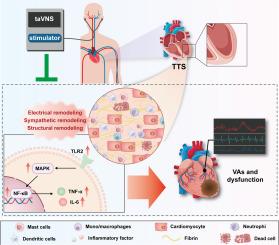
耳迷走神经刺激通过抑制交感神经系统的过度激活和炎症减轻Takotsubo综合征心功能障碍。
背景:Takotsubo综合征(TTS)是一种应激性心脏疾病,与急性冠状动脉综合征非常相似,但缺乏有效和安全的治疗干预措施。本研究旨在探讨经皮耳迷走神经刺激(taVNS)(一种无创神经调节技术)对tts样心肌病大鼠模型的心脏保护作用。方法:将Sprague-Dawley大鼠随机分为sham组、TTS组和TTS + taVNS组。腹腔注射异丙肾上腺素诱导TTS, taVNS作用1 h。使用心电图、心率变异性和心室电生理记录评估心功能。分析组织病理学变化、炎症反应和自主神经系统活动。进行RNA测序以探索潜在的分子机制,并通过RT-qPCR和Western blotting验证了关键发现。结果:无创taVNS可显著改善TTS大鼠左心室功能障碍,降低心律失常易感性、心肌损伤及胶原蛋白反应。治疗显著抑制交感神经过度激活和全身性炎症。转录组学分析发现TLR2/MAPK通路是tavns诱导保护炎症的关键介质。此外,与TTS组相比,taVNS在mRNA和蛋白水平上均显著下调了TLR2/MAPK通路和促炎细胞因子的表达。结论:无创taVNS通过抑制交感神经和炎症对TTS有广泛的心脏保护作用。这种方法有望作为TTS的辅助治疗,在炎症控制、结构保存和心脏电稳定性方面提供益处。
本文章由计算机程序翻译,如有差异,请以英文原文为准。
求助全文
约1分钟内获得全文
求助全文
来源期刊
Translational Research
医学-医学:内科
CiteScore
15.70
自引率
0.00%
发文量
195
审稿时长
14 days
期刊介绍:
Translational Research (formerly The Journal of Laboratory and Clinical Medicine) delivers original investigations in the broad fields of laboratory, clinical, and public health research. Published monthly since 1915, it keeps readers up-to-date on significant biomedical research from all subspecialties of medicine.
 求助内容:
求助内容: 应助结果提醒方式:

 京公网安备 11010802042870号


