
Molecular insights into physiological impact of micro- and nano-plastics on the digestive system and gut-brain axis
IF 4.3
3区 环境科学与生态学
Q2 BIOCHEMISTRY & MOLECULAR BIOLOGY
Comparative Biochemistry and Physiology C-toxicology & Pharmacology
Pub Date : 2026-06-01
Epub Date: 2026-02-11
DOI:10.1016/j.cbpc.2026.110473
引用次数: 0
Abstract
Microplastics (MPs) and Nanoplastics (NPs) represent an alarming and persistent threat to global human health, owing to their resilience and ubiquity in the environment. Ingestion via contaminated food and water is the primary exposure route, resulting in the accumulation of MNPs in key organs such as the gastrointestinal tract (GI), liver, and pancreas, highlighting the urgent need to understand their potential cumulative and systemic effects. This review critically evaluates recent molecular-level insights into the physiological impacts of MNPs, with particular emphasis on the GI system and the intricate gut-brain axis.
MNPs induce cellular toxicity through oxidative stress (OS) and mitochondrial dysfunction, which activate inflammatory and apoptotic pathways. Accumulation in the GI tract causes gut microbiota dysbiosis and a compromised intestinal barrier, and translocates systemically to the liver and pancreas, leading to hepatotoxicity, insulin resistance, and chronic inflammation.
Crucially, the disruption of the gut barrier facilitates MNPs access to the central nervous system (CNS) via the gut-brain axis, leading to a breach of the Blood-Brain Barrier. CNS-accumulated MNPs induce neuroinflammation and neurotoxicity, accelerating neurodegenerative disorders such as Parkinson's, Alzheimer's, and multiple sclerosis.
This review elucidates the complex mechanisms and highlights significant gaps in understanding MNPs risks, which are currently limited by the use of short-term animal and in vitro models, as well as a lack of precise human data. Future research should prioritize the development of standardized quantification techniques and advanced tracking methods to accurately assess the biodistribution, metabolism, and long-term health effects of MNPs. This approach will facilitate the development of targeted therapeutic interventions and preventive measures.
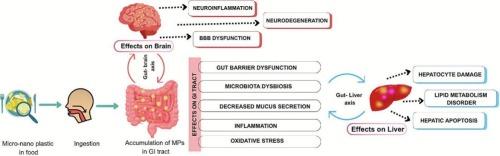
微观和纳米塑料对消化系统和肠脑轴的生理影响的分子见解。
微塑料和纳米塑料由于其复原力和在环境中无处不在,对全球人类健康构成了令人震惊的持续威胁。通过受污染的食物和水摄入是主要的暴露途径,导致MNPs在胃肠道(GI)、肝脏和胰腺等关键器官中积累,因此迫切需要了解其潜在的累积和全身效应。这篇综述批判性地评估了最近对MNPs生理影响的分子水平见解,特别强调了GI系统和复杂的肠-脑轴。MNPs通过氧化应激(OS)和线粒体功能障碍诱导细胞毒性,激活炎症和凋亡途径。在胃肠道的积累导致肠道菌群失调和肠道屏障受损,并全身转运到肝脏和胰腺,导致肝毒性、胰岛素抵抗和慢性炎症。至关重要的是,肠道屏障的破坏促进了MNPs通过肠-脑轴进入中枢神经系统(CNS),导致血脑屏障的破坏。cns积累的MNPs诱导神经炎症和神经毒性,加速神经退行性疾病,如帕金森病、阿尔茨海默病和多发性硬化症。这篇综述阐明了复杂的机制,并强调了在理解MNPs风险方面的重大差距,目前受限于短期动物和体外模型的使用,以及缺乏精确的人体数据。未来的研究应优先发展标准化的量化技术和先进的跟踪方法,以准确评估MNPs的生物分布、代谢和长期健康影响。这种方法将促进有针对性的治疗干预和预防措施的发展。
本文章由计算机程序翻译,如有差异,请以英文原文为准。
求助全文
约1分钟内获得全文
求助全文
来源期刊
CiteScore
7.50
自引率
5.10%
发文量
206
审稿时长
30 days
期刊介绍:
Part C: Toxicology and Pharmacology. This journal is concerned with chemical and drug action at different levels of organization, biotransformation of xenobiotics, mechanisms of toxicity, including reactive oxygen species and carcinogenesis, endocrine disruptors, natural products chemistry, and signal transduction with a molecular approach to these fields.
 求助内容:
求助内容: 应助结果提醒方式:

 京公网安备 11010802042870号


