
Metal endowment and fertility of Andean porphyry-copper belts
IF 4.3
2区 地球科学
Q1 GEOLOGY
引用次数: 0
Abstract
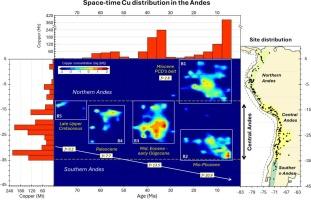
The Andes are among the richest copper-bearing regions globally, hosting significant porphyry copper deposits (PCDs). The Central Andes segment has become a focal point in global copper production, with substantial contributions from Cenozoic PCDs. This study provides an updated assessment of the copper endowment generated over the last 80 million years and its spatial–temporal distribution along the Andean orogen. The new estimates indicate that the total copper is about 1,300 Mt distributed within five major Andean PCD belts, emphasizing the importance of reassessing the region’s copper fertility.
Focus is placed on the younger and better-preserved Neogene PCD belts, which minimize preservation biases and allow for more accurate comparisons of their metallogenic fertility. The results highlight the heterogeneous distribution of copper, with significant disparities between the Northern and Central Andes despite their similar geodynamic settings. Notably, average copper productivity correlates strongly with PCD belt age in the Central Andes, suggesting a combination of preservation bias and increasing copper fertility with time.
This work also explores the relationship between slab flattening related to the subduction of buoyant oceanic anomalies and PCD formation. The findings underscore their role as critical geodynamic factors of metallogenic efficiency in Neogene PCD belts.
This study emphasizes the interplay between tectonic compression, magmatic productivity, and ore preservation, providing valuable insights for future target generation programs in the Andes and analogous subduction settings worldwide. By linking large-scale geodynamic processes to metallogenic outcomes, this work advances understanding of the factors governing copper endowment and fertility. It confirms the fertility of the Andean continental arc as a highly prospective target region for the future exploration of additional, but likely concealed, porphyry Cu systems.
安第斯斑岩-铜带的金属赋存与赋力
安第斯山脉是全球含铜最丰富的地区之一,拥有重要的斑岩铜矿床(PCDs)。安第斯山脉中部地区已成为全球铜生产的焦点,新生代PCDs的贡献很大。本研究对过去8000万年来安第斯造山带的铜资源及其时空分布进行了更新评估。新的估计表明,总铜储量约为1300公吨,分布在安第斯山脉的五个主要PCD带中,这强调了重新评估该地区铜储量的重要性。重点放在较年轻和保存较好的新近系PCD带上,这样可以最大限度地减少保存偏差,并可以更准确地比较它们的成矿能力。结果强调了铜的不均匀分布,尽管安第斯山脉北部和中部的地球动力学环境相似,但它们之间存在显著差异。值得注意的是,平均铜产量与安第斯山脉中部的PCD带年龄密切相关,这表明随着时间的推移,铜的保存倾向和铜的生育能力增加相结合。本文还探讨了浮力海洋异常俯冲引起的板块扁平化与PCD形成的关系。这些发现强调了它们作为新近系PCD带成矿效率的关键地球动力学因素的作用。该研究强调了构造压缩、岩浆生产力和矿石保存之间的相互作用,为安第斯山脉和世界范围内类似的俯冲环境的未来目标生成计划提供了有价值的见解。通过将大规模地球动力学过程与成矿结果联系起来,本工作促进了对铜禀赋和肥力控制因素的理解。它证实了安第斯大陆弧的丰富性是未来勘探其他(但可能隐藏的)斑岩型铜系统的极有前景的目标区域。
本文章由计算机程序翻译,如有差异,请以英文原文为准。
求助全文
约1分钟内获得全文
求助全文
来源期刊
Ore Geology Reviews
地学-地质学
CiteScore
6.50
自引率
27.30%
发文量
546
审稿时长
22.9 weeks
期刊介绍:
Ore Geology Reviews aims to familiarize all earth scientists with recent advances in a number of interconnected disciplines related to the study of, and search for, ore deposits. The reviews range from brief to longer contributions, but the journal preferentially publishes manuscripts that fill the niche between the commonly shorter journal articles and the comprehensive book coverages, and thus has a special appeal to many authors and readers.
 求助内容:
求助内容: 应助结果提醒方式:

 京公网安备 11010802042870号


