
Ore-forming processes of the Uragen giant sandstone-hosted Zn-Pb deposit in the Ulugqat Basin, Xinjiang, Northwest China: Constraints from sphalerite micro-texture, elemental and in-situ sulfur isotopic compositions
IF 4.3
2区 地球科学
Q1 GEOLOGY
引用次数: 0
Abstract
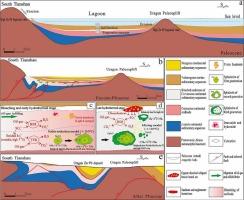
The Uragen giant sandstone-hosted Zn-Pb deposit is located in the Ulugqat basin, Northwest China. The mineralization mainly features disseminated sulfides such as sphalerite, galena, minor pyrite and marcasite in the bleached sandstone and conglomerate, with no discernable crosscutting relationships between different mineral assemblages. It is generally agreed that the deposit is of epigenetic nature and formed from hydrothermal fluids, but the detailed ore-forming processes remain poorly understood. In this study, three generations of sphalerite with different colors, morphologies and micro-textures were identified in hydrothermal mineralization, i.e., Sph1 (coarse-grained, grey, non-fluorescence), Sph2 (coarse-grained, honey-yellow, non-fluorescence), and Sph3 (fine-grained, colorless, yellowish-brown and celeste fluorescence). The micro-textures, major and trace elements, and sulfur isotopes of the different generations of sphalerite were examined with microscopy, scanning electron microscopy, electron probe microanalysis and laser ablation inductively coupled plasma mass spectrometry. The early sphalerites (Sph1 and Sph2) show relatively high Fe-Mn-Ga-Ge-As-Tl contents, low Cd-Cu-Ag contents and high δ34S values (+9.9‰ ∼ +74‰), whereas the late sphalerites (Sph3) display relatively low Fe-Mn-Ga-Ge-As-Tl contents, high Cd-Cu-Ag contents and low δ34S values (−12.91‰ ∼ +5.06‰). Based on the GGIMFis geothermometer and the FeS mol% of sphalerite, the average precipitation temperatures are estimated to be 124.1 ℃ for Sph1, 148 ℃ for Sph2, and 107 ℃ for Sph3, and the average log fS2 values are calculated to be −17.1 for Sph1, −14.9 for Sph2, and −16.2 for Sph3. These differences among three generations of sphalerite may indicate the hydrothermal mineralization of an early stage, including two pulsed substages, and a late stage under different physicochemical conditions. H2S in the early stage is primarily derived from thermal sulfate reduction (TSR) of residual aqueous sulfate with high and variable δ34S values in the sulfate-closed sandstone reservoir, while it is likely formed by in situ bacterial sulfate reduction (BSR) of dissolved sulfate from the evaporite sequences of the Paleocene Aertashi Formation in the late stage. We therefore proposed that the multistage mineralization and multiple sulfur sources may account for the formation of the Uragen giant sandstone-hosted Zn-Pb deposit, which involved episodic influx of hydrocarbon and hydrothermal fluids driven by basin inversion due to the far-field effects of the India-Eurasia collision. This study highlights the necessity of basin structure and evaporites in future ore prospecting of the Uragen-style sandstone-hosted Zn-Pb mineralization in comparable foreland basin in front of South Tianshan and elsewhere.
乌鲁嘎特盆地乌拉根巨型砂岩型铅锌矿床成矿过程:闪锌矿显微结构、元素和原位硫同位素组成的约束
乌拉根巨型砂岩型铅锌矿床位于中国西北部的乌拉根盆地。矿化特征主要为浸染型硫化物,如闪锌矿、方铅矿、少量黄铁矿和马氏铁矿等,在漂白的砂岩和砾岩中,不同矿物组合之间没有明显的横切关系。普遍认为该矿床为表成型,由热液流体形成,但详细的成矿过程尚不清楚。本研究在热液成矿中鉴定出3代不同颜色、形态和显微质地的闪锌矿,分别为Sph1(粗粒、灰色、无荧光)、Sph2(粗粒、蜜黄色、无荧光)和Sph3(细粒、无色、黄褐色、荧光)。采用显微镜、扫描电镜、电子探针微量分析和激光烧蚀电感耦合等离子体质谱等方法对不同代闪锌矿的显微结构、主微量元素和硫同位素进行了研究。早期闪锌矿(Sph1和Sph2)表现出较高的Fe-Mn-Ga-Ge-As-Tl含量、较低的Cd-Cu-Ag含量和较高的δ34S值(+9.9‰~ +74‰),晚期闪锌矿(Sph3)表现出较低的Fe-Mn-Ga-Ge-As-Tl含量、较高的Cd-Cu-Ag含量和较低的δ34S值(- 12.91‰~ +5.06‰)。根据GGIMFis地温计和闪锌矿的FeS mol%, Sph1的平均降水温度为124.1℃,Sph2为148℃,Sph3为107℃,Sph1的平均log fS2值为- 17.1,Sph2为- 14.9,Sph3为- 16.2。3代闪锌矿的这些差异,可能指示了不同物理化学条件下的早期热液成矿,包括两个脉冲亚期和一个晚期热液成矿。早期的硫化氢主要来自于硫酸盐封闭砂岩储层中高δ34S值和可变δ34S值的残余硫酸盐水热还原(TSR),而后期可能是古新世阿尔塔什组蒸发岩层中溶解硫酸盐的原位细菌硫酸盐还原(BSR)。因此,我们认为多期成矿作用和多硫源可能是乌拉根巨型砂岩型铅锌矿床的形成原因,该矿床的形成涉及到印度-欧亚碰撞远场作用下盆地反转导致的烃类和热液流体的幕式流入。该研究强调了盆地构造和蒸发岩在今后找矿工作中对南天山前类似前陆盆地乌拉根型砂岩型铅锌成矿的必要性。
本文章由计算机程序翻译,如有差异,请以英文原文为准。
求助全文
约1分钟内获得全文
求助全文
来源期刊
Ore Geology Reviews
地学-地质学
CiteScore
6.50
自引率
27.30%
发文量
546
审稿时长
22.9 weeks
期刊介绍:
Ore Geology Reviews aims to familiarize all earth scientists with recent advances in a number of interconnected disciplines related to the study of, and search for, ore deposits. The reviews range from brief to longer contributions, but the journal preferentially publishes manuscripts that fill the niche between the commonly shorter journal articles and the comprehensive book coverages, and thus has a special appeal to many authors and readers.
 求助内容:
求助内容: 应助结果提醒方式:

 京公网安备 11010802042870号


