
Tracing copper mineralisation anomalies using multi-element geochemistry and machine learning in the Okiep Copper District, South Africa
IF 4.3
2区 地球科学
Q1 GEOLOGY
引用次数: 0
Abstract
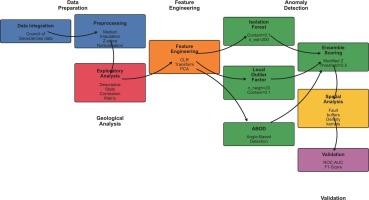
Copper (Cu) remains a critical component of the global energy transition, underpinning technologies from renewable power infrastructure to electric vehicles. As demand continues to increase, the discovery of new Cu deposits becomes increasingly urgent. However, greenfield exploration is becoming riskier and costlier, prompting a renewed focus on brownfield regions, especially those with underutilised historical datasets and proven mineral systems. The Okiep Copper District, located in the Northern Cape Province of South Africa, hosts one of the world’s oldest known Cu districts. It represents a geologically complex, multistage mineralised system within the Mesoproterozoic anorthosite–charnockite–dominated Koperberg Suite. Despite extensive historical mining, the region remains underexplored using modern tools, offering a compelling opportunity to revisit its prospectivity through data-driven approaches. This study aims to refine exploration targeting in the Okiep District by integrating machine learning (ML) based anomaly detection with multivariate geochemical interpretations. In this study, we applied three unsupervised outlier detection algorithms, namely (a) Isolation Forest (IF), (b) Local Outlier Factor (LOF), and (c) Angle-Based Outlier Detection (ABOD), to regional stream sediment geochemical data. Each algorithm provides details of potential Cu hotspots for target exploration, i.e., IF and LOF showed concentration of geochemical anomalies closer to structural boundaries, while ABOD provided spatial zonation patterns. Key findings include (a) a significant spatial correlation (22–30% within 5 km) between Cu occurrences and major faults, particularly the Skelmfontein Thrust Zone; (b) a diagnostic Cu-Fe2O3T-Zn association consistent with intermediate sulfidation conditions; and (c) the identification of novel high-temperature pathfinder elements (Sb, U, Th, Co, Y), suggesting a metasomatic overprint potentially linked to hybrid crustal-mantle fluids. Based on these findings, a mineral prospectivity model is proposed for Okiep-type deposits, integrating structural architecture (e.g., fault intersections and dyke margins), geochemical vectors, and metallogenic analogues. This holistic framework underscores the value of coupling domain knowledge with machine learning for copper prospectivity mapping in structurally complex terranes. The results have direct implications for brownfield exploration strategy and highlight the need to incorporate multi-variate/source data.
利用多元素地球化学和机器学习在南非Okiep铜区追踪铜矿化异常
铜(Cu)仍然是全球能源转型的关键组成部分,支撑着从可再生能源基础设施到电动汽车的各种技术。随着需求的不断增加,发现新的铜矿变得越来越紧迫。然而,绿地勘探的风险越来越大,成本也越来越高,这促使人们重新关注棕地地区,尤其是那些历史数据集和矿产系统未得到充分利用的地区。位于南非北开普省的奥基普铜区是世界上最古老的铜区之一。它代表了中元古代以辉长岩为主的Koperberg套内一个地质复杂的多期矿化系统。尽管有广泛的历史开采,但该地区仍未充分利用现代工具进行勘探,这为通过数据驱动的方法重新审视其前景提供了一个令人信服的机会。本研究旨在通过将基于机器学习(ML)的异常检测与多元地球化学解释相结合,来细化Okiep地区的勘探目标。在本研究中,我们将3种无监督异常点检测算法(a)隔离森林(IF)、(b)局部异常点因子(LOF)和(c)基于角度的异常点检测(ABOD)应用于区域水系沉积物地球化学数据。每一种算法都提供了铜靶勘探潜在热点的详细信息,即IF和LOF显示的是靠近构造边界的地球化学异常集中,而ABOD提供的是空间分带格局。主要发现包括:(a)铜产状与主要断裂(特别是Skelmfontein逆冲带)在5 km范围内具有显著的空间相关性(22-30%);(b)诊断性Cu-Fe2O3T-Zn关联与中间硫化条件一致;(c)发现新的高温探路者元素(Sb, U, Th, Co, Y),表明交代叠印可能与壳幔混合流体有关。在此基础上,结合构造构造(如断层交点和脉缘)、地球化学矢量和成矿类似物,提出了奥基普型矿床的找矿模型。这一整体框架强调了将领域知识与机器学习结合起来,在结构复杂的地层中进行铜远景映射的价值。研究结果对棕地勘探策略具有直接意义,并强调了整合多变量/源数据的必要性。
本文章由计算机程序翻译,如有差异,请以英文原文为准。
求助全文
约1分钟内获得全文
求助全文
来源期刊
Ore Geology Reviews
地学-地质学
CiteScore
6.50
自引率
27.30%
发文量
546
审稿时长
22.9 weeks
期刊介绍:
Ore Geology Reviews aims to familiarize all earth scientists with recent advances in a number of interconnected disciplines related to the study of, and search for, ore deposits. The reviews range from brief to longer contributions, but the journal preferentially publishes manuscripts that fill the niche between the commonly shorter journal articles and the comprehensive book coverages, and thus has a special appeal to many authors and readers.
 求助内容:
求助内容: 应助结果提醒方式:

 京公网安备 11010802042870号


