
Multi-Method analysis including 57Fe Mössbauer Spectroscopy to quantify vivianite for phosphorus recovery in real wastewater environments
IF 6.5
Q2 ENGINEERING, ENVIRONMENTAL
Cleaner Engineering and Technology
Pub Date : 2026-04-01
Epub Date: 2026-02-05
DOI:10.1016/j.clet.2026.101166
引用次数: 0
Abstract
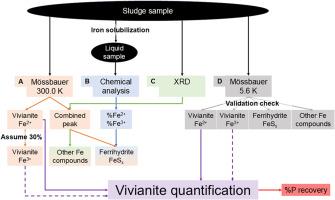
Phosphorus recovery from wastewater is increasingly vital due to its limited availability and essential role in food production. This study investigates the formation and quantification of vivianite, a promising pathway for phosphorus recovery, in Viikinmäki wastewater treatment plant (WWTP) in Helsinki, Finland, utilizing a combination of 57Fe Mössbauer spectroscopy at 300.0 K and 5.6 K, X-ray diffraction (XRD), and chemical analysis. The study revealed the strengths and limitations of Mössbauer spectroscopy, using the multi-method analysis. The findings highlight the effectiveness of Mössbauer spectroscopy in distinguishing vivianite from other rarely discussed iron phases such as siderite and ferrihydrite. XRD confirmed the presence of crystalline phases, while chemical analysis provided a clear differentiation between Fe2+ and Fe3+, crucial for distinguishing vivianite Fe3+ from other components. Single approaches for estimating the recovery potential of phosphorus were compared. These methods had the tendency to overestimate the amount of phosphorus that can be recovered as vivianite. However, the multi-method analysis provided the most realistic balanced estimates. Practical recommendations are offered to WWTP operators to monitor the enhancement of phosphorus recovery efficiency, complying with evolving stringent regulations, and optimizing coagulant dosing. This comprehensive approach bridges the gap between academic research and real-world application, promoting sustainable wastewater management practices.
包括57Fe Mössbauer光谱在内的多方法分析,量化在真实废水环境中磷回收的活石
从废水中回收磷越来越重要,因为其有限的可用性和在粮食生产中的重要作用。本研究利用57Fe Mössbauer光谱(300.0 K和5.6 K)、x射线衍射(XRD)和化学分析相结合的方法,研究了芬兰赫尔辛基Viikinmäki污水处理厂(WWTP)中vivianite的形成和定量,vivianite是一种有前途的磷回收途径。通过多方法分析,揭示了Mössbauer光谱学的优势和局限性。这一发现突出了Mössbauer光谱在区分橄榄石和其他很少讨论的铁相(如菱铁矿和水合铁)方面的有效性。XRD证实了晶体相的存在,而化学分析则提供了Fe2+和Fe3+的明确区分,这对于区分vivianite Fe3+与其他成分至关重要。比较了几种估算磷回收潜力的方法。这些方法倾向于高估磷的数量,可以作为活铁矿回收。然而,多方法分析提供了最现实的平衡估计。为污水处理厂运营商提供了切实可行的建议,以监测磷回收效率的提高,遵守不断变化的严格法规,并优化混凝剂的投加量。这种综合方法弥合了学术研究和实际应用之间的差距,促进了可持续的废水管理实践。
本文章由计算机程序翻译,如有差异,请以英文原文为准。
求助全文
约1分钟内获得全文
求助全文
来源期刊

Cleaner Engineering and Technology
Engineering-Engineering (miscellaneous)
CiteScore
9.80
自引率
0.00%
发文量
218
审稿时长
21 weeks
 求助内容:
求助内容: 应助结果提醒方式:

 京公网安备 11010802042870号


